Sign up with Google
 Sign in with Zoho

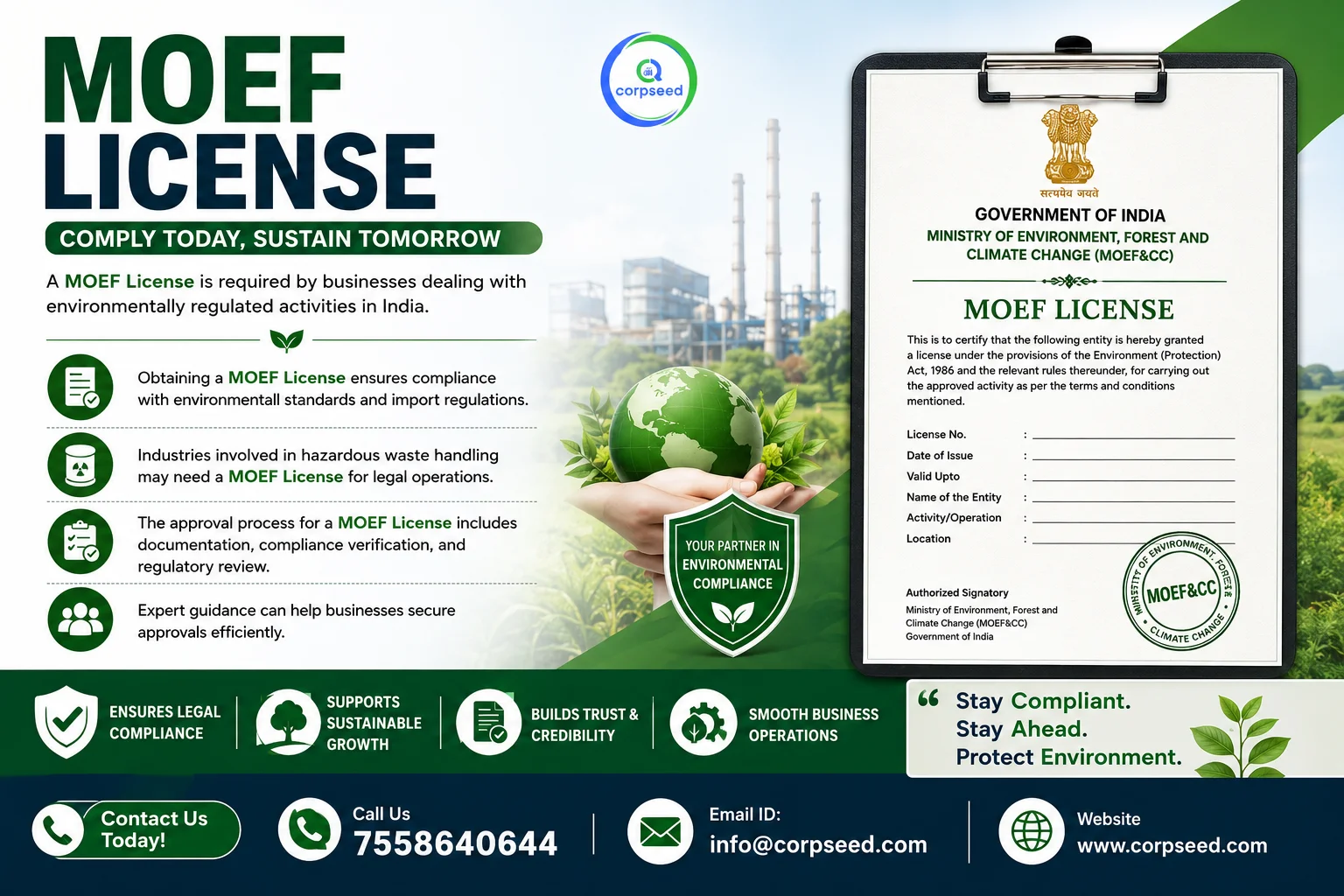
If your business imports hazardous or "other" waste — for recycling, reprocessing, or reuse — you cannot bring a single consignment across the border without prior approval from the Ministry of Environment, Forest and Climate Change (MoEFCC). This approval, commonly called the MoEF certificate or MoEF clearance, is a legal precondition, not a formality, and getting it wrong can mean seized shipments, penalties, or blacklisting.
This guide breaks down what MoEF clearance actually is, who needs it, how the process works, and where liquid waste products and pollution control board clearance fit into the picture.
What is MoEF Certificate?
The MoEF certificate is an official permission issued by the Ministry of Environment, Forest and Climate Change that authorizes a company to import specific categories of hazardous or other waste into India. The authority for this approval flows from the Hazardous and Other Wastes (Management and Transboundary Movement) Rules, 2016, and India's obligations as a signatory to the Basel Convention, the international treaty that governs the cross-border movement of hazardous waste and its environmentally sound disposal.
In simple terms: <cite index="4-1">the MoEFCC is the authority responsible for granting clearance for the import of hazardous waste in India, and it is the Ministry that makes the final call on whether a specific import consignment gets approved.</cite>
HSMD Full Form and Its Role
You'll often see the abbreviation "HSMD" on official MoEF letters, file numbers, and notifications related to waste import/export. HSMD stands for Hazardous Substances Management Division. <cite index="2-1">This division functions as the nodal point within the Ministry for managing chemical emergencies and hazardous substances, with the core objective of promoting the safe handling and use of hazardous chemicals and hazardous wastes so that health and the environment are protected from harm.</cite>
The HSMD isn't just a domestic regulator — <cite index="1-1">it also acts as India's nodal point for four major international agreements: the Basel Convention on transboundary movement of hazardous waste, the Rotterdam Convention on prior informed consent for hazardous chemicals and pesticides, the Stockholm Convention on persistent organic pollutants, and the Minamata Convention on mercury.</cite> Every file number tagged "HSMD" on an import/export order traces back to this division.
Who Needs MoEF Permission?
Not every imported material needs Ministry sign-off, but a large share of industrially useful waste does. <cite index="9-1">Importers of lead scrap and battery scrap, waste tyres and rubber scrap, used oil, and electrical and electronic assemblies must obtain MoEF permission before bringing these wastes into the country, and must demonstrate the intended end use.</cite>
Under the applicable Schedule III classifications:
- Waste listed in Part A can be imported with the exporting country's prior informed consent and MoEF's permission.
- Waste listed in Part B ("other wastes") also needs MoEF permission, though the process is comparatively lighter.
- Certain low-hazard materials under Part D can move without Ministry permission at all.
- Materials not explicitly listed but showing hazardous characteristics under Part C still require prior written MoEF clearance.
This is also where liquid waste products — used oil, waste solvents, spent catalysts, and similar liquid industrial residues — get captured. Because these substances carry contamination and disposal risk, they're almost always regulated and typically require chemical composition analysis from an accredited laboratory before an application is even considered.
The Import Clearance Process
While specific documentation varies by waste category, the general MoEF clearance procedure looks like this:
- Application filing – The importer submits Form 5 (or the prescribed form) to the MoEFCC, along with justification for the import, a laboratory-tested chemical composition report, and a process flow chart showing the pollution control equipment installed at the receiving facility.
- Simultaneous SPCB copy – <cite index="9-1">A copy of the application must be sent to the relevant State Pollution Control Board for acknowledgment, and that acknowledgment is submitted along with the MoEF application.</cite>
- Ministry review – <cite index="9-1">The Ministry examines the complete application, factoring in observations from the concerned State Pollution Control Boards.</cite>
- Grant of permission – <cite index="9-1">If approved, the Ministry typically grants import permission within sixty days, subject to the importer meeting the specified conditions.</cite>
- Intimation to authorities – <cite index="9-1">A copy of the granted permission is sent to the relevant port and customs authorities, the Central Pollution Control Board, and the State Pollution Control Board to ensure compliance is tracked at every checkpoint.</cite>
Once granted, the importer must maintain import records in the prescribed Form 3 and file an annual return with the State Pollution Control Board.
Pollution Control Board Clearance — Why It Runs Parallel
MoEF clearance and pollution control board clearance aren't interchangeable — they work together. The MoEF certificate authorizes the import itself, while the state or central Pollution Control Board (SPCB/CPCB) clearance — typically Consent to Operate and an Authorisation under the Hazardous and Other Wastes Rules — confirms your facility is actually equipped to store, process, or dispose of that waste safely. MoEF applications routinely require your existing SPCB Authorisation number and its validity period as supporting documentation, so an outdated or missing pollution control board clearance can stall your import approval regardless of how complete the rest of your file is.
Why Professional Guidance Matters
The paperwork here is unforgiving: incomplete lab reports, missing SPCB acknowledgments, or an expired Authorisation are among the most common reasons applications get delayed or rejected. Given that shipments can be held at port pending clearance, getting the documentation right the first time saves real time and money.
If you're planning to import hazardous or other waste into India and want the process handled correctly from application to final Ministry approval, Corpseed's specialists can manage documentation, liaise with the MoEFCC and SPCB, and track your file through to clearance. Learn more about the complete process here: MoEF Clearance for Hazardous Waste Import in India.
Frequently Asked Questions
1. What is MoEF certificate used for? It is the official government approval that legally permits a business to import specified categories of hazardous or other waste into India for recycling, reprocessing, reuse, or disposal.
2. What does HSMD stand for? HSMD stands for Hazardous Substances Management Division, the branch within the MoEFCC that processes hazardous waste import/export applications and represents India in Basel, Rotterdam, Stockholm, and Minamata Convention matters.
3. Is MoEF clearance mandatory for all waste imports? No. Waste listed under Part D of Schedule III can generally be imported without MoEF permission. However, most hazardous categories — including lead scrap, used oil, waste tyres, and e-waste components — require it.
4. How long does it take to get MoEF permission? Once a complete application is submitted, the Ministry typically aims to grant permission within about sixty days, though this depends on documentation completeness and SPCB response time.
5. Do I need pollution control board clearance separately from MoEF clearance? Yes. SPCB/CPCB Consent to Operate and Authorisation confirm your facility can safely handle the waste, and this documentation is generally required as part of your MoEF application itself.
6. Are liquid waste products like used oil covered under MoEF clearance? Yes. Liquid hazardous waste such as used oil, spent solvents, and similar residues fall under regulated categories and typically require chemical composition testing from an accredited lab before import approval.
7. What happens if I import hazardous waste without MoEF permission? Unauthorized import can lead to consignment seizure at customs, penalties under the Environment (Protection) Act, and potential blacklisting from future imports.
8. Who do I contact for help with MoEF clearance? Compliance consultants like Corpseed assist with documentation, SPCB coordination, and end-to-end filing for MoEF clearance applications.