Sign up with Google
 Sign in with Zoho

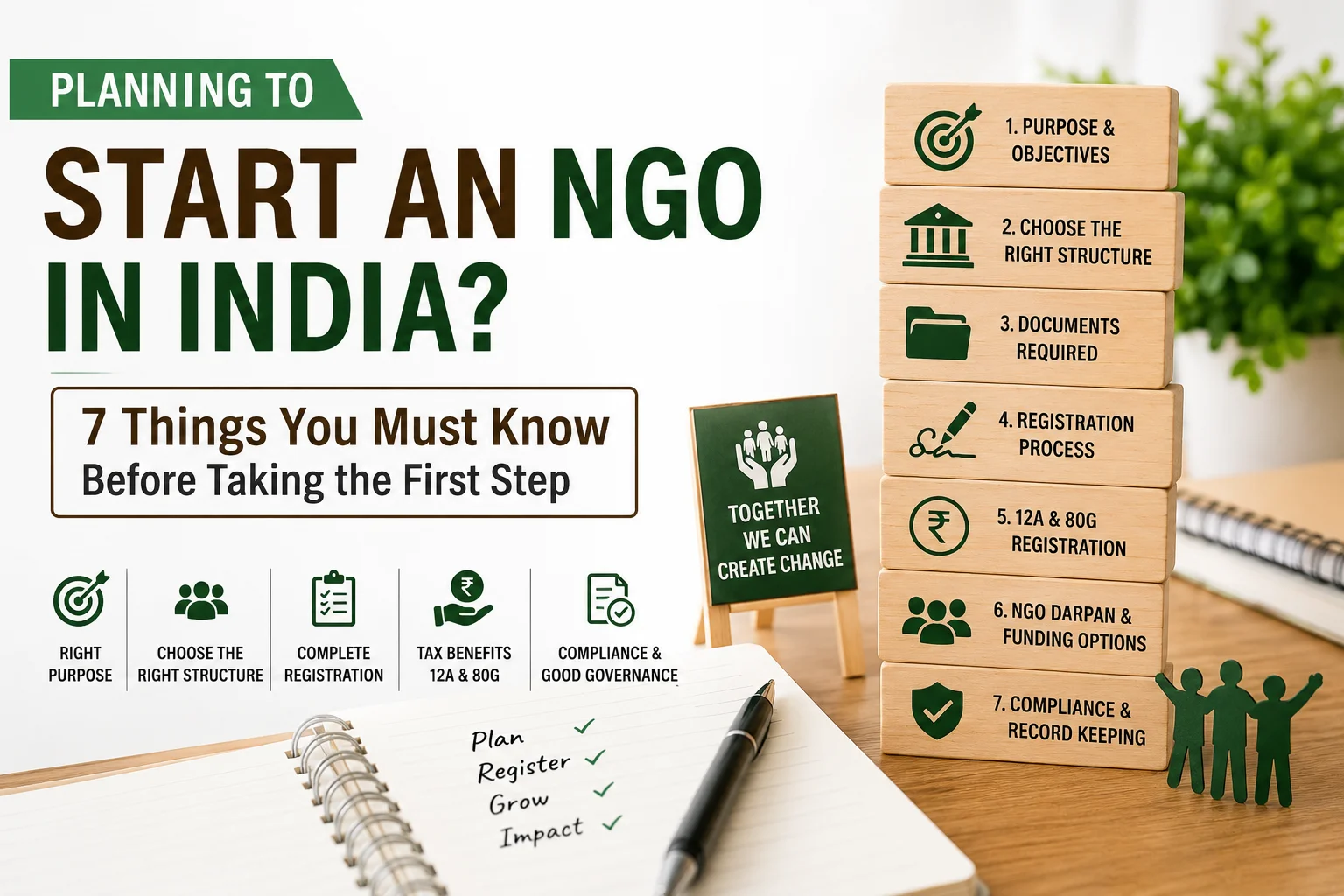
Starting an NGO is a meaningful step towards creating social change, but turning an idea into a legally registered organisation requires proper planning. From choosing the right legal structure to obtaining government registrations, every decision matters.
If you are planning to establish an NGO in India, here are seven important things you should understand before getting started.
1. Identify Your NGO's Purpose and Objectives
Before starting the registration process, decide what social issue your organisation wants to address. Your objectives could include education, healthcare, women's empowerment, environmental protection, child welfare or rural development.
A clearly defined purpose will help you choose the right activities, prepare your governing documents and approach potential donors.
2. Choose the Right Legal Structure
In India, an NGO can generally be registered as a Trust, Society or Section 8 Company. Each structure has different legal requirements, governance rules and compliance responsibilities.
- Trust: Suitable for charitable and philanthropic activities.
- Society: Generally preferred for organisations formed by a group of individuals.
- Section 8 Company: Suitable for professionally managed non-profit organisations with defined governance structures.
Compare the options before making your decision.
3. Understand the Documents Required for Registration
Documentation is an important part of establishing an NGO. Depending on the legal structure, you may need identity and address proofs of founders, photographs, registered office proof, NOC from the property owner and governing documents.
For a Section 8 Company, the Memorandum of Association (MOA) and Articles of Association (AOA) are particularly important.
4. Complete the NGO Registration Process
Once the structure and documents are finalised, you can proceed with the applicable registration process.
For a Section 8 Company, incorporation is completed through the Ministry of Corporate Affairs (MCA) portal. Trusts and Societies follow their respective state-level registration procedures.
Accurate documentation and proper filing help reduce unnecessary delays.
5. Apply for 12A and 80G Registration
After establishing your NGO, consider applying for relevant income tax registrations.
- 12A/12AB: Provides eligible charitable organisations with income tax exemption, subject to applicable conditions.
- 80G: Allows eligible donors to claim deductions on qualifying donations.
These registrations can improve donor confidence and support fundraising efforts.
6. Register on NGO Darpan and Explore Funding Opportunities
NGO Darpan registration provides an organisation with a unique Darpan ID and is required for various government grant-related processes.
Depending on eligibility, NGOs can also explore CSR funding, government schemes, institutional grants and private donations.
Remember that every funding opportunity has its own eligibility and documentation requirements.
7. Maintain Legal Compliance and Financial Records
Registration is only the beginning. NGOs must maintain proper financial records, file applicable returns, conduct audits where required and comply with the laws relevant to their legal structure and activities.
Good compliance practices help organisations build credibility and maintain long-term operations.
Why Choose NGOExperts for NGO Registration and Compliance?
Choosing professional assistance can make the registration process easier. NGOExperts provides support for Trust, Society and Section 8 Company registration, 12A and 80G registration, CSR-1, NGO Darpan, FCRA and other NGO-related compliance services.
NGOExperts Contact Details
- Address: 1117, Supertech Astralis, Sector-94, Noida, Uttar Pradesh - 201301
- Mobile: +91 85957 66812
- Website: https://ngoexperts.com/
Whether you are establishing your first charitable organisation or expanding an existing initiative, getting the legal and compliance foundation right is essential.
Final Takeaway: Starting an NGO requires more than a social vision. Choosing the right structure, completing registrations, understanding tax benefits and maintaining compliance can help you build an organisation that is ready to create a lasting impact.