Sign up with Google
 Sign in with Zoho

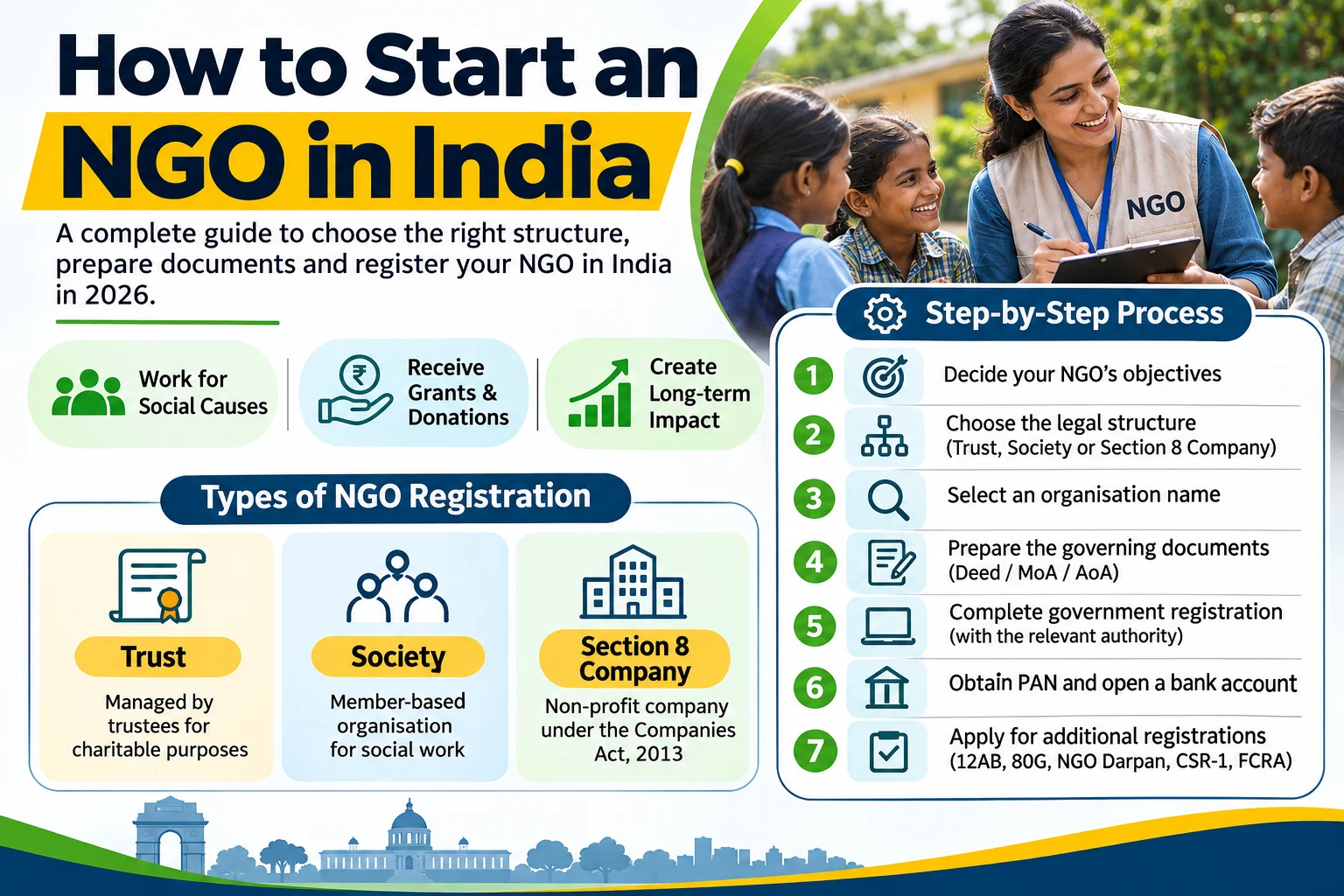
Starting an NGO in India is an important step towards creating social impact through education, healthcare, women empowerment, environmental protection or community development. To start an NGO in India, founders must choose a suitable legal structure, define charitable objectives, prepare documents and register with the appropriate government authority.
India recognises three common legal structures for NGOs: Trust, Society and Section 8 Company. Each has different registration procedures, governance requirements and compliance obligations. This guide explains how to establish an NGO and complete the essential registrations in 2026.
What Is an NGO in India?
A Non-Governmental Organisation (NGO) is a non-profit organisation established to work towards social, charitable, educational, religious, cultural or environmental objectives.
An NGO can receive donations, grants and eligible funding and may earn income from permitted activities. However, its surplus must be used towards its objectives rather than distributed among founders or members.
Which Type of NGO Should You Register?
Before starting, choose the legal structure that matches your objectives, number of founders and future funding plans.
1. Trust Registration
A charitable trust is generally suitable for founders who want to establish an organisation managed by trustees. Its registration and regulatory requirements depend on applicable state laws.
2. Society Registration
A society is suitable for organisations managed by a group of members working towards common objectives. Under the central Societies Registration Act, 1860, seven or more persons can form a society, subject to applicable state amendments.
3. Section 8 Company Registration
A Section 8 Company is incorporated under the Companies Act, 2013. It promotes charitable and social objectives without distributing profits as dividends. It is suitable for organisations seeking structured governance and institutional partnerships.
Who Can Start an NGO in India?
Individuals and groups can establish NGOs if they meet the applicable legal requirements.
Generally, founders should:
- Have a genuine charitable or social objective.
- Identify the trustees, members or directors required for their chosen structure.
- Select a suitable organisation name.
- Prepare the necessary governing documents.
- Arrange a registered office address.
- Agree on management responsibilities and financial arrangements.
Documents Required for NGO Registration
The required documents depend on the selected structure and registering authority.
How to Register an NGO in India: Step-by-Step Process
Step 1: Decide Your NGO's Objectives
Identify the social issue your organisation will address. Common objectives include education, healthcare, poverty reduction, women empowerment, rural development and environmental protection.
Step 2: Choose the Legal Structure
Select a Trust, Society or Section 8 Company after considering management, funding plans and compliance responsibilities.
Step 3: Select an Organisation Name
Choose a unique and appropriate name that reflects the organisation's purpose. Check availability and applicable naming requirements before proceeding.
Step 4: Prepare the Governing Documents
Draft the Trust Deed, Society Memorandum and Rules, or Section 8 Company's Memorandum of Association and Articles of Association.
Step 5: Complete Government Registration
Submit the application to the appropriate authority:
- Trust: Relevant Sub-Registrar or state authority, as applicable.
- Society: Registrar of Societies.
- Section 8 Company: Ministry of Corporate Affairs through SPICe+.
Step 6: Obtain PAN and Open a Bank Account
After registration, ensure the organisation has the required PAN and opens a dedicated bank account in its legal name.
Step 7: Apply for Additional Registrations
Depending on the organisation's activities, consider income-tax registration, NGO Darpan, CSR-1 and FCRA approval.
Important Registrations After NGO Incorporation
Registering an NGO does not automatically provide tax exemptions or permission to receive foreign contributions.
Under the Income-tax Act, 2025, effective from 1 April 2026, the relevant framework includes:
- Section 332: Registration of eligible non-profit organisations for income-tax benefits. Fresh provisional applications generally use Form 104; regular registration applications use Form 105.
- Section 354: Approval relating to deductions for eligible donations, subject to applicable conditions.
- NGO Darpan: Registration and Unique ID for eligible NGOs seeking government grants.
- CSR-1: Required for eligible implementing agencies undertaking CSR activities.
- FCRA: Registration or prior permission is required before accepting foreign contributions.
Common Mistakes to Avoid
- Choosing an unsuitable legal structure.
- Drafting unclear charitable objectives.
- Submitting incomplete documents.
- Assuming registration automatically provides tax exemption.
- Accepting foreign donations without FCRA compliance.
- Ignoring annual accounts, audits and statutory filings.
Frequently Asked Questions
1. How much money is required to start an NGO in India?
There is no universal minimum starting capital for every NGO structure. Registration charges, stamp duty and professional fees depend on the structure and applicable state requirements.
2. Can one person start an NGO?
A single person cannot independently incorporate every NGO structure. The minimum founder, member, trustee and director requirements depend on the chosen legal form.
3. Which NGO registration is best in India?
Trusts suit trustee-managed charitable activities, Societies suit member-based organisations, and Section 8 Companies suit organisations seeking structured corporate governance.
4. Can an NGO receive government funding?
Eligible NGOs can apply for government grants, subject to the scheme's conditions, required registrations and documentation. NGO Darpan registration is required for many government grant opportunities.
5. Is 12A and 80G registration mandatory?
These approvals are not automatic or universally mandatory for incorporation. Eligible organisations should apply separately under the applicable income-tax provisions to obtain relevant tax benefits.
6. Can an NGO receive foreign donations?
Yes, subject to FCRA registration or prior permission and compliance with the Foreign Contribution (Regulation) Act, 2010.
7. How can I register my NGO online?
Section 8 Companies are incorporated through the MCA portal. Trust and Society procedures depend on the relevant state authority and may involve physical documentation.
Conclusion
Starting an NGO in India requires careful planning, appropriate legal registration and long-term compliance. Founders should select the right structure, prepare accurate governing documents and obtain additional registrations according to their funding and operational requirements.
For professional assistance with NGO Registration, NGOExperts can help founders understand the available structures, documentation and registration procedures.


.webp)