Sign up with Google
 Sign in with Zoho
In today's technology-driven world, high-power laser diodes are at the core of critical systems across medical, industrial, defense, and scientific research sectors. Whether you're developing a next-generation surgical tool, a precision material processing system, or a cutting-edge fiber laser pump, the performance of your end product depends heavily on one foundational decision: choosing the right custom laser diode manufacturer.
This is not a decision to take lightly. The wrong partner can mean delayed timelines, inconsistent output power, unreliable wavelength accuracy, or worse — a product that fails in the field. The right manufacturer, however, can accelerate your development cycle, ensure long-term reliability, and give you a genuine competitive advantage.
This guide walks you through the critical factors to evaluate when selecting a custom laser diode manufacturer for high-power applications — so you can make an informed, confident choice.
1. Understand What 'Custom' Really Means
Before evaluating manufacturers, it's essential to clarify your own requirements. 'Custom laser diode solutions' is a broad term that can mean anything from selecting a standard product from a catalog to designing an entirely new diode from the wafer level up.
Ask yourself:
• Do you need a specific wavelength not available off the shelf?
• Are you looking for a custom package, form factor, or beam profile?
• Do you require multi-wavelength modules in a single housing?
• What are your output power requirements — milliwatts or multiple watts?
• What operating environment will the device be used in?
A true custom laser diode manufacturer will ask you these exact questions upfront. If a vendor jumps straight to quoting without deeply understanding your application, that's a red flag.
2. Evaluate Technical Expertise and Engineering Depth
High-power laser diodes are sophisticated devices. The manufacturer you choose must possess deep technical expertise — not just in laser physics, but in thermal management, optical engineering, packaging science, and reliability testing.
Key technical capabilities to look for:
• Wavelength engineering: Can they hit precise wavelength targets (e.g., 793 nm, 976 nm, 1064 nm) with tight tolerances?
• Power scaling: Can they design solutions from single-emitter chips to stacked arrays or bars for kilowatt-class systems?
• Beam quality: Do they offer beam conditioning and shaping for applications requiring specific divergence or M² values?
• Multi-wavelength integration: Can they combine multiple wavelengths in a single compact module?
• Thermal design: Do they engineer effective heat dissipation to maximize diode lifetime at high power levels?
Request technical datasheets, application notes, and case studies. A manufacturer with genuine engineering depth will have documented evidence of performance across diverse application areas.
3. Assess Manufacturing Quality and Process Control
In high-power laser diode manufacturing, process consistency is everything. Small deviations in fabrication can lead to significant variations in output power, threshold current, or operating lifetime. When evaluating a custom laser diode manufacturer, dig into their manufacturing process and quality controls.
Questions to ask:
• What quality management system do they operate under (ISO 9001, MIL-SPEC, etc.)?
• How do they test every unit before shipment — what are their burn-in, screening, and characterization protocols?
• What is their production yield and how do they manage lot-to-lot consistency?
• Do they have in-house wafer fabrication or do they rely on third-party chip suppliers?
• What traceability systems are in place to track components through the supply chain?
For mission-critical applications such as medical devices or defense systems, these quality controls are non-negotiable. Ask for quality reports, test data, and reliability documentation before committing to a supplier.
4. Review Industry Experience and Application Knowledge
Different industries have very different requirements for laser diode products. A manufacturer experienced in industrial laser cutting may not fully understand the regulatory environment and biocompatibility demands of medical device manufacturing. Similarly, defense applications have unique environmental specifications (shock, vibration, temperature extremes) that require specific design and testing expertise.
Industry verticals that benefit from specialized laser diode expertise include:
• Medical & aesthetic: Dermatology, ophthalmology, photobiomodulation, surgical tools
• Industrial processing: Laser cutting, welding, soldering, marking, and additive manufacturing
• Fiber laser pumping: High-efficiency pumping of Nd:YAG, Er:YAG, and fiber lasers
• Scientific research: Spectroscopy, LIDAR, atomic physics, and optical communications
• Defense & aerospace: Target designation, rangefinding, countermeasures, and sensing
A manufacturer with deep vertical expertise will anticipate requirements you haven't thought of yet and proactively design for them. Look for case studies or reference customers from your specific industry.
5. Examine Product Range and Design Flexibility
A custom laser diode manufacturer worth considering should offer a wide range of product platforms that can be adapted to your specifications. Breadth of portfolio signals both engineering capability and manufacturing versatility.
A comprehensive product range typically includes:
• Single-emitter laser diodes in various packages (C-mount, TO-can, open heatsink)
• Single-wavelength modules for focused, monochromatic applications
• Multi-wavelength modules combining 2, 3, 4, or more wavelengths in one assembly
• High-power laser diode bars and stacked arrays for maximum power density
• Turnkey fiber-coupled modules for ease of system integration
Design flexibility is equally important. Can the manufacturer accommodate non-standard form factors? Can they scale from prototype quantities to full production runs without compromising quality? These capabilities define whether a supplier is truly a long-term partner or just a one-time vendor.
6. Consider Responsiveness and Engineering Collaboration
Custom laser diode development is an iterative process. Your initial specifications will evolve as prototypes are tested and real-world constraints emerge. The ability to collaborate closely with your manufacturer's engineering team is one of the most underrated factors in the selection process.
Evaluate the following during your initial interactions:
• How quickly do they respond to technical inquiries?
• Do they assign a dedicated application engineer to your project?
• Are they willing to sign an NDA and engage in detailed technical discussions before a purchase order?
• How do they handle design iteration feedback and specification changes mid-project?
• What is their typical lead time from design approval to sample delivery?
A manufacturer that treats every customer inquiry as a priority — and assigns dedicated resources to your program — will dramatically reduce your time-to-market and development risk.
7. Scrutinize Long-Term Reliability and Warranty Support
High-power laser diodes represent a significant investment, and their failure in the field can have severe consequences — especially in medical or industrial environments. Reliability engineering should be a core competency of any manufacturer you consider.
Due diligence on reliability should cover:
• Mean Time Between Failures (MTBF) data from accelerated life testing
• Electrostatic discharge (ESD) protection and handling protocols
• Operating lifetime ratings at rated power and temperature
• Failure mode analysis and corrective action processes
• Warranty terms — duration, coverage, and replacement procedures
A manufacturer that publishes detailed reliability data and stands behind its products with a clear warranty policy is one that is confident in what it builds. Transparency here is a strong signal of quality.
8. Evaluate Supply Chain Stability and Scalability
Even the best-engineered laser diode solution can become a liability if your manufacturer can't reliably deliver at scale. Supply chain disruptions are a real and growing risk in the photonics industry. Evaluating a manufacturer's production stability and scalability is therefore an essential part of the selection process.
Key supply chain considerations:
• Where are their wafer fabrication and assembly operations located?
• Do they maintain strategic inventory buffers for long-lead components?
• What is their capacity for scaling from R&D quantities to production volumes?
• How do they manage component obsolescence — especially for multi-year programs?
• Do they have a formal supply chain risk management program?
For programs with multi-year production requirements, securing a manufacturer with demonstrated supply chain resilience can be as important as technical performance.
9. Compare Pricing — But Don't Let Cost Drive the Decision
Cost is always a factor, but in the world of high-power custom laser diodes, the cheapest option is rarely the best value. Poor-quality diodes that fail prematurely can cost exponentially more in field replacements, warranty claims, and reputational damage than the savings realized upfront.
Instead of evaluating price alone, calculate total cost of ownership:
• What is the expected operating lifetime, and what is the cost per hour of operation?
• What is the cost of integration — does the module require additional optics, drivers, or thermal management?
• What is the cost of qualification — does the manufacturer provide ready-to-use test data or do you need to retest everything?
• What is the risk cost — what happens to your product line if this supplier can't deliver?
When evaluated on a total cost of ownership basis, a higher-priced manufacturer with superior engineering support, longer-lifetime products, and robust after-sales service often provides significantly better value.
Conclusion: The Right Partner Makes All the Difference
Selecting the right custom laser diode manufacturer for high-power applications is a strategic decision that will influence the performance, reliability, and commercial success of your product for years to come. The best manufacturers are not just suppliers — they are engineering partners who invest in understanding your application, challenge your assumptions, and bring decades of photonic expertise to every project.
As you evaluate your options, prioritize technical depth, quality systems, application experience, engineering collaboration, and long-term reliability over short-term cost savings. Ask hard questions, request documentation, and insist on a manufacturer who treats your success as their own.
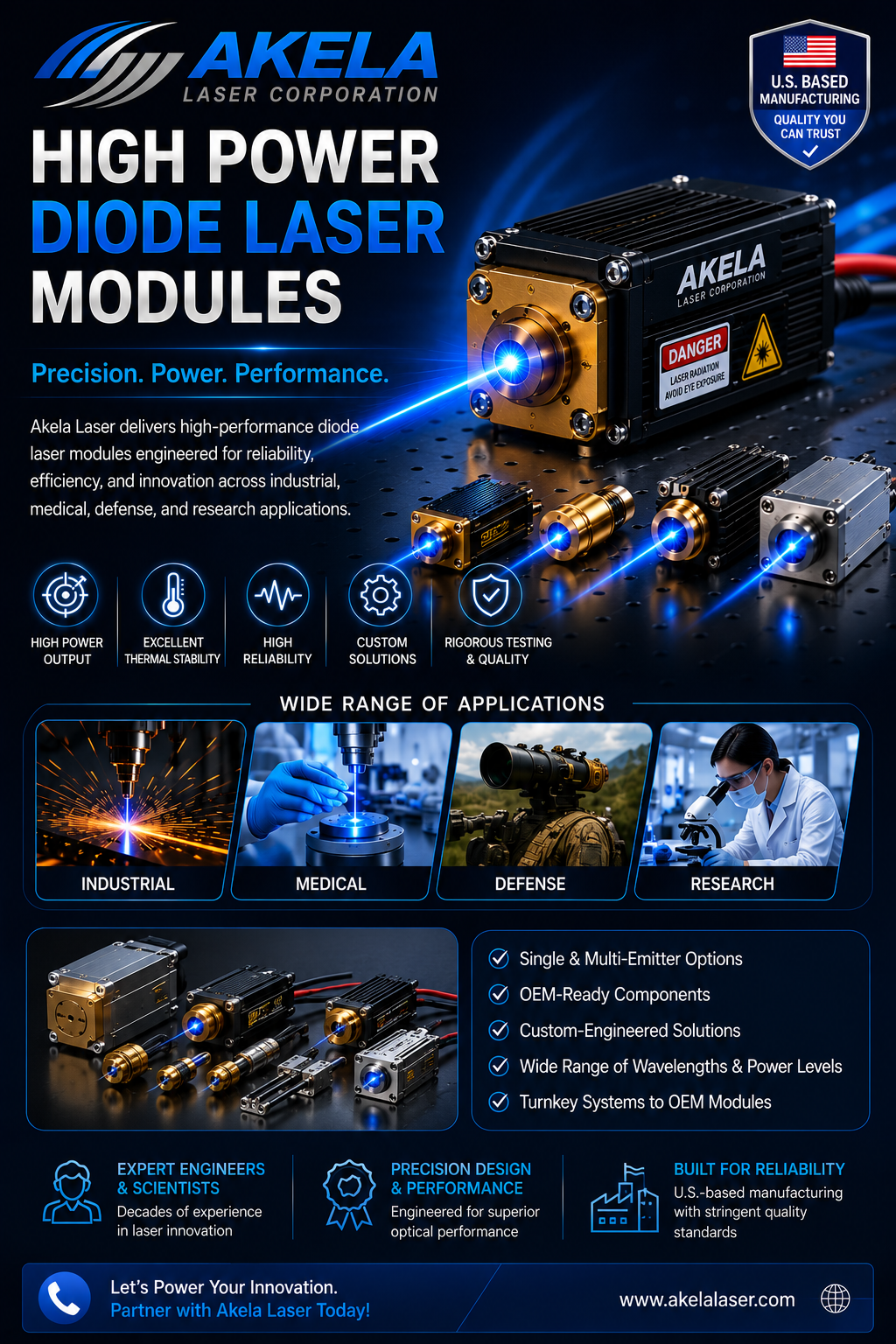
At Akela Laser Corporation, we specialize in high-power custom laser diode solutions engineered for the most demanding applications. From single-wavelength modules to complex multi-wavelength assemblies, our team of experts collaborates with you from concept through production to deliver laser diode products that perform — reliably, precisely, and at scale.
Ready to discuss your custom laser diode requirements? Contact Akela Laser today to speak with one of our application engineers.