Sign up with Google
 Sign in with Zoho
If you're sourcing laser diodes for a medical device, an industrial system, or a defense application, one of the very first and most important decisions you'll make is wavelength. Get it right, and your system performs exactly as intended. Get it wrong, and you could face poor efficiency, safety issues, regulatory hurdles, or a product that simply doesn't do what it needs to do.
This guide breaks down what laser diode wavelength means, how it affects performance, and how to choose the right wavelength (or combination of wavelengths) for your application with help from a trusted Laser Diodes Manufacturer in the USA.
What Is Laser Diode Wavelength, and Why Does It Matter?
Wavelength refers to the color of light a laser diode emits, measured in nanometers (nm). It's not just a technical specification, it'sa the single biggest factor determining how a laser interacts with its target material, tissue, or sensor.
Wavelength affects:
- Absorption – how much energy is absorbed by a target material (skin, tissue, metal, plastic, etc.)
- Penetration depth – how deep the light travels before being absorbed or scattered
- Visibility – whether the beam is visible (typically 400–700 nm) or invisible (infrared, UV)
- Eye and tissue safety – different wavelengths carry different safety classifications and exposure limits
- Compatibility – matching the laser to detectors, fibers, lenses, and coatings designed for specific wavelength ranges
Choosing the correct wavelength isn't a matter of preference, it's dictated by the physics of your application.
Common Laser Diode Wavelength Ranges and Their Applications
While laser diodes are available across a broad spectrum, certain wavelength ranges are especially common in commercial and medical systems:
UV (around 375–405 nm) Used in curing, sterilization, fluorescence excitation, and certain diagnostic instruments.
Visible Red (630–700 nm) Common in alignment lasers, barcode scanners, photodynamic therapy, and low-level laser therapy.
Near-Infrared (780–1064 nm) Widely used in industrial cutting, welding, marking, pumping solid-state lasers, and many surgical and aesthetic applications due to favorable tissue absorption and penetration characteristics.
Mid-Infrared (1300–1550 nm and beyond) Used in telecommunications, certain medical procedures, range-finding, and applications requiring eye-safer operation at higher power.
Every application has a "sweet spot" wavelength range and sometimes more than one wavelength is needed to achieve the desired result.
How to Choose the Right Wavelength for Your Application
Here are the key questions to work through with your laser diode supplier:
- What material or tissue is the laser interacting with? Different materials have absorption peaks at different wavelengths. A wavelength that's highly absorbed by one tissue type may pass right through another.
- What power level do you need, and how does that interact with safety classifications at your chosen wavelength?
- Does the wavelength need to be visible for alignment or user feedback, or is invisible (IR) operation acceptable or preferred?
- Are there regulatory or industry-standard wavelength requirements for your application (especially common in medical and defense procurement)?
- Will the laser need to integrate with existing optics, fibers, or detectors that are wavelength-specific?
This is where working with an experienced manufacturer pays off. A knowledgeable partner won't just sell you a diode off a datasheet they'll help you validate that the wavelength you're considering actually achieves the outcome you need, and can recommend alternatives if there's a better-performing option.
Why Wavelength Selection Is Especially Critical in Medical Applications
Medical and aesthetic laser systems are perhaps the most wavelength-sensitive of all applications. The same procedure say, hair removal, vascular treatment, or surgical cutting can require different wavelengths depending on patient skin type, target chromophore (melanin, hemoglobin, water), and desired depth of effect.
This is why working with a specialized Laser System Manufacturer For Medical in New Jersey matters. A US-based partner with deep medical experience understands not only the optical physics, but also the practical realities of device design: thermal management for patient safety, regulatory documentation, biocompatible housing materials, and reliability testing standards that medical-grade systems demand.
Akela Laser Corporation, based in Jamesburg, NJ, brings exactly this kind of cross-disciplinary expertise combining laser diode design with system-level engineering for medical OEMs who need a partner that understands both the optics and the clinical application.
When One Wavelength Isn't Enough: Custom Dual Wavelength Laser Modules
Many advanced applications particularly in medical, diagnostic, and industrial sensing systems require more than one wavelength operating from a single, compact source. Multi-wavelength designs allow a system to:
- Treat multiple tissue types or chromophores with one device
- Combine a visible aiming beam with an invisible treatment or measurement beam
- Enable simultaneous diagnostic and therapeutic functions
- Improve versatility without increasing device footprint
This is where a Custom Dual Wavelength Laser Module becomes a powerful solution. Rather than integrating two separate laser sources which adds cost, size, complexity, and points of failure a dual wavelength module combines both wavelengths into a single, optically aligned, thermally managed package.
Designing a custom dual wavelength module requires careful engineering: managing thermal crosstalk between emitters, aligning beams through shared or separate optical paths, balancing power output between wavelengths, and packaging everything into a form factor that fits the end product. This level of custom design is best handled by a manufacturer with full in-house engineering and production capability from initial prototype through burn-in, testing, and volume production.
Questions to Ask Your Laser Diode Supplier
Before finalizing your wavelength selection, ask your supplier:
- Can you provide data on absorption/performance at this wavelength for my specific application?
- What power output and beam quality can be achieved at this wavelength reliably?
- Can this wavelength be combined with others in a custom multi-wavelength module if needed in the future?
- What testing (burn-in, lifetime, thermal cycling) is performed before shipment?
- Is prototyping available, and how smoothly does the design transfer to production?
Final Thoughts
Wavelength is the foundation of laser diode performance it determines how your system interacts with the real world, whether that's human tissue, industrial materials, or sensing targets. Choosing correctly from the start saves significant time, cost, and redesign risk down the line.
If you're evaluating wavelength options for a new design whether you need a single high power diode, a fully integrated medical laser system, or a Custom Dual Wavelength Laser Module partnering with an experienced Laser Diodes Manufacturer in USA gives you access to the engineering expertise, US-based production, and rapid prototyping capability needed to bring your product to market with confidence.
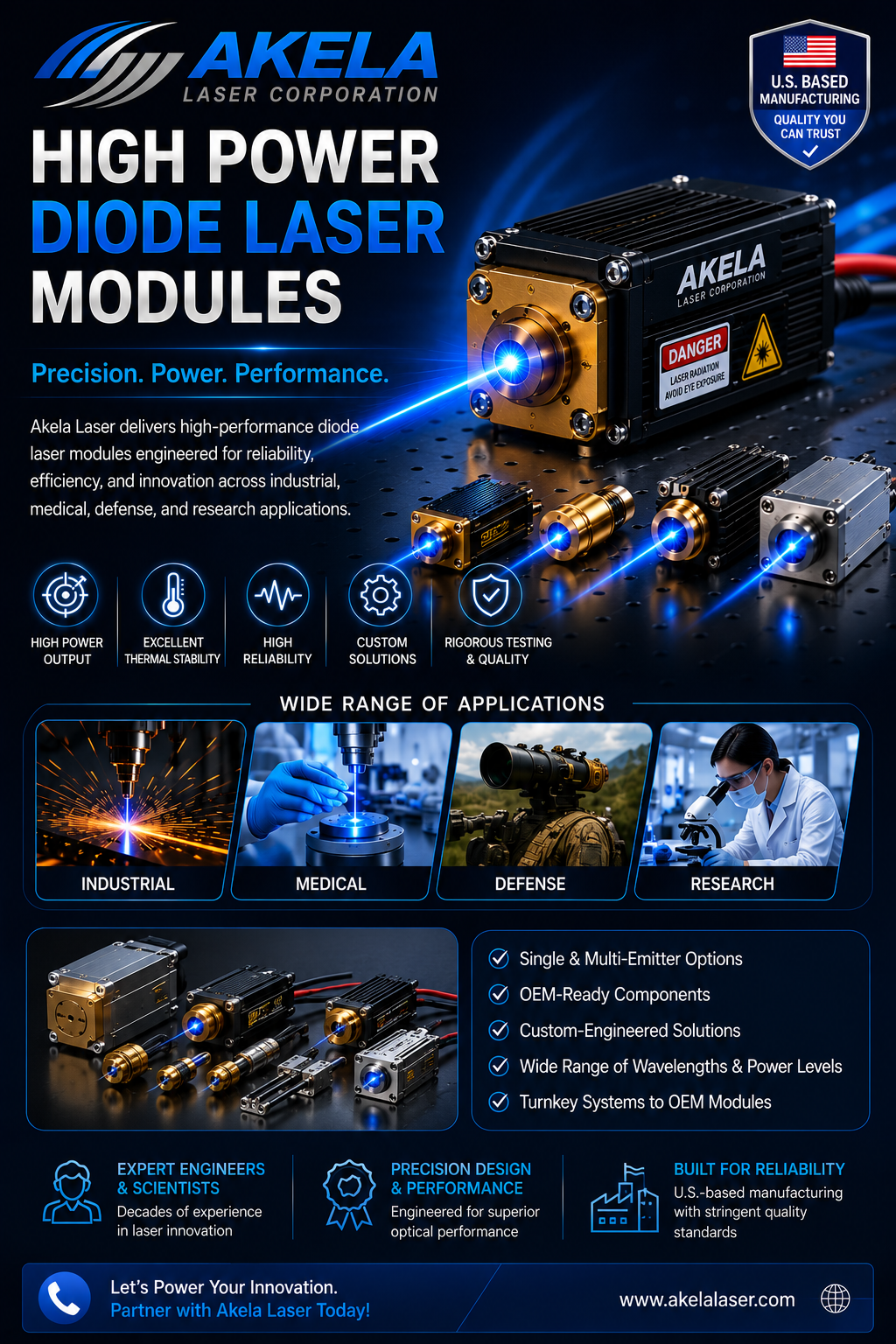
Akela Laser Corporation designs, prototypes, and manufactures high power laser diodes and complete laser systems entirely on-site at our 8,200 square foot facility in Jamesburg, NJ supporting medical, industrial, and military customers from initial concept through high-volume production.
Have a project that requires a specific wavelength or a custom multi-wavelength solution? Contact Akela Laser Corporation to discuss your application with our engineering team.