Sign up with Google
 Sign in with Zoho
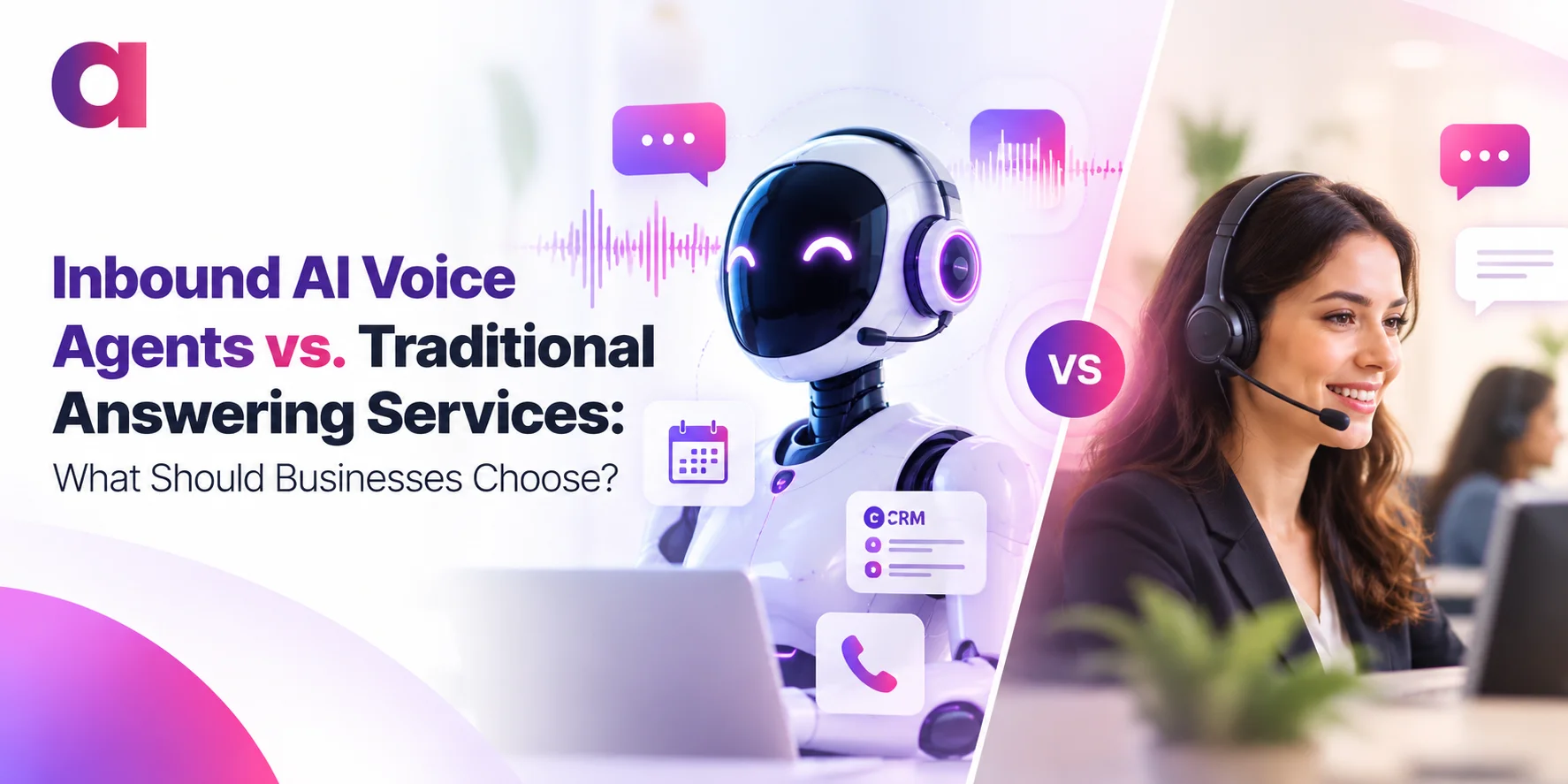
Every unanswered call can cost your business a lead, a booking, or a sale. But hiring staff to answer every call can also add to your monthly costs. This leaves many businesses with a practical question: should you use an automated voice system or a traditional answering service?
The answer depends on your call volume, customer needs, budget, and daily tasks. An automated system can handle routine questions and collect lead details. A human receptionist can offer personal attention and deal with complex requests.
The numbers show why businesses need to weigh both options. A September 2025 survey of 1,000 US consumers found that 78% had abandoned a business after an unanswered call. Another 21% said they would call a competitor right away. These figures show why reliable phone coverage matters.
This guide compares the two options, examines recent research, and explains how to choose the right setup for your business.
What are Inbound AI Voice Agents?
Inbound AI voice agents are software that receives calls and communicates with customers in real-time. The inbound AI Voice Assistant make use of speech recognition technology and language models to comprehend the request of the users and provide a response in the natural language.
In contrast to the phone menu that provides some predefined choices, the inbound AI voice agents ask additional questions in order to comprehend the request of users. Besides, the inbound AI Voice Assistant are capable of being integrated with the business applications and perform certain actions, in case such integrations exist.
For instance, the customer wants to make an appointment on Friday. The AI voice agent will need the name of the client, will find out the availability of the desired time slot from the calendar integration and will schedule the appointment.
The tasks performed by the AI voice agent are:
- To provide answers to the inquiries related to the hours of work, services and prices.
- Obtain names, phone numbers, and leads.
- To qualify the leads for sale and pass them to you.
- To schedule, reschedule and cancel appointments.
- To synchronize the call information in the CRM system.
- Connecting difficult calls to an employee.
An inbound AI voice agent performs well if you provide instructions, correct information, and access to the required systems. Without that, the system will not be able to perform the task successfully.
How Does a Typical Answering Service Function?
An answering service uses live operators to handle calls for your company. This could be done depending on your contract during the daytime, in the evenings, during weekends, or any time of the day.
They do tasks like taking messages, making transfers, answering questions, and obtaining information about customers. Some of them can even assist in scheduling and handling requests.
The biggest advantage of having such receptionists is human judgement. They will react to the mood of the person calling, if more information is required they would ask, and even deal with an abnormal request without the use of a pre-designed call flow.
Nevertheless, the amount of calls that people can handle simultaneously is finite. In peak times you can experience some delays. Also, training of your employees, updating the instructions, and delivering the message to the correct person might be required.
An answering service built around AI operates in a completely different way. They are software-based and can handle calls anytime of the day and night.
AI Voice Agents vs. Traditional Answering Services: Key Differences
1. Availability and call volume
An automated system can answer calls around the clock. It can also handle several calls at once, depending on its plan and technical limits.
A traditional service depends on staffing levels and the hours covered by your contract. During busy periods, callers may wait or need a callback.
The cost of missed calls can be serious. A 2025 survey found that 78% of respondents had abandoned a business after an unanswered call. This was a survey of US consumers, so the result may not reflect every market or industry.
For a business that receives enquiries after hours, an AI answering service can collect caller details and pass urgent requests to the team. This gives your staff a chance to follow up when they are available.
2. Quality of conversation
Human receptionists have a higher degree of flexibility in handling unexpected or emotional conversations. They can listen, empathize, and use discretion when the caller requires assistance that goes beyond the standard procedure.
An AI system can provide a rapid response to standard inquiries, although it may encounter difficulties in handling poorly articulated requests, noisy backgrounds, unfamiliar names, or issues that go beyond its programming.
According to recent studies, there is a need for balance in the selection. For example, in a recent consumer poll by a well-known Research Institute, which involved 9,500 consumers during November and December 2024, 71 percent of the respondents preferred human agents for empathy, and 69 percent for creativity. However, 52 percent favored virtual agents for quickness and ease of handling.
3. CRM & Business System Integration
Classic receptionists could transmit the message via e-mail or SMS. Then it will be necessary to input it into the CRM, to update the calendar or set a reminder. There are some options for direct integration, depending on your service provider.
AI voice agents could integrate call handling with business systems via application program interface (API). Depending on the configuration, the system could store lead information, update customer information, and generate reminders.
Before choosing your service provider, make sure it provides:
- Secure access to business systems.
- Transmission of accurate caller information.
- Handling errors if integration fails.
- Checking for duplicates in the database.
- Confirmation of the completed reservation.
Such checks are important, since fast handling of the call is useless if incorrect information was saved or the wrong appointment was made.
4. Cost and ROI
The AI answering service may have a subscription or usage cost, or both. The regular one will most likely have a pay-per-minute, pay-per-call, pay-per-staffing, or pay-per-package deal.
Neither solution will be cheaper automatically; your specific situation will determine what is more expensive and what is not. You should consider such factors as call volume, length of the conversation, work schedule, setup fee, and how much staff is required for assistance.
The following costs must be accounted for:
- Cost of monthly services or software subscription.
- Phone cost and pay-for-use cost.
- Setup, integration, maintenance.
- Staff time required for call review and mistakes fixing.
- Profit from completed bookings and leads.
- Losses due to missed calls and delays.
A company getting 600 calls per month should calculate the number of calls that produce a useful outcome. Compare the cost of a completed booking or lead rather than the cost of each call.
When Should You Choose Each Option?
The right choice depends on what your callers need and how your team works.
Consider an AI answering service when:
- Your team answers the same questions throughout the day.
- You receive calls outside office hours.
- Customers often ask to book or change appointments.
- Your sales team needs consistent lead details.
- Staff spend too much time taking messages and updating records.
Consider a traditional answering service when:
- Callers often need personal attention.
- Requests involve complex decisions or sensitive issues.
- Your business depends on human judgment.
- You cannot dedicate time to setting up and monitoring software.
- Customers need a person to resolve problems.
You can also use a hybrid model. The AI handles routine calls and gathers initial details. A human steps in when the caller needs extra help or the system cannot provide a reliable answer.
Recent research supports this approach. In August 2026, it was reported that 87% of surveyed customers considered access to a human agent essential when companies use generative AI for customer service. The survey covered 3,566 business and consumer customers. This finding reinforces the need for a clear path to human support.
What to Check before Purchase?
The demo may reveal an elegant dialogue, but in reality, calls may be quite unpredictable. Try the system with typical questions and complex situations related to your business.
Consider the following technical issues:
- Voice recognition: does it recognize people’s names, dates, addresses, and industry-specific terminology?
- Response speed: does it respond timely to create a natural conversation?
- Call transferring: can it transfer a client to the proper employee?
- Reliability of integration: does it update your records after the change is accepted by the other system?
- Capacity of calls: can it handle peak periods without dropped calls?
- Privacy: does the provider explain how it stores voice records and texts, manages access, and deletes the information about your clients?
Also, try to use interruptions, vague questions, and integration failures. Define the scenarios in which the system should ask a question, leave a message, or transfer a call.
Measuring the Effectiveness of the System
When your system goes into operation, analyze its effectiveness weekly. Take into account the following six criteria:
- Answer rate: The share of incoming calls answered.
- Task completion rate: The share of calls that end with the requested task completed.
- Transfer rate: The share of calls passed to a person.
- Booking accuracy: The share of bookings recorded correctly.
- Lead capture rate: The share of relevant calls that produce complete lead details.
- Cost per completed task: Total call-handling costs divided by useful outcomes.
Use these figures to find gaps. For example, a high transfer rate may mean your instructions are unclear or your system handles too few request types. A low booking accuracy rate may point to an integration problem.
Conclusion
The traditional answering service will still be a good choice for companies that require human intelligence and personal involvement. AI voice agent services can be ideal for companies that have many calls, standard questions, and a requirement for off-the-hour operations. A blend of these two can allow you to handle these two requirements effectively.
Before choosing any of the systems, analyze your calling logs, estimate the cost of dropped calls, and compare their performance in actual calling tasks. Agentli AI provides customized voice agents for incoming calls, including services like lead qualification, appointment scheduling, transfer into CRM, and call summary. You can check the company’s official website for more information on its services.
The most effective system should be able to respond, perform tasks correctly, protect customer information, and provide a person where needed.







.webp)