Sign up with Google
 Sign in with Zoho

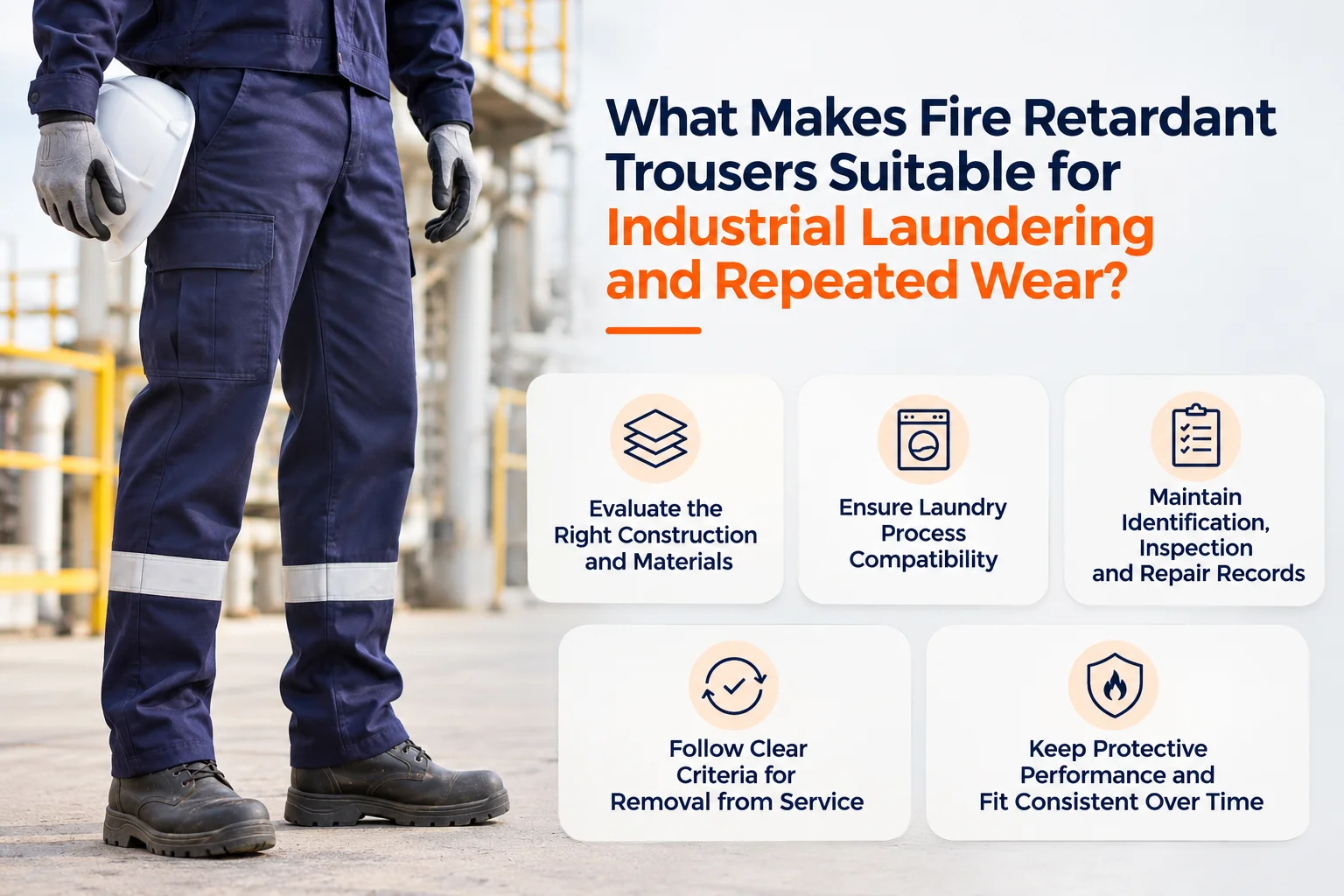
Industrial laundering places repeated demands on protective workwear. Washing, drying, handling and daily use can gradually affect fabric dimensions, seams, closures and garment identification. For organisations issuing protective clothing across multiple shifts, selecting fire retardant trousers means looking beyond the initial fabric specification. The garment must remain suitable for its intended hazard, fit correctly after repeated care cycles and be inspected using clear replacement criteria. Its care process must also follow the manufacturer's instructions.
Fire retardant trousers: What Should Buyers Evaluate Before Approval?
A garment intended for repeated industrial use needs to be assessed as a complete construction rather than as a fabric sample alone. The fabric, sewing thread, pocket construction, waistband, fasteners and reinforcement details all contribute to how the trousers perform during routine work.
Start by identifying the conditions in which the garment will be worn. Workers who frequently kneel, climb, operate machinery or handle equipment may place greater stress on particular areas than employees performing mostly stationary tasks.
During supplier evaluation, examine:
● Fabric composition and the protective performance claimed for the complete garment.
● Seam construction around the crotch, seat, knees and inner legs.
● Reinforcement at pocket openings, belt loops and other high-stress points.
● Closure design and the security of buttons, zippers and other fasteners.
● Care-label instructions and the availability of written industrial laundering guidance.
Ask the supplier to identify the applicable garment standard and provide supporting documentation. A fabric test report alone should not be treated as proof that every garment configuration has the same certified performance.
How Fabric and Garment Construction Affect Service Life
Repeated movement creates friction and mechanical stress, particularly around the knees, seat, crotch and inner thighs. These areas deserve attention during product trials because damage may develop through normal work even when the fabric initially appears suitable.
Fabric selection should account for the intended hazard, required protective performance, weight, construction and expected working conditions. The choice between inherently flame-resistant fibres and treated fabrics also matters. Their care requirements and performance characteristics can differ, so a laundry provider should not assume that one wash formula is suitable for every garment.
Construction quality is equally important. A weak seam may open under repeated bending, while poorly secured pocket corners can deteriorate when workers carry tools. Reinforcement can help manage local stress, but its suitability depends on the garment design and the materials used.
Before approving a bulk order, inspect representative samples and, where practical, conduct a controlled wear-and-laundering trial. Record visible changes in fit, dimensions, seams, closures and fabric condition. Compare the results with the manufacturer's requirements rather than relying only on visual appearance.
Industrial Laundry Chemistry and Process Compatibility
A protective garment can look clean without necessarily being suitable for continued use. Residual oil, grease or other flammable contamination may create an additional fuel source during a thermal incident. Cleaning effectiveness is therefore a safety consideration, not simply a matter of appearance.
ASTM F1449-20(2026), the current reapproved edition of the Standard Guide for Industrial Laundering Care and Maintenance of Flame Resistant or Arc Rated Clothing, addresses industrial laundering programmes, process compatibility, cleaning, repair, inspection and removal from service. It is a guide, not a universal wash formula. The appropriate process depends on the garment materials, level of soiling and manufacturer's care instructions.
The laundry provider should obtain written guidance covering detergent selection, permitted wash conditions, drying method and any chemical restrictions. Avoid applying a standard formula across different garment types without confirming compatibility.
Particular care is needed with:
● Chlorine bleach and other chemicals: Do not use them unless the garment manufacturer explicitly permits them.
● Fabric softeners and finishing products: Confirm compatibility before use rather than assuming that products intended for ordinary workwear are suitable.
● Wash temperature and mechanical action: Follow the specified process because excessive heat or unsuitable handling may affect dimensions and construction.
● Contamination control: Assess the actual substances encountered at work and whether the laundry process can remove them effectively.
Where hazardous chemical contamination is suspected, the employer should establish a controlled handling and laundering procedure. Garments should not simply be returned to general circulation because they have passed through a normal wash cycle.
Maintaining Garment Identification, Inspection and Repair Records
Industrial laundry systems often handle garments belonging to different employees, departments or contractors. Without reliable identification, a damaged item can be returned to service without the right person knowing its history.
Use a garment identification method compatible with the manufacturer's instructions. Depending on the system, this may involve a suitable label, approved marking or electronic tracking method. Identification should remain legible after the intended care process and should not introduce unapproved materials or alterations.
Inspection should take place at defined points, including after laundering and before reissue. Pay particular attention to open seams, damaged fasteners, torn fabric, excessive abrasion, dimensional changes and unauthorised modifications.
Repairs also need control. A patch, replacement component or altered seam can affect the garment's construction. Use only repair methods and materials approved by the garment manufacturer or an authorised repair provider. If the repair history is uncertain, quarantine the item until its suitability has been assessed.
Maintain records that connect each garment or batch with its issue history, laundry route, inspection findings, repairs and retirement decision. This allows the organisation to identify recurring problems, such as damage concentrated around a particular seam or deterioration associated with a specific handling process.
When Should Protective Trousers Be Removed From Service?
A fixed number of wash cycles should not be treated as a universal retirement limit. Garment life depends on the design, materials, exposure conditions, care process and extent of wear. Follow the manufacturer's stated service-life and inspection guidance.
Remove a garment from circulation for assessment when it has significant fabric damage, open seams, missing or defective closures, unapproved repairs or contamination that cannot be adequately removed. A garment that no longer fits correctly or has undergone an unapproved alteration should also be reviewed before further use.
The same approach applies when protective identification becomes unreadable or the item's history cannot be established. If the organisation cannot confirm what the garment is, how it was maintained or whether it remains suitable for its intended application, it should not be issued on assumption alone.
Frequently Asked Questions
1. Can flame-resistant trousers be washed by an industrial laundry service?
Yes, industrial laundering can be suitable when the process follows the garment manufacturer's care instructions and is compatible with its materials. ASTM F1449 provides guidance for industrial laundering and maintenance of flame-resistant and arc-rated clothing.
2. Does repeated washing automatically reduce flame-resistant performance?
Not necessarily. The effect depends on the fabric technology, garment construction, washing conditions and contamination. Some fabrics have inherent flame-resistant properties, while others rely on a treatment. Follow the manufacturer's care instructions and do not assume that all fabrics respond identically to repeated washing.
3. Why should oil and grease contamination be checked after washing?
Residual flammable contamination can act as additional fuel during a fire exposure. A garment should not be considered ready for reissue solely because it looks clean. The organisation should assess the workplace contaminants and confirm that its laundry process removes them effectively.
4. Can damaged protective trousers be repaired instead of replaced?
Some damage may be repairable, but the repair must follow an approved method using compatible materials and components. Unauthorised patches, stitching or alterations can affect garment construction. Consult the manufacturer or an authorised repair provider before returning a repaired item to service.
5. How should a company decide when to replace protective trousers?
Use the manufacturer's inspection and retirement guidance, supported by documented checks of fabric condition, seams, closures, fit, contamination and repair history. Replace garments that cannot be confirmed as suitable for their intended protective application.
Conclusion
Long-term garment suitability depends on more than fabric durability. Construction, compatible laundering, effective contamination removal, controlled repairs and consistent inspection all influence whether protective workwear like fire retardant trousers remains appropriate for continued use. Establishing these checks before bulk procurement helps organisations manage garment condition across workers and shifts.