Sign up with Google
 Sign in with Zoho
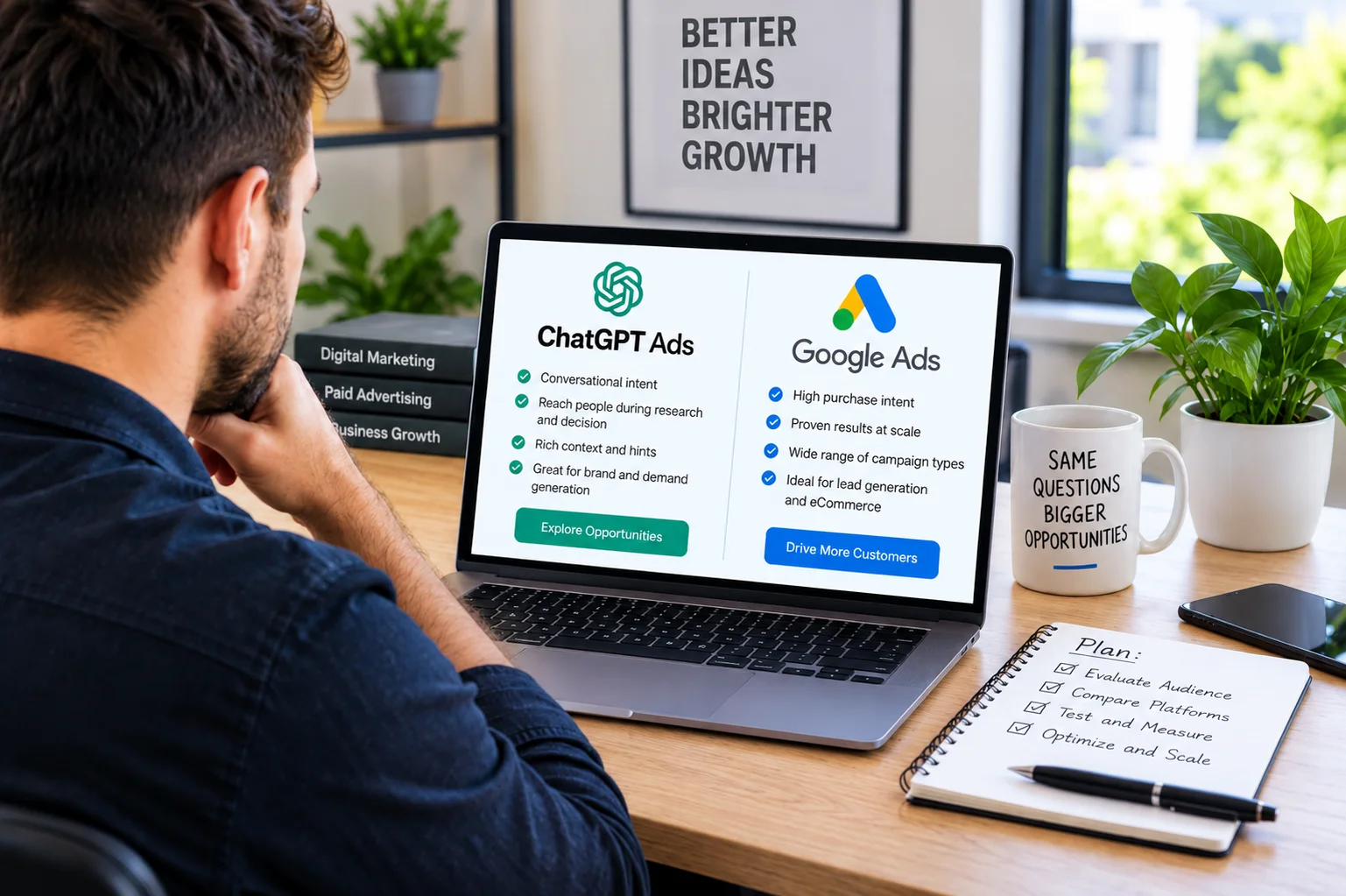
A new advertising platform creates an obvious question for business owners: should I move budget there, or keep investing in the channel I already understand?
That question is becoming more common with ChatGPT Ads. Businesses can reach users while they research products, compare providers, or work through a decision inside ChatGPT. Google Ads, meanwhile, remains an established way to capture people who are actively searching.
At Adzlance, I would not choose between them because one is newer or more familiar. The better starting point depends on customer intent, existing performance, measurement, and how much budget the business can responsibly test.
Google Ads Starts With Existing Search Demand
Google Search Ads are powerful because the customer often tells you what they want.
Someone searching for an emergency plumber, accounting software, a dermatologist, or a specific product has already expressed intent. Strong Google Ads management can organize campaigns around those searches, control budget, measure conversions, and improve performance as data builds.
For a business with clear search demand, Google is usually easier to evaluate because you can connect searches with leads or sales. Competitive clicks and weak tracking can still create waste, but the advertising model is mature.
ChatGPT Ads Enters the Journey Differently
ChatGPT Ads can reach someone during a longer conversation rather than relying mainly on a short search query.
A user might explain their company size, what they have tried, the features they need, their budget, and the alternatives they are considering. That creates a different advertising environment.
Good ChatGPT Ads management should not be treated as Google Ads with different labels. Context hints, creative, landing pages, and measurement need to reflect situations where the offer is genuinely useful.
If the platform is new to you, the complete guide to ChatGPT Ads explains the campaign structure, objectives, creative approach, and measurement in more detail.
Should Small Businesses Test ChatGPT Ads or Google Ads First?
For most small businesses with proven search demand and no established paid acquisition channel, I would usually investigate Google Ads first.
Someone actively searching for the service or product is already demonstrating demand. That gives a smaller advertiser a clearer starting signal.
ChatGPT Ads becomes more interesting when potential customers spend time researching, comparing options, asking detailed questions, or deciding which solution fits their situation.
A software company, professional service, education provider, e-commerce brand, or considered purchase may have good reasons to test conversational advertising. But it should be a controlled experiment, not an automatic replacement for a profitable Google campaign.
Do Not Move Budget Just Because ChatGPT Ads Is New
Novelty is not a media strategy.
If Google Ads already produces profitable customers, I would not cut a successful campaign simply to fund a large ChatGPT Ads test. Protect what works and create a separate testing budget where possible.
Start with one clear offer, a focused market, reliable conversion tracking, and enough budget to collect useful information. Adzlance's guide to ChatGPT Ads costs explains current budget and bidding considerations for advertisers planning a test.
The first test should answer whether the channel can generate valuable traffic, leads, or sales for your business.
Keywords and Context Hints Are Not the Same
This is one of the biggest adjustments for advertisers coming from Google.
Google Search campaigns rely heavily on search queries and keyword targeting. ChatGPT Ads uses conversational context and other relevance signals, while advertisers can provide context hints describing relevant needs, topics, and situations.
Context hints are not exact match keywords and do not guarantee an ad will appear whenever a specific phrase is mentioned.
Copying a Google keyword list into a ChatGPT campaign is therefore not a strategy. Our guide to ChatGPT Ads targeting explains conversational relevance and context hints in more detail.
Which Platform Gives You Better Intent?
Neither platform owns the word intent. They can reveal it differently.
Google can be strong when someone knows what they want and searches directly. ChatGPT may become valuable earlier in the decision process, when someone is explaining a problem, evaluating approaches, or comparing solutions.
A business owner might search Google for 'CRM software for small business.' Inside ChatGPT, the same owner could explain that they manage a ten-person sales team, need automated follow-up, and want software employees can learn quickly.
Both situations can be commercially valuable, but the context around the decision is different.
How Should You Measure a ChatGPT Ads Test?
Do not judge it only by impressions or clicks.
Decide what a valuable outcome looks like before launch. For lead generation, that may be qualified enquiries, booked calls, or customers. For e-commerce, it may be purchases, revenue, and profitable acquisition.
Use consistent tracking and UTMs so performance can be compared with other channels. Then look at lead quality and customer economics, not simply which platform reports the cheapest click.
If you are still deciding whether the channel fits a smaller advertiser, read are ChatGPT Ads worth it for small businesses before assigning budget.
So, Which Should You Test First?
If customers already search Google for exactly what you sell and you are not capturing that demand effectively, Google Ads will often be the logical first test.
If you already have proven acquisition channels and want to explore customers during research and consideration, ChatGPT Ads can deserve a controlled place in the media plan.
For some businesses, the answer may eventually be both. Google can capture direct search demand while ChatGPT Ads tests opportunities created by conversational research and decision-making.
At Adzlance, I would rather give each platform a defined job than force a winner before the data exists.
The best advertising channel is the one that reaches the right customer at the right stage and turns that attention into measurable business value.