Sign up with Google
 Sign in with Zoho

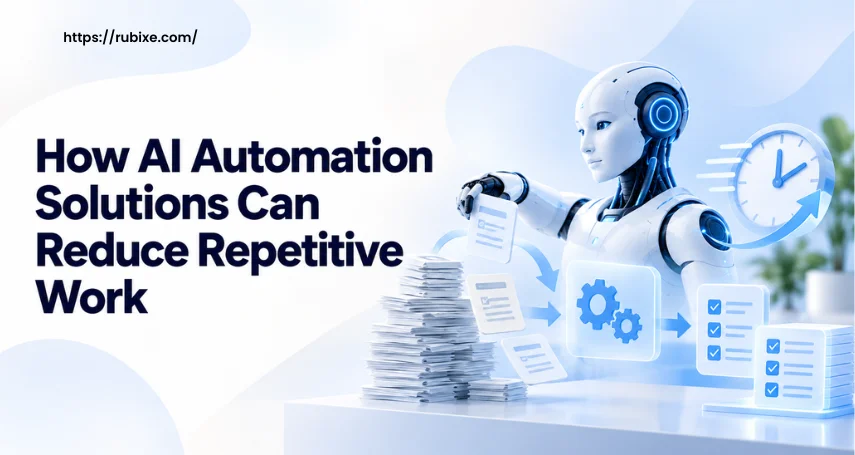
How much time does your team spend on work that follows the same steps every day? From entering data and sorting emails to preparing reports and updating records, repetitive tasks can take employees away from customer service, problem-solving, and business planning. AI automation solutions can help businesses reduce this manual workload by classifying information, processing documents, and supporting routine workflows.
However, automation is not about handing every task over to technology. Businesses need to identify the right processes, assess the available data, and maintain suitable human oversight to protect accuracy and privacy. This guide explores which tasks can be automated, the benefits businesses can expect, and the practical steps to implement AI automation responsibly.
What Are AI Automation Solutions?
AI automation solutions use artificial intelligence to perform or support tasks that would otherwise require manual effort. Depending on the tool, they can classify information, recognise patterns, summarise documents, process customer messages and assist with routine decisions.
Traditional automation usually follows predefined rules. AI-based automation can also work with less structured information, such as emails, documents and customer feedback. Human review remains important when the results involve sensitive data or decisions that affect customers and employees.
Which Repetitive Tasks Can Businesses Automate?
Different departments handle different types of routine work. The most suitable tasks depend on how often they occur, the information available, and the level of accuracy required.
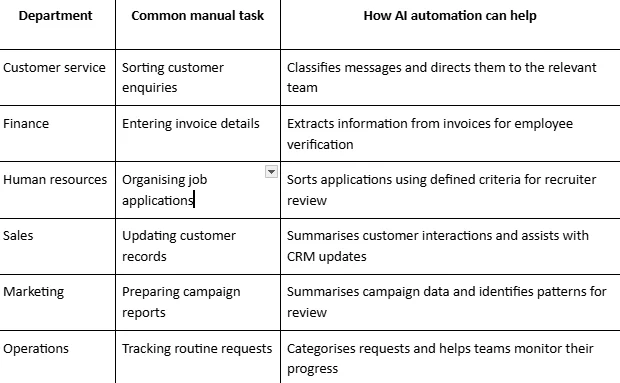
For example, a customer support team receiving hundreds of emails may spend considerable time sorting messages before answering them. An AI tool can classify incoming enquiries and send them to the appropriate team, while employees handle complex complaints and review uncertain cases.
Automation does not remove the need for checking results. Businesses should verify important outputs before using them in financial, employment, or customer-related decisions.
Benefits of AI Automation Solutions
1. Less Time Spent on Manual Tasks
Employees can spend less time copying information, sorting messages, and preparing routine reports. This can make daily workflows easier to manage and reduce the time spent on repetitive activities.
2. More Consistent Workflows
Automated processes can follow the same instructions across repeated tasks. This can reduce variations in routine work, although the results still depend on data quality, system settings, and the accuracy of the AI tool.
3. Faster Access to Information
AI tools can summarise documents, organise records and help employees locate relevant information. Staff can review the resulting summaries instead of searching through every document individually.
4. More Time for Work That Needs Human Judgement
When routine tasks take less time, employees can focus on responsibilities that require communication, problem-solving and decision-making. A customer service team, for instance, can spend more time resolving complicated complaints instead of manually sorting every incoming message.
5. Better Visibility Into Delays
Automation tools can help businesses track recurring requests and identify where tasks are waiting for review or approval. Managers can use this information to investigate bottlenecks and improve the process.
How Can You Identify Tasks Worth Automating?
Not every task needs AI. Businesses should first look for activities that happen frequently, follow a reasonably consistent process, and take up a noticeable amount of employee time.
Use these questions to evaluate a task before selecting a tool:
- Does the task happen daily or several times a week?
- Does it involve repetitive data entry, sorting, or summarising?
- Do employees follow similar steps each time?
- Can the result be checked against clear requirements?
- Would the expected time savings justify the total cost?
- Does the task involve sensitive information or decisions that require human judgement?
Tasks with clear steps and measurable results are often easier to test than activities that depend heavily on context, negotiation or personal judgement.
Steps to Implement AI Automation in a Business
Step 1: Identify One Specific Problem
Start with a task that creates a visible delay or adds to the team's workload. For example, employees may spend too much time sorting incoming customer emails.
Write down what takes time, who performs the task, and what needs to improve.
Step 2: Review the Existing Process
Understand how employees complete the task, which systems they use and where mistakes or delays occur. This helps establish what the proposed solution needs to do.
Step 3: Check Data and System Requirements
Confirm that the business has the required data, software access, and technical support. Review privacy, security, and integration requirements before selecting a tool.
Step 4: Run a Small Pilot
Test the solution on a limited number of tasks before expanding its use. Compare the results with the existing process and check whether the output is accurate enough for its intended purpose.
Step 5: Keep Human Review in Place
Employees should check important outputs, handle exceptions, and correct errors. The level of review should match the risks associated with the task.
Step 6: Measure the Results
Compare the new process with the original one. Useful measures include processing time, error rates, cost per task, and employee feedback. If the pilot does not deliver practical improvements, review the workflow or adjust the solution before investing further.
What Should Businesses Consider Before Automating Tasks?
AI automation can reduce manual work, but businesses should assess several practical concerns before implementation.
- Accuracy: AI tools can produce incorrect or incomplete results. Important outputs need appropriate checks.
- Data privacy: Understand how the tool stores, processes, and uses business or customer information.
- System integration: Check whether the solution can work with existing software and workflows.
- Employee concerns: Explain how automation will affect daily responsibilities and provide suitable training.
- Total cost: Include subscriptions, setup, integration, maintenance, and training when evaluating the investment.
- Ongoing monitoring: Review performance over time to identify errors, changing requirements or declining results.
A gradual rollout gives employees time to learn the new process and helps businesses identify issues before expanding automation to other departments.
Frequently Asked Questions
What are AI automation solutions used for?
They can help classify messages, extract information from documents, summarise reports, organise records and support routine customer service tasks.
Can small businesses use AI automation?
Yes. Small businesses can start with a specific task, such as organising enquiries or preparing routine summaries. The solution should fit their budget, available data, and existing workflow.
Will AI automation replace employees?
AI automation can change how certain tasks are completed, but many processes still need people to review results, handle exceptions, communicate with customers, and make decisions. Its impact depends on the task and how the business implements the technology.
How can a business measure the success of automation?
Businesses can compare processing time, error rates, operating costs, and workload before and after implementation. Employee feedback can help determine whether the new process is practical and useful.
Should a business automate every repetitive task?
No. Some repetitive tasks are inexpensive, straightforward, or too sensitive to automate. Businesses should compare the expected benefits with the cost, risks, and need for human oversight before choosing a task.
Conclusion
AI automation solutions can help businesses reduce repetitive tasks, organise information, and give employees more time to focus on work that requires human judgement. The key is to start with a specific business problem, test a suitable solution, and measure its impact on time, accuracy, and workflow efficiency.
Before expanding automation across departments, review the pilot results, gather employee feedback, and check that the solution meets your security and operational requirements. For practical examples of how AI can reduce manual workloads, read Rubixe’s guide on how AI solutions reduce manual work. If you’re exploring automation opportunities for your business.