Sign up with Google
 Sign in with Zoho
Ask ten different systems who your top customer is, and you might get ten slightly different answers. A supplier record still catching up after a merger, a slightly different spelling here, and an updated address that didn't quite make it everywhere.
By itself, none of these gaps appear to be significant. When combined, they subtly undermine the one thing that every business says it wants: a single, trustworthy reality about the individuals and companies it works with.
Entity resolution is what closes that gap. It gives organizations the clarity to act on their data rather than second-guess it by piecing together the disparate, flawed copies of a customer or supplier across your systems into a single accurate, reliable record.
How Does Entity Resolution Turn Fragmented Records Into Trusted Business Identities?
Quality data management services reconcile the many versions of the same customer or supplier across systems.
Entity resolution is the specific discipline that makes this reconciliation possible. Usually, the procedure consists of several related steps:
1. Standardize Data Before Comparing Records
Records rarely arrive in the same format.
Addresses may adhere to various traditions, phone numbers may have different country codes, and names may be shortened. In order to prevent superficial differences from impeding matching, entity resolution first standardizes certain properties. This establishes a uniform basis for precise cross-system record comparisons.
2. Examine Several Signals, Not Just One Field
Seldom is an email address or business name sufficient to verify a person's identity. Names, addresses, phone numbers, domains, tax identities, and transaction patterns are just a few of the data that entity resolution considers collectively. The likelihood that two data points reflect the same entity increases with the number of relevant signals that align.
3. Score Each Potential Match by Confidence
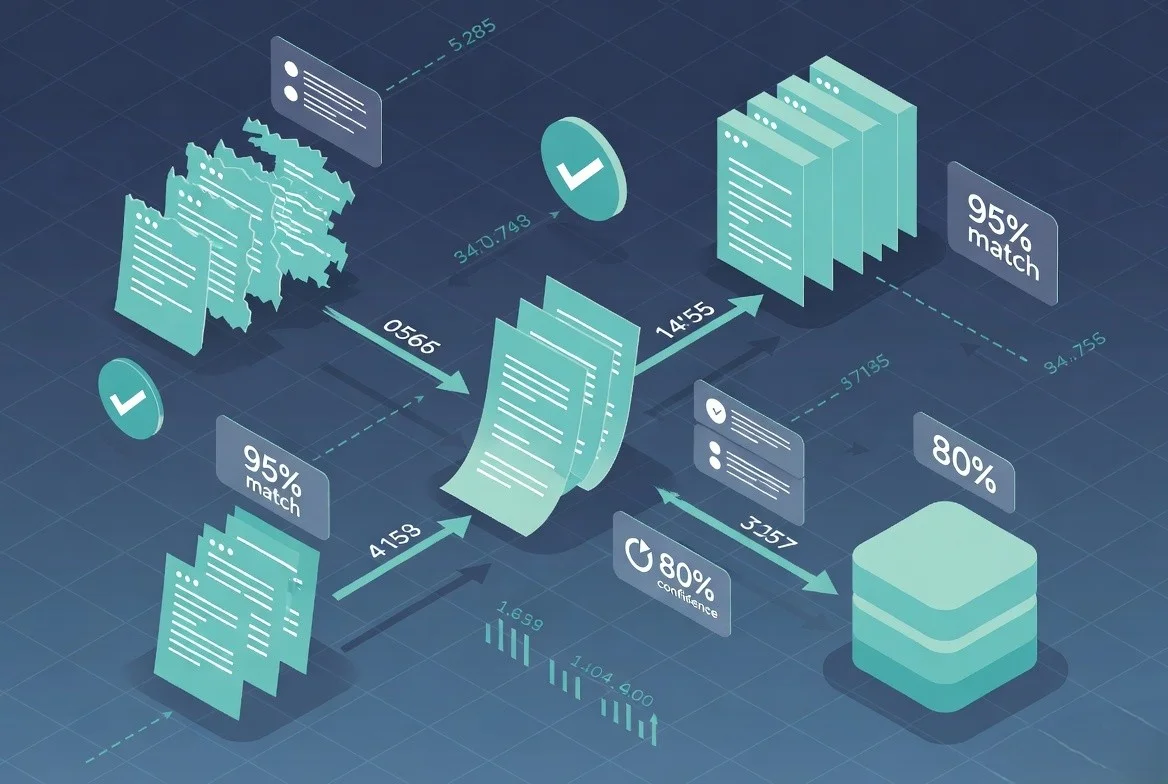
Not every similarity should result in an automatic merge. Confidence scores are assigned by entity resolution according to the combination and strength of matching signals. Uncertain matches can be marked for review, but high-confidence matches can proceed immediately. Combining two really diverse providers or consumers is less risky as a result.
4. Add Business Context to Improve Match Decisions
The same matching rules do not work equally well for every dataset. Effective data management services incorporate source reliability, industry context, business rules, and known relationships into the resolution process. For example, a verified tax identifier may carry more weight than a similar company name entered manually in a spreadsheet.
5. Preserve Lineage and Source-Level Detail
A trusted identity should not erase the history behind it. Entity resolution preserves where each attribute came from, when it was updated, and which source is considered authoritative. This lineage helps teams investigate discrepancies, validate decisions, and understand why specific records were linked without losing valuable source-level context.
How to Create an Entity Resolution Roadmap That Delivers Results?
According to Gartner, poor data quality will be reason enough for 60% of organizations to abandon their AI projects by 2026. That single number is reason enough for businesses to treat entity resolution as a roadmap, not a one-off project.
Here is how you can build one that actually delivers:
1. Start With a Clear Business Case
Whether it's cutting back on unnecessary marketing expenditures, enhancing supplier risk visibility, or expediting onboarding, your strategy should be anchored in precise business results.
Entity resolution works best when it's grounded in context, not treated as a standalone IT initiative. An enterprise metadata management platform gives you that context, mapping where your data lives and how it connects across systems. This makes it easier to directly connect entity resolution efforts to measurable business goals.
2. Map your Most Impactful Data Domains
On the first day, you don't have to resolve every entity in every system.
Start by determining which domains, such as supplier data linked to compliance reporting or customer records feeding your sales forecasts, are most negatively impacted by fragmentation. Your roadmap will remain focused and produce results more quickly if you prioritize based on business impact.
3. Audit Your Current Data Quality Honestly
Before selecting tools or timetables, you need to have a clear picture of how severe the fragmentation is.
To identify duplicate rates, inconsistent formats, and missing variables, make sure to conduct a baseline review across your primary systems. This audit helps you avoid underestimating the amount of the work that lies ahead and serves as your standard for tracking progress in the future.
4. Choose the Right Mix of Matching Techniques
Since no single approach can adequately handle every situation, you will require both probabilistic and deterministic matching.
Determine early on which entities benefit from more flexible, AI-assisted approaches and which require tight, rule-based matching. If this mix is done incorrectly, too many duplicates remain unaltered or too many false mergers are produced.
5. Build on a Strong Metadata Foundation
If you don't know the ownership, lineage, and structure of your data, you can't resolve entities accurately.
With the aid of an enterprise metadata management platform, you can keep track of the provenance, ownership, and reliability of each attribute, providing your matching logic with the context it requires to make more intelligent and persuasive conclusions.
Make Trusted Identities Part of Your Data Strategy
Entity resolution shouldn't sit on the sidelines as a cleanup task you revisit once a year.
Make it an integral part of your data management process so that each new supplier entry or customer record is fixed as soon as it enters your systems, rather than months later when the harm has already been done. Instead of treating the review checkpoints, the metadata foundation, and the confidence rating as a one-time job with a deadline, include them in your normal routine.
Straive works with enterprises on exactly this kind of shift. It helps build the clean, connected data layer that agentic AI and GenAI systems need to actually deliver on their promise.
Trusted identities aren't a nice-to-have anymore; they're the difference between AI that works and AI that quietly gets things wrong. Build that trust once, and everything downstream gets easier.