Sign up with Google
 Sign in with Zoho

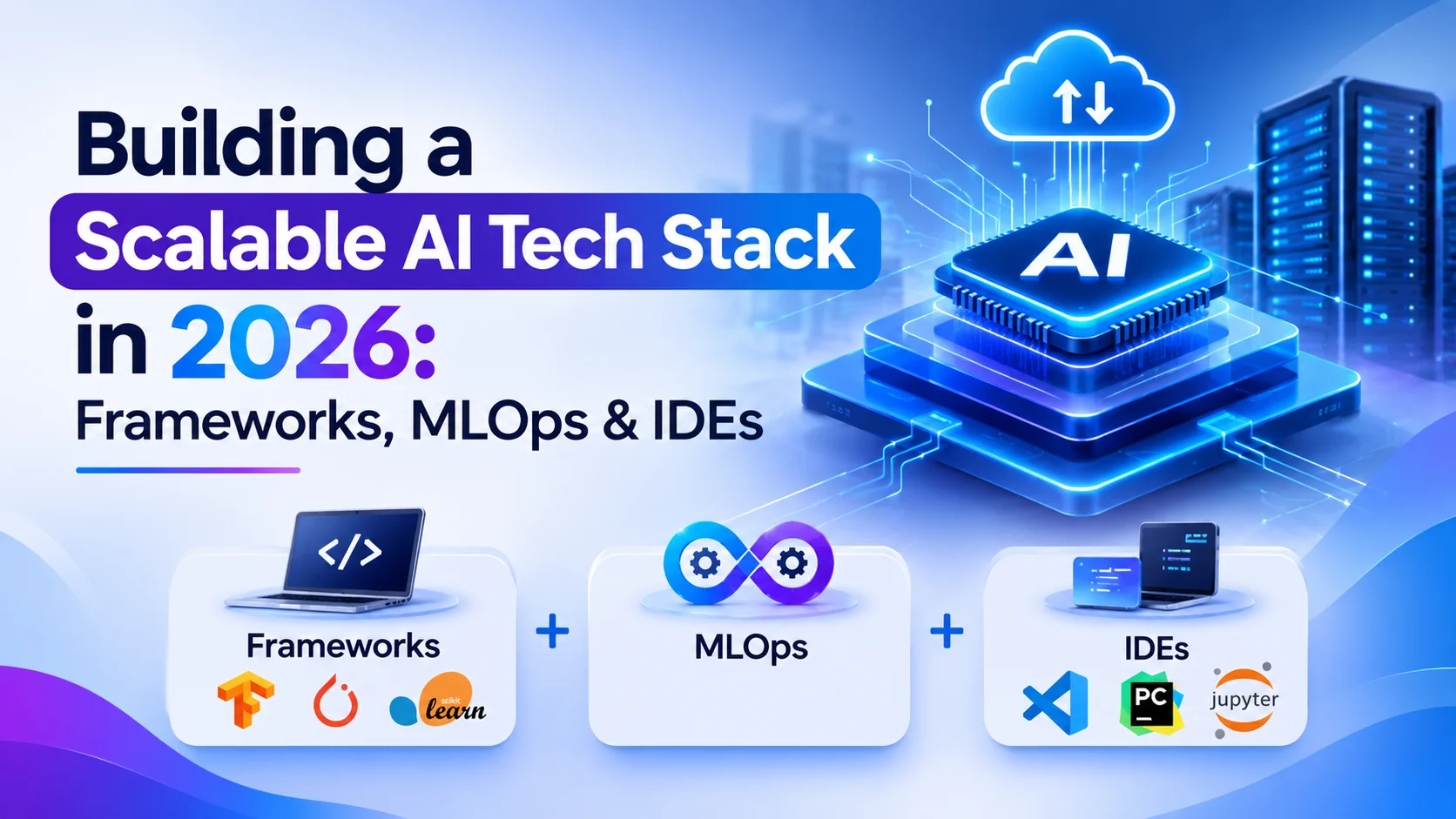
Enterprise AI adoption has surged past 70 percent, yet many organizations still struggle to move models from isolated experiments into reliable production systems. Failed deployments, model drift, and ballooning cloud bills rarely stem from a lack of AI talent—they happen when teams build on fragmented infrastructure. Choosing the right AI Tech Stack has become the defining factor between stalled prototypes and scalable business value.
Unlike traditional software architectures, a modern AI Tech Stack must handle massive data pipelines, GPU-intensive training, model versioning, and continuous real-time observability. Moving away from rigid, monolithic scripts toward containerized, cloud-native workflows allows engineering teams to compress deployment cycles from weeks down to hours—while cutting infrastructure spending by 30 to 50 percent.
Our latest guide breaks down the essential layers powering production AI in 2026:
- Data Infrastructure & Governance: Over 70 percent of enterprises face bottlenecks integrating clean data into models. Combining streaming tools like Apache Kafka, data lakes, and Data Version Control (DVC) ensures reproducible, compliant datasets across batch and real-time workflows.
- Top AI & ML Frameworks: Whether you need PyTorch for rapid experimentation, TensorFlow for battle-tested edge and production serving, JAX for high-performance TPU/GPU computing, or Hugging Face Transformers for plug-and-play foundation models, matching the framework to the workload is critical. For tabular data, Scikit-learn, XGBoost, and LightGBM remain indispensable.
- End-to-End MLOps Platforms: Tools like MLflow, Kubeflow, AWS SageMaker, and Weights & Biases automate experiment tracking, validation, and rollout pipelines—allowing teams to catch data drift proactively rather than firefighting production outages.
- Specialized AI IDEs: Environments like VS Code, PyCharm, Jupyter Notebook, and cloud-based Google Colab reduce friction between data scientists and production engineers through shared registries and integrated debugging.
Why does data matter in AI tech stack?
Data forms the foundation of every AI system, yet defining processes for data governance and developing the ability to quickly integrate data into AI models remain top challenges, with insufficient training data also presenting significant obstacles. Your AI tech stack must handle data collection, storage, versioning, and pipeline orchestration.Modern data infrastructure requires tools like Apache Kafka for streaming data, data lakes for storage, and versioning systems like DVC (Data Version Control). Data quality directly impacts model accuracy. Organizations that invest in robust data infrastructure within their AI tech stack achieve faster iteration cycles and better model performance. The data layer must support both batch and real-time processing while maintaining strict governance controls.
MLOps in the AI tech stack
MLOps represents the engineering discipline that combines machine learning, DevOps, and data engineering services to reliably and efficiently deploy and maintain ML systems in production. The MLOps component of your AI technology stack automates model training, validation, deployment, and monitoring workflows.MLflow remains the most widely adopted open-source MLOps platform in 2025, providing a comprehensive lifecycle solution for tracking experiments, managing models, and deploying them across multiple environments. Key MLOps platforms include Kubeflow for Kubernetes-native orchestration, AWS SageMaker for cloud-native deployments, and Weights & Biases for experiment tracking.
IDEs in AI tech stack
Integrated Development Environments specialized for AI development accelerate coding, debugging, and experimentation. Top IDEs for AI development in 2026 include PyCharm, Visual Studio Code, and Jupyter Notebook, offering support for multiple languages, debugging, and version control.PyCharm provides intelligent code assistance with seamless integration into TensorFlow, PyTorch, and Scikit-learn frameworks. VS Code delivers lightweight performance with extensive Python extensions and native Git integration. Jupyter Notebook remains essential for data scientists, enabling interactive coding with visualization capabilities built directly into notebooks.Cloud-based IDEs like Google Colab and AWS Cloud9 offer additional benefits including scalable compute resources, collaboration features, and remote access for distributed teams. The right IDE integration within your AI tech stack reduces development friction and improves team productivity.






.webp)