Sign up with Google
 Sign in with Zoho

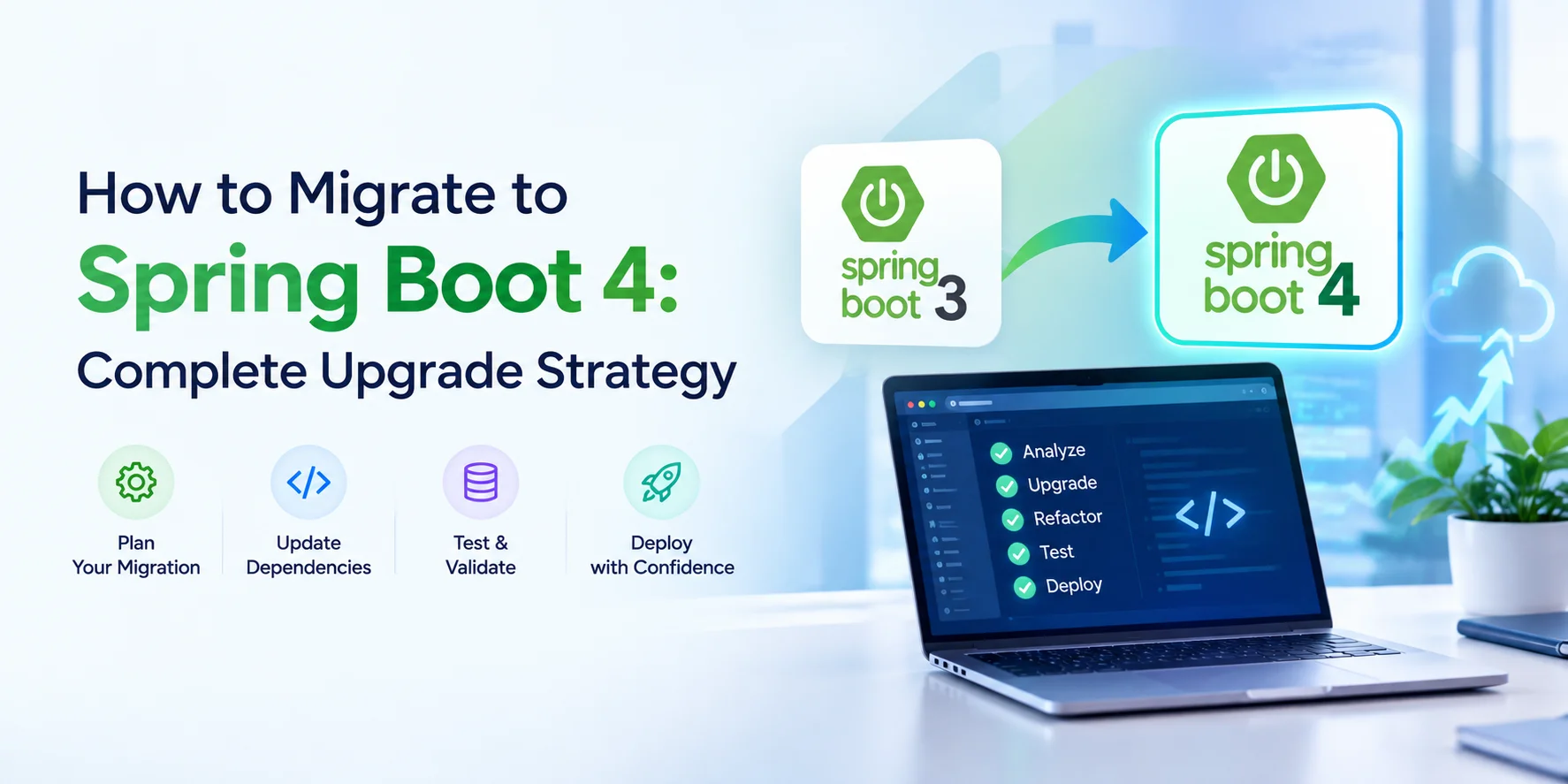
Moving to the Next Generation of Spring Boot
Spring Boot 4 marks a significant leap forward in JVM application development. Built on Spring Framework 7 and Jakarta EE 11, it brings enhanced performance, modern Java capabilities, and declarative programming models to enterprise microservices.
Moving from Spring Boot 3.x to 4.x is more than a routine version bump. Executing a Spring Boot 4 Migration introduces critical architectural changes that help developers write cleaner, safer, and more maintainable code while reducing boilerplate across the entire tech stack."
+-----------------------------------------------------------------------+ | Spring Boot 3.x vs. 4.x | +--------------------------+--------------------------------------------+ | Feature | Spring Boot 4.x | +--------------------------+--------------------------------------------+ | Base Foundation | Spring Framework 7 / Jakarta EE 11 | | Minimum Java Version | Java 17+ (Java 21/25 Recommended) | | Null-Safety | JSpecify standard (@NullMarked) | | API Versioning | First-class native support on mapping | | HTTP Clients | Declarative interfaces (@ImportHttpServices)| | JSON Engine | Jackson 3 (JsonMapper) | +--------------------------+--------------------------------------------+
Major Features and Architecture Improvements
- JSpecify Null-Safety StandardSpring Boot 4 replaces internal @Nullable annotations with JSpecify standard (@NullMarked), establishing package-wide non-null defaults that major IDEs and static analysis tools recognize natively.
- Declarative HTTP ClientsBuilding on @HttpExchange, Spring Boot 4 introduces @ImportHttpServices. This allows developers to auto-register declarative HTTP clients without hand-crafting proxy factories or custom RestTemplate beans.
- Built-in API VersioningTeams no longer need custom interceptors or complex URL mapping to manage API changes. Spring Boot 4 migration adds direct version attributes to @RequestMapping shortcuts, configurable via headers, paths, or media types.
- Jackson 3 IntegrationThe framework transitions from Jackson 2 to Jackson 3, introducing dedicated JsonMapper and XmlMapper beans. (Note: Exception handling changes from checked IOException to unchecked RuntimeException.)
Essential Steps for a Smooth Migration
- Prerequisites: Ensure your runtime environment is updated to Java 17 or higher (Java 21/25 recommended) and build tools match Gradle 8.14+ or current Maven releases.
- Audit Dependencies: Check third-party libraries for Jakarta EE 11 compatibility and update Jackson 2 configurations to Jackson 3 builders.
- Refactor Annotations: Update package-level nullability annotations to JSpecify @NullMarked and align controller mappings with native API versioning.
If you're coming from Spring Boot 3.x, this isn't a routine point upgrade. Spring Boot 4 restructures how the framework is packaged, rethinks null safety across the entire portfolio, and ships genuinely new capabilities, including declarative HTTP clients, first-class API versioning, and a move to Jackson 3, all of which change how you write everyday Spring code. This guide walks through what's new, why it matters in practice, where teams tend to get stuck, and exactly how to move an existing application from 3.x to 4.x.This guide breaks down Spring Boot 4 through a practical, upgrade-focused lens rather than just a changelog — covering what changed, why it matters, and what actually trips teams up during migration, so you can plan the move with confidence.
Key takeaways
- Learn what's genuinely new in Spring Boot 4 versus a routine version bump.
- Understand how JSpecify null safety changes the way you write everyday Spring code.
- See how native API versioning and declarative HTTP clients cut down on boilerplate.
- Spot the Jackson 3 migration traps before they surface in production.
- Get a step-by-step path for moving an existing Spring Boot 3.x app to 4.x.
- Know which features (Undertow, Jersey) are gone and what to replace them with.