Sign up with Google
 Sign in with Zoho

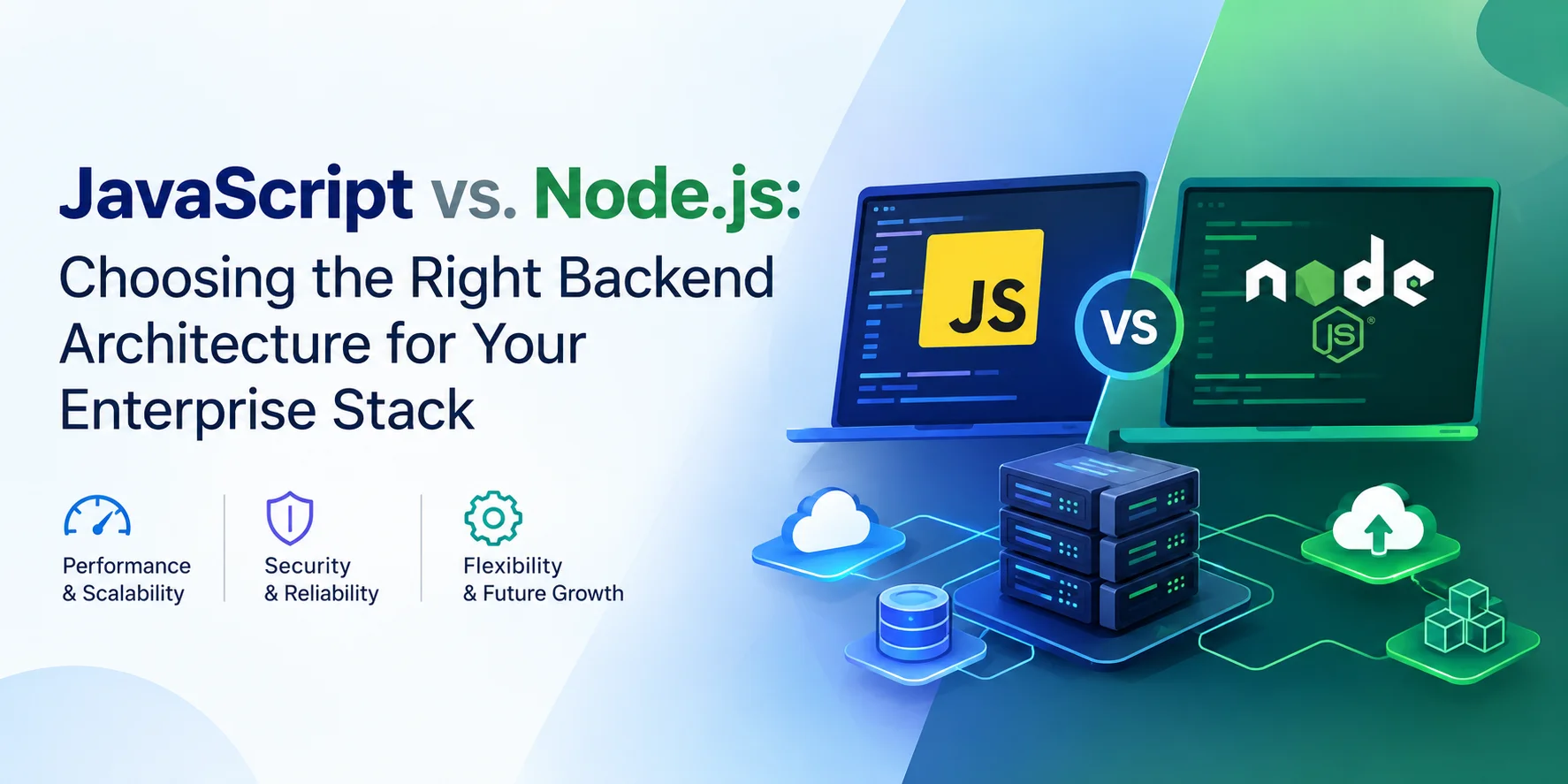
Selecting the right backend architecture directly impacts system performance, API response times, infrastructure costs, and long-term scalability. A common point of confusion among technology leaders and product managers is the relationship between JavaScript and Node.js. While frequently mentioned together, they serve fundamentally different roles in a modern web application stack.
JavaScript is a high-level, lightweight programming language standardized under ECMAScript. Originally created to add interactivity to web browsers, it has evolved into a universal language. However, JavaScript itself does not define where or how code executes; its capabilities depend entirely on the hosting runtime environment.
Node.js, on the other hand, is an open-source, cross-platform runtime environment built on Google’s V8 JavaScript engine. It allows developers to execute JavaScript code outside the browser—primarily on backend servers. Powered by an event-driven, non-blocking asynchronous I/O architecture, Node.js excels at managing thousands of concurrent network connections without creating excessive thread overhead.
Key Takeaways & Use Cases:
- Role Distinction: JavaScript is the programming language; Node.js is the runtime environment that enables server-side execution.
- When to Use Node.js: Node.js is ideal for I/O-intensive workloads, API gateways, real-time applications (such as chat or notification systems), Microservices, and Backend-for-Frontend (BFF) layers.
- Workload Considerations: While Node.js handles asynchronous data calls efficiently, heavy CPU-bound computational tasks (like complex mathematical calculations or AI/ML processing) may require worker threads, background job queues, or specialized alternative stacks (such as Python, Java, or Go).
Ultimately, choosing between client-side JavaScript execution, server-side Node.js, or alternative backend technologies requires evaluating transaction complexity, team capabilities, and total cost of ownership (TCO) to ensure long-term production readiness.
Why does backend technology selection affect software delivery costs?
Backend technology decisions influence much more than initial development speed because they affect the engineering effort required to build features, integrate enterprise systems, maintain service reliability, respond to security vulnerabilities, and support increasing transaction volumes throughout an application's lifecycle.
Consider an enterprise customer portal that begins to experience slow responses as more customers use it concurrently. The engineering team may initially attribute the problem to insufficient server capacity, but a closer investigation could reveal that database connection pools are exhausted, a third-party service is responding slowly, or a CPU-intensive operation is blocking JavaScript execution on the event loop. Increasing infrastructure capacity without identifying the underlying constraint may raise operating costs while leaving the principal performance problem unresolved.
This illustrates why backend technology selection should be treated as an architectural and operational decision rather than a narrow development preference.