Sign up with Google
 Sign in with Zoho


Why IABAC Data Science Certifications Matter in 2026?
Let's be honest, the job market in 2026 doesn't reward potential as much as it rewards proof. If you're working in data, analytics, or AI and you don't have credentials that back up your skills, you're already competing at a disadvantage.
That's exactly where IABAC data science certifications come in. IABAC (International Association of Business Analytics Certifications) has built a globally recognized framework of credentials specifically designed for analytics and AI professionals. And unlike some certification bodies that feel disconnected from the real world, IABAC's programs are structured around practical, job-ready skills.
The data science job market is still growing fast. According to the U.S. Bureau of Labor Statistics, data science roles are projected to grow 35% through 2032 far outpacing most other fields. But growth also means more competition. The professionals landing the best roles aren't just skilled, they're credentialed, visible, and trusted.
This guide will help you cut through the noise. We'll look at which IABAC certifications exist, who they're for, how to choose the right one, and most importantly how to actually get certified without wasting your time or money.
Who Is This Guide For?
Before we go any further, let's get specific. This guide is most useful for you if you're:
A working professional in analytics, IT, or a data-adjacent role who wants to validate their skills with a recognized credential
- Someone with 1–5 years of experience looking to move into a data science or AI role and needing a certification to signal competence
- A mid-career professional eyeing a promotion or salary bump and wanting something concrete to point to
- A recent graduate who's completed online courses and projects but doesn't yet have a formal credential to show recruiters
What Is IABAC?
IABAC the International Association of Business Analytics Certifications is a global certification body focused specifically on data, analytics, and AI. Think of it like CompTIA or PMI, but purpose-built for the data science ecosystem.
A few things that set IABAC apart from the sea of online certificates floating around:
- Vendor-neutral credentials: IABAC certifications aren't tied to any single tool, cloud provider, or software. They test your understanding of concepts and methodologies, which means they stay relevant even as the tech landscape shifts.
- Globally recognized framework: IABAC credentials are recognized by employers in over 170 countries. This is particularly valuable if you're working in a global organization or looking at international job markets.
- Structured learning paths: Rather than offering a single catch-all certificate, IABAC has built a tiered system: foundational, intermediate, and advanced credentials that let you grow in a logical progression.
- Affordable and accessible: Compared to some professional certifications that cost thousands of dollars, IABAC keeps its programs accessible without cutting corners on rigor.
The State of Data Science Careers in 2026
Here's the context you need to understand why certifications matter right now specifically:
AI has changed the job description:
Two or three years ago, a data analyst and a data scientist had fairly distinct roles. In 2026, almost every data-facing job requires at least a working understanding of machine learning concepts, prompt engineering, or AI-augmented analytics. The skill floor has risen.
Hiring managers are overwhelmed:
When a data science role opens up, recruiters can receive hundreds of applications. Certifications function as a first-pass filter; they tell a hiring manager that you've met a minimum validated standard without them having to read every project portfolio in detail.
The self-taught narrative has limits
Yes, there are brilliant self-taught data scientists. But most hiring pipelines, especially in enterprise organizations, still look for structured validation. A LinkedIn Learning badge doesn't carry the same weight as a recognized industry certification.
If you've been putting off getting certified because it felt like just another checkbox it's time to reconsider. In 2026, it's become a baseline expectation in many job postings, not a nice-to-have.
IABAC Certifications Overview: What's Available
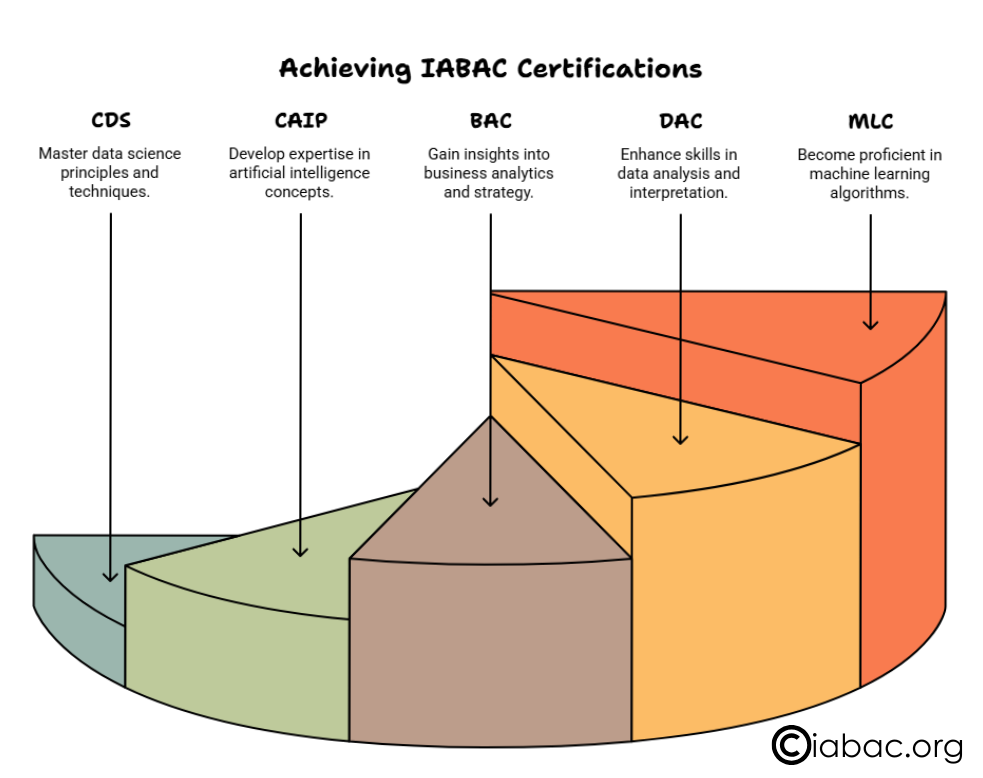
IABAC offers a range of certifications across the data and analytics spectrum. Here's a look at the main ones relevant to data science professionals:
1) IABAC Certified Data Scientist (CDS)
The flagship credential. The CDS certification covers the end-to-end data science workflow from data wrangling and exploratory analysis through to machine learning model building and deployment. It's designed for professionals who are working with data daily and want to validate that they can operate at a senior level.
What makes it credible: the exam tests applied knowledge, not just terminology. You'll be evaluated on how you'd approach real-world problem scenarios, not just whether you can define what a random forest is.
2) IABAC Certified AI Professional (CAIP)
This one's for the engineers and practitioners who are building or implementing AI systems, not just analyzing data. The CAIP certification digs into AI architecture, model deployment, ethics, and the practical realities of working with large language models and deep learning systems.
In 2026, this is arguably the most in-demand credential in the IABAC portfolio. AI roles have exploded, and the CAIP gives you a way to signal genuine depth, not just familiarity with AI tools.
3) IABAC Business Analytics Certification (BAC)
A strong intermediate credential for professionals bridging the gap between business and data. This certification focuses on analytics strategy, data-driven decision making, and translating technical insights into business outcomes.
It's particularly valuable for people in management, consulting, or product roles who work alongside data teams and want a stronger analytical foundation.
4) IABAC Data Analytics Certification (DAC)
The entry-level credential. If you're newer to the field or transitioning from a different role, the DAC is your starting point. It covers data fundamentals, visualization, SQL basics, and introductory statistics. Clean, well-structured, and genuinely useful for building your baseline.
5) IABAC Machine Learning Certification (MLC)
Focused specifically on ML concepts, algorithms, and implementation. This sits between the DAC and CDS in terms of depth — ideal for analysts who want to move into ML engineering, or developers who are pivoting toward data science.
IABAC Certifications Table
Here's a side-by-side look to help you compare your options at a glance:
Top Recommended: IABAC Certified Data Scientist (CDS)
If you're a working professional with some data experience and you're asking which IABAC certification to prioritize, the CDS is the answer for most people. Here's why, beyond just saying it's the best:
It covers the full workflow. A lot of certifications test you on isolated skills. The CDS is structured around the complete data science pipeline: problem framing, data collection and cleaning, statistical analysis, model building, validation, and communication of results. That end-to-end thinking is what employers actually need.
It positions you for senior roles. The CDS signals that you can work autonomously on a data science project, not just assist on one. That's the difference between a mid-level analyst and a data scientist on most job descriptions.
The exam is challenging enough to mean something. Some certifications have a reputation for being easy to pass with a weekend of cramming. The CDS requires genuine preparation. That's a feature, not a bug — because it means the credential carries weight when employers see it.
Step-by-Step Roadmap: How to Get IABAC Certified
Getting certified doesn't have to be complicated. Here's a practical roadmap that works for most working professionals
- Assess where you are: Be honest about your current skill level. If you're new to data science, start with the DAC. If you've been working with data for 2+ years, you're probably ready for the CDS or MLC. IABAC's website has a skills assessment tool to help you choose.
- Review the exam blueprint: IABAC publishes detailed exam blueprints for each certification. Download it, read through the competency areas, and flag where your knowledge gaps are. This alone will make your study time 40% more efficient.
- Choose your study approach: IABAC certifications are self-paced, so you have flexibility. Most people do best with a structured plan: 1–2 hours per day, 4–6 weeks. Use a mix of the official study materials, real-world projects, and practice exams.
- Do at least two full practice exams: This is the step most people skip and later regret. Practice exams help you internalize the question format and identify weak spots before the real thing.
- Schedule and take the exam: IABAC exams are online proctored, which means you can take them from home. Once you feel consistently scoring above 75% on practice tests, you're ready.
- Share your credential: IABAC provides a digital badge after you pass. Add it to your LinkedIn profile, your resume, and your email signature. This is not optional; visibility is part of the value.
- Keep going: The CDS or CAIP doesn't have to be your last stop. IABAC has a logical progression. Once you're certified, check what the next credential in your path looks like.
Study Tips That Actually Work
After talking to dozens of certified professionals about how they prepared, a few patterns come up consistently:
Study in active recall mode. Don't just re-read notes. After each topic, close the material and try to explain it out loud or write it down from memory. It's slower, but you'll retain it far better.
Connect concepts to your current job. If you're learning about feature engineering, think about a dataset you've actually worked with. The more you anchor abstract concepts to real examples, the stickier they become.
Don't underestimate the business context questions. IABAC's advanced certifications include scenario-based questions about how you'd communicate findings to a non-technical stakeholder. These catch a lot of people off guard. Prepare for them.
Find a study partner. Even just one person you can talk through concepts with once a week makes a meaningful difference. If you can't find one locally, IABAC's online community forums are active.
What Does an IABAC Certification Actually Do for Your Career?
Let's be concrete about this, because vague promises about 'career advancement' aren't useful.
Resume impact: In a competitive job market, a recognized certification moves your resume past initial filters. For technical roles, many HR systems are now keyword-driven having 'IABAC Certified Data Scientist' on your resume means you surface in relevant searches.
Salary negotiations: Certifications give you a tangible anchor point in salary discussions. You're not just arguing based on years of experience you have a validated credential that supports a higher-tier role title and compensation range.
Internal mobility: For people already inside an organization, certifications are often the missing piece for promotion cases. When your manager has to justify moving you to a senior data scientist role, a recognized certification makes that conversation easier.
Confidence: This sounds soft, but it's real. Preparing for and passing a rigorous certification changes how you think about your own skills. Many professionals report that the process of studying actually closes the gaps they didn't realize they had.
Conclusion: The Right IABAC Data Science Certification for You
If there's one thing to take away from this guide, it's this: the best IABAC data science certification is the one that matches where you are right now and where you want to go, not the most advanced one, and not the easiest one.
For most working professionals with some data experience, the IABAC Certified Data Scientist (CDS) is the credential that opens the most doors in 2026. It's rigorous, globally recognized, and directly aligned with what employers are looking for in senior data science roles.
But if you're earlier in your journey, start with the DAC or BAC, build your foundation, and work your way up. IABAC's tiered structure is designed for exactly this kind of progression.