Sign up with Google
 Sign in with Zoho


If you asked a developer in 2010 what AI features meant to them, they would have probably shrugged and mentioned a spell-checker. Today, in 2026, AI features are woven into virtually every layer of modern software from the IDE that suggests your next line of code to the production pipeline that monitors and self-heals your microservices in real time.
This shift did not happen overnight. The AI features powering today's applications represent decades of incremental progress: smarter algorithms, faster hardware, better training data, and an explosion of open-source tooling that put machine learning within reach of any software team. Understanding that evolution is not just an academic exercise — it is a practical advantage for any engineer building software in the next decade.
This article walks you through that journey. By the end, you will understand what AI features actually are inside real software systems, how they evolved, which ones matter most right now in 2026, and how you can build the expertise to work with them professionally.
Why AI Features Matter More Than Ever in 2026?
The conversation around AI features has shifted fundamentally. Three years ago, adding AI to your application meant calling a third-party API and hoping it worked. Today, engineering teams are expected to understand AI at a much deeper level: how models are trained, how they are deployed as services, how they degrade in production, and how to maintain them.Several forces are driving this shift simultaneously. Cloud providers now offer managed AI infrastructure so mature that deploying a machine learning model requires roughly the same effort as deploying a REST endpoint. Open-source models from Hugging Face, Meta, and others have made sophisticated AI capabilities accessible without enterprise licensing fees. And the competitive pressure is real applications without intelligent features are increasingly losing ground to those that have them.
For software engineers, this creates both urgency and opportunity. The engineers who understand how AI features are designed, integrated, and maintained will shape the next generation of software systems. Those who treat AI as a black box someone else handles will find themselves increasingly on the outside of the most interesting engineering decisions.
What Are AI Features?
The term gets thrown around loosely, so let us be precise. AI features are capabilities embedded in software systems that allow applications to perform tasks which traditionally required human intelligence recognizing patterns, understanding language, making predictions, generating content, or making decisions under uncertainty.
Contrast that with a traditional software feature. A traditional feature follows explicit rules: if the user clicks this button, show this dialog. An AI feature follows learned patterns: if this user's behaviour matches this pattern, recommend this content. The logic is not written by a human — it is inferred from data.
In practice, AI features in modern software systems include things like: a recommendation engine in an e-commerce app, a fraud detection model in a payment processor, a code completion assistant in an IDE, a sentiment classifier in a customer support tool, or a generative model that produces marketing copy on demand.
The Evolution of AI Features: From Rules to Intelligence
Stage 1: Rule-Based Systems (1950s–1990s)
Early artificial intelligence features in software were entirely rule-based. A programmer sat down and encoded every decision the system could make as explicit if-then logic. Expert systems, a popular form of AI in the 1980s, used thousands of handcrafted rules to diagnose medical conditions or configure computer hardware.
These systems worked well in narrow, predictable domains. But they broke the moment they encountered something outside the rule set. They could not learn, adapt, or generalize. And maintaining thousands of rules was a nightmare as domains grew in complexity.
Stage 2: Statistical Learning and Early Machine Learning (2000s)
The shift toward statistical methods changed everything. Instead of programmers writing rules, algorithms learned patterns from labelled data. Spam filters were among the first mass-market applications of this approach trained on millions of emails; they could identify junk mail with accuracy no rule set could match.
This era introduced the machine learning capabilities that now underpin most AI features: linear regression, decision trees, support vector machines, and eventually neural networks. The key insight was that given enough data and the right algorithm, software could discover its own rules.
Stage 3: Deep Learning and Neural Networks (2010s)
The 2010s brought a step change. Deep learning neural networks with many layers dramatically improved performance on tasks like image recognition, speech processing, and language understanding. ImageNet competition results in 2012 showed that deep neural networks could classify images better than any previous approach by a wide margin.
This unlocked computer vision technology and natural language processing capabilities at a scale previously impossible. Suddenly, applications could see (identify objects in photos), hear (transcribe speech), and read (understand documents). These capabilities began appearing in consumer apps almost immediately in your camera's face detection, your voice assistant, your email's smart reply suggestions.
Stage 4: Pre-trained Models and AI-as-a-Service (Late 2010s–Early 2020s)
Training a deep learning model from scratch requires enormous compute and data. Pre-trained models changed economics entirely. Models like BERT for language understanding and Reset for image recognition were trained once on massive datasets, then made available for developers to fine-tune for their specific use case with a fraction of the resources.
AI capabilities and functions became accessible via APIs. Instead of building a sentiment analysis model, you call an API. Natural language processing features that previously required a dedicated ML team were available to any developer with a few lines of code. This democratization of AI features accelerated their adoption across the software industry.
Stage 5: Generative AI and Intelligent Systems (2022–Present)
The emergence of large language models and generative AI in 2022 marked another inflection point. These models do not just classify or predict what they create. Code, text, images, audio, and structured data can all be generated on demand from a text prompt.
For software engineers, this opened an entirely new category of AI features: copilots that write code, assistants that explain codebases, agents that execute multi-step tasks autonomously, and systems that can reason through problems and produce plans. The advanced AI system features of 2026 look less like traditional software and more like collaborators embedded in the development workflow itself.
1) Machine Learning Integration
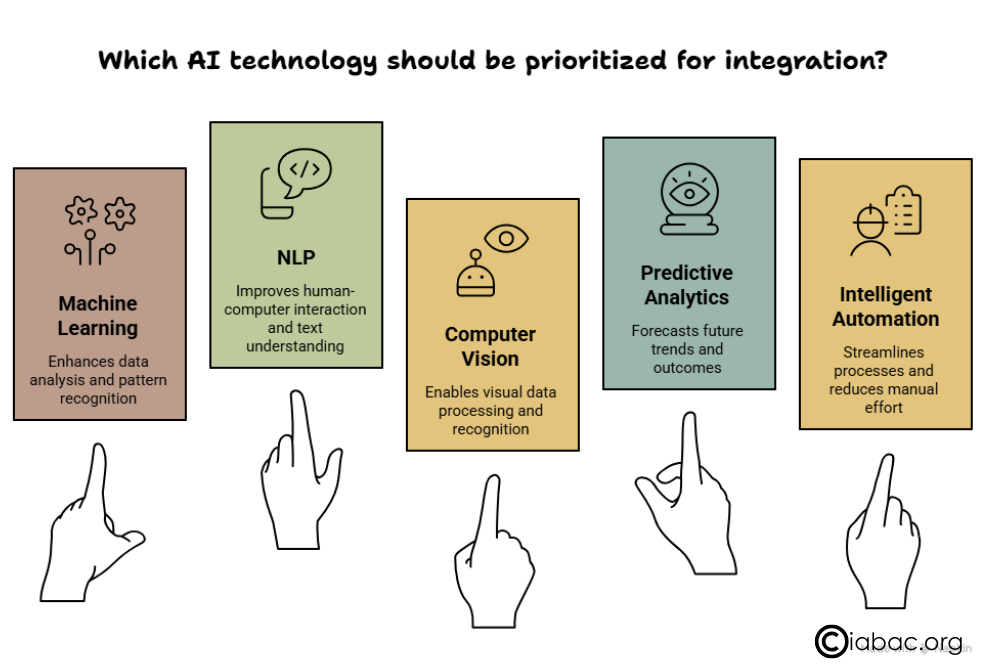
Machine learning capabilities are the backbone of most AI-powered software features today. In practical terms, ML integration means embedding a trained model into a software pipeline so that it can make predictions or decisions on live data.
A recommendation system is a classic example: a model trained on user behavior continuously updates its predictions as new data arrives, influencing what content appears on your screen. In software engineering, ML integration involves model serving infrastructure, versioning, monitoring for data drift, and retraining pipelines all of which are now standard parts of a modern engineering team's toolkit.
2) Natural Language Processing (NLP)
Natural language processing allows software to understand, interpret, and generate human language. This is the technology behind chatbots, document summarizers, search engines that understand intent (not just keywords), and AI writing assistants.
In modern applications, NLP features typically come from large pre-trained models fine-tuned for specific tasks. A customer support platform might use NLP to classify incoming tickets, extract key entities, suggest responses, and route complex issues to human agents all automatically and in real time.
3) Computer Vision Technology
Computer vision technology gives software the ability to interpret visual information photos, video, documents, or live camera feeds. Applications range from the obvious (facial recognition on your phone) to the industrial (defect detection on a manufacturing line) to the practical (document parsing that extracts data from scanned invoices).
For software engineers, integrating computer vision typically means working with pre-trained models via APIs or frameworks like OpenCV, and building pipelines that handle image preprocessing, inference, and postprocessing at the scale your application demands.
4) Predictive Analytics Features
Predictive analytics features help applications forecast future outcomes based on historical patterns. This shows up in financial applications that predict credit risk, in SaaS platforms that flag accounts likely to churn, in logistics systems that anticipate delivery delays, and in development tools that predict which code changes are most likely to introduce bugs.
The software engineering challenge here is less about the model and more about the data pipeline — ensuring the model receives clean, timely, relevant data and that its predictions are surfaced to users in a way that is actionable and trustworthy.
5) Intelligent Automation Systems
Intelligent automation systems go beyond simple scripted automation. They handle variability, make decisions, and adapt to conditions that were not explicitly anticipated. AI-powered DevOps tools that automatically identify and roll back problematic deployments are a good example — they are not following a fixed script but rather making inferences from observed metrics.
Robotic process automation (RPA) enhanced with AI is another form: instead of automating only rigid, rule-based workflows, intelligent automation can handle documents that arrive in varying formats, emails with ambiguous intent, or customer requests that do not fit a predefined template.
How AI Features Are Integrated into Modern Software Architecture?
Understanding that AI features exist is one thing. Understanding how they fit into software systems is what separates engineers who can build and maintain them from those who can only consume them.
1) APIs and Microservices
The most common pattern for adding artificial intelligence features in software today is through APIs. Your application sends a request — text, an image, structured data and receives a prediction or generated output in response. The AI model lives in its own service, separate from your application logic.
This microservices approach keeps your AI capabilities independently deployable and scalable. You can swap one model for a better version without touching your core application. You can scale your inference service independently when demand spikes. And you can monitor AI-specific metrics (latency, accuracy, data drift) without tangling them with your application metrics.
2) ML Pipelines and Feature Stores
Production ML systems require more than a model — they require a pipeline. Data must be collected, cleaned, and transformed into features (the inputs the model expects). Those features must be computed consistently across training and serving. The model must be retrained as data drifts. Predictions must be logged and compared against ground truth to detect degradation.
Feature stores shared repositories for computed ML features have emerged as a key piece of modern ML infrastructure. They ensure that the same feature values used to train a model are also available at inference time, eliminating a common source of training-serving skew that degrades model performance in production.
3) Edge AI and On-Device Inference
Not all AI features live in the cloud. Edge AI brings model inference to the device itself, your phone, a smart camera, or an IoT sensor. This is essential when latency requirements are strict (a real-time object detection system in a vehicle cannot wait for a round-trip to the cloud) or when data privacy concerns make cloud processing unacceptable.
Frameworks like TensorFlow Lite and Apple's Core ML allow developers to deploy optimized models on-device. The trade-off is model size and complexity; larger, more accurate models must be compressed or quantized to run efficiently on constrained hardware.
Step-by-Step Roadmap: Building Expertise in AI Features
Here is a practical path for a software engineer who wants to move from AI consumer to AI practitioner:
1) Audit your current stack: Identify where AI features are already present in the applications you work on recommendation engines, search ranking, spam filters, monitoring anomalies. Understanding what already exists builds intuition for what is possible.
2) Learn the ML fundamentals: You do not need to become a researcher, but you need to understand supervised vs unsupervised learning, how models are trained and evaluated, and what overfitting means. Fast.ai and Andrew Ng's courses on Coursera are strong starting points.
3) Build a simple end-to-end ML pipeline: Take a dataset, train a model, serve it via a REST API, and monitor it. The hands-on experience of seeing the full cycle from data ingestion to live predictions is irreplaceable.
4) Integrate an NLP or computer vision API: Add a real AI feature to a project, a sentiment classifier on user reviews, an image labeling capability, or a document parser. Working with real data surfaces practical challenges that tutorials skip.
5) Study system-level AI design: Go beyond model APIs. Learn about feature stores, model versioning, A/B testing for ML, and monitoring for data drift. These are the skills that make the difference between an AI prototype and a production AI system.
6) Formalize your knowledge with a certification: Structured learning paths fill the gaps that project work leaves. A certification like the CAIE from IABAC provides a curriculum that covers AI, ML, and system-level AI design in a way that maps directly to what engineering teams need in production.
AI Feature Certifications: Which One Is Right for You?
Certifications serve two purposes: they structure your learning so you cover what matters, and they signal credibility to employers and clients. The AI certification space is crowded, so here is an honest comparison of the most relevant options for software engineers focused on AI features and machine learning capabilities.
Why the CAIE from IABAC?
The Certified Artificial Intelligence Expert (CAIE) stands out for one reason: it is built around how AI works in real software systems, not just how models work in isolation. The curriculum covers machine learning theory, but it also addresses deployment architectures, AI system design, and the operational considerations of running AI features in production — which is exactly what software engineers actually need.
IABAC is globally recognized, vendor-neutral, and the certification is designed by practitioners with real-world AI implementation experience. For a software engineer who wants to understand artificial intelligence features in software at the level needed to design, integrate, and maintain them, not just consume them, the CAIE is the most direct path.
Conclusion: AI Features Are Now a Core Engineering Skill
The evolution of AI features in modern software engineering is not a story about technology replacing developers. It is a story about what developers need to know to build the next generation of applications.
From rule-based automation to machine learning integration, from early statistical models to generative AI systems that write code alongside you every stage of this evolution has expanded what software can do. And every stage has created new engineering challenges: How do you serve a model at scale? How do you monitor it for drift? How do you design systems that degrade gracefully when the model is uncertain?
These are not AI researcher questions. They are software engineering questions. The developers who understand AI capabilities and functions at the system level who can design the pipeline, not just call the API will define what modern software looks like in 2026 and beyond.
The roadmap is clear. The tools are available. The certifications exist. The only remaining variable is where you choose to invest your learning time.