Sign up with Google
 Sign in with Zoho

If you've used a chatbot to draft an email, asked an AI tool to generate an image, or watched code get written in seconds, you've already experienced Generative AI firsthand. This isn't a futuristic concept — it's woven into how businesses create content, build software, support patients, and personalize customer experiences.
But knowing that Generative AI exists is different from understanding how it's actually used. This guide breaks down real applications of Generative AI, industry by industry, using concrete examples instead of buzzwords. You'll see how Large Language Models (LLMs) and text-to-image AI technology actually work, where they create genuine business value, where they fall short, and how to start building your own skills.
Why Generative AI Matters Right Now (2026)?
Generative AI stopped being a novelty around 2023, and by 2026 it is infrastructure. Microsoft, Google, and AWS have each built generative AI services directly into their core cloud platforms, and most enterprise software now ships with some form of AI assistant built in by default.
That shift changes what's expected of professionals. AI and machine learning literacy isn't reserved for engineers anymore:
- Marketers are expected to know AI content generation applications.
- Analysts are expected to know when synthetic data can fill a gap.
- Non-technical managers are expected to evaluate where generative AI makes sense and where it doesn't.
There's also a practical, personal reason this matters: the gap between people who use Generative AI thoughtfully and those who avoid it or misuse it is widening fast, and it's showing up directly in hiring decisions and performance reviews across many industries.
How Generative AI Actually Works?
Think of a Large Language Model (LLM) as an extremely well-read autocomplete. It's been trained on enormous amounts of text books, articles, code, conversations and has learned the statistical patterns of how language flows. When you give it a prompt, it predicts, word by word, what's most likely to come next.
Text-to-image AI works on a similar principle, but for pixels instead of words. Models learn to associate written descriptions with visual patterns, then generate new images that match a text prompt by gradually refining random visual 'noise' into a coherent picture.
The same underlying idea is to learn patterns from massive datasets, then generate new content that fits those patterns extends to audio, video, software code, and synthetic data. That's the common thread running through every application in this guide.
Real-World Applications of Generative AI
Below are the generative AI applications creating the most genuine business value today, organized by where they actually show up in everyday work.
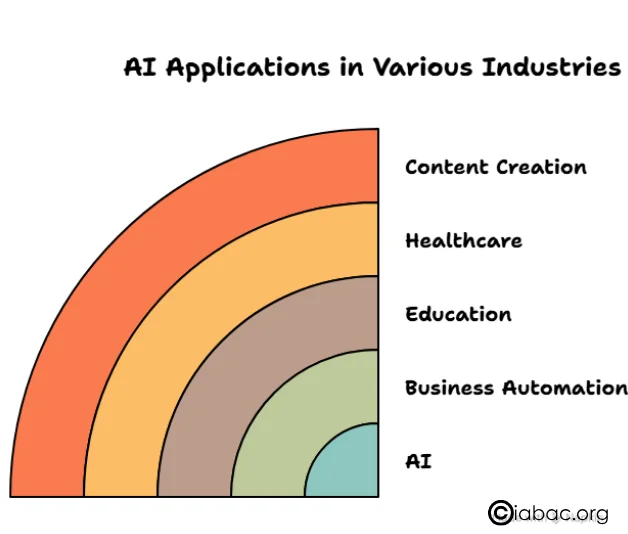
1) Content Creation and Marketing
AI-generated content is probably the most visible of all generative AI use cases. Marketing teams use LLM-based tools to draft blog posts, ad copy, and social captions, then have a human editor refine tone, accuracy, and brand voice before publishing.
Tools like Adobe Firefly and Canva's AI features extend this into visuals generating product mockups, social graphics, and design variations in minutes instead of days. Retailers use this to test dozens of ad creative versions without commissioning a new photoshoot for each one.
2) Software Development
AI coding assistants like GitHub Copilot are now standard tools in many development teams, suggesting code completions, writing boilerplate, and explaining unfamiliar code. This is one of the clearest business applications of generative AI because the output code is itself testable and verifiable.
Beyond autocomplete, generative AI in software development now extends to:
- Automated test-case generation
- Code documentation
- Translating legacy code from one programming language to another
These were tasks that used to consume entire sprints of engineering time.
3) Healthcare and Medical Research
In healthcare, generative AI applications focus heavily on accelerating research rather than autonomous decision-making. Pharmaceutical companies use generative models to propose candidate molecular structures, narrowing years of trial-and-error chemistry into a shorter shortlist worth testing in the lab work that companies like Insilco Medicine and Pfizer have both publicized.
On the clinical side, AI-powered automation helps draft clinical documentation and summarize patient records, freeing physicians from administrative work.
4) Education and Personalized Learning
EdTech platforms have leaned heavily into generative AI for personalized learning. Tools such as Khan Academy's Khanmigo and Duolingo Max use LLMs as on-demand tutors — explaining a wrong answer a different way, generating practice questions on the fly, or simulating a conversation partner for language practice.
This matters in real-world education because it solves a problem human teachers can't always solve at scale: giving every student instant, individualized feedback instead of waiting for the next class session.
5) Business Automation and Productivity
Customer service is one of the highest-volume business applications of generative AI. AI chatbots and virtual agents built on LLMs now handle a meaningful share of tier-one support tickets, summarizing customer history and drafting responses for human agents to approve.
In back-office work, generative AI shows up in:
- Automatically summarizing meetings
- Drafting first-pass contracts
- Generating reports from raw data
These are AI-powered automations that don't eliminate jobs so much as eliminate their most repetitive parts.
6) Synthetic Data and Model Training
Not every application of Generative AI is visible to the end user. Generative models are widely used to create synthetic data artificial but statistically realistic datasets to train other AI systems when real data is scarce, sensitive, or imbalanced.
- Banks use synthetic transaction data to train fraud-detection models without exposing real customer records.
- Autonomous vehicle companies generate synthetic driving scenarios, including rare, dangerous edge cases that would be too risky or rare to collect from real-world driving.
7) Audio, Video, and Creative Media
Generative AI now extends well past text and images. Voice-generation tools produce realistic voiceovers and dubbing, while AI video platforms generate or edit short clips directly from text prompts.
Game studios use generative AI to rapidly prototype character voices, concept art, and level layouts — work that used to require entire specialist teams just to produce a first draft.
A Step-by-Step Roadmap to Learning Generative AI
Reading about applications of Generative AI is useful, but turning that into a real skill set takes a plan. Here's a sequence that works whether you're starting from a business background or a technical one.
- Build foundational AI/ML literacy: Learn what a model, training data, and inference actually mean before learning prompt tricks. The fundamentals are easy to learn well and hard to fake in an interview.
- Understand how LLMs and diffusion models work conceptually: You don't need to derive the math, but you should be able to explain why an LLM can 'hallucinate' or why an image model needs a detailed prompt.
- Practice prompt engineering on real tasks: Take something from your actual job drafting a report, summarizing a document and iterate on prompts until the output is genuinely useful.
- Build one small project end to end: Connect to an API (OpenAI, Gemini, or similar), build a simple automation even a script that summarizes daily emails and ship it.
- Learn responsible AI practices: Understand bias, hallucination risk, data privacy, and when human review is non-negotiable. This is what separates someone who uses AI carelessly from someone employers trust.
- Validate your skills with a recognized certification: This signals to employers that your knowledge isn't just self-taught and unverified.
- Apply it to your actual work: The fastest way to retain everything above is to find one real workflow at your job and rebuild it using generative AI tools.
Generative AI Certifications Worth Considering
Certifications won't replace hands-on practice, but they give your skills a verifiable, recognized form which matters when you're changing roles or industries.
If you only pursue one certification from this list, the Certified Generative AI Expert program by IABAC is the most directly relevant choice. It's built specifically around the practical use of generative AI across business, technology, and creative domains.
IABAC Certified Generative AI Expert — Curriculum Overview
- Generative AI fundamentals
- Large Language Models (LLMs)
- Prompt engineering techniques
- AI-powered content generation
- Text, image, and multimedia AI applications
- Generative AI tools and platforms
- Real-world implementation strategies
- Responsible AI practices
Certification Table
Conclusion: From Theory to Practice
The applications of Generative AI covered here content creation, software development, healthcare, education, business automation, synthetic data, and creative media all share the same underlying pattern: a model trained on massive data, generating new output that fits learned patterns.
What separates professionals who benefit from this shift from those who get left behind isn't access to the tools; most of them are free or cheap. It's understanding where generative AI use cases create real value, where they fall short, and how to apply that judgment to your own work.
Whether you build that judgment through hands-on projects, a structured certification like IABAC's Certified Generative AI Expert program, or both, the goal is the same: move from watching Generative AI happen to actively using it.