Sign up with Google
 Sign in with Zoho
Introduction
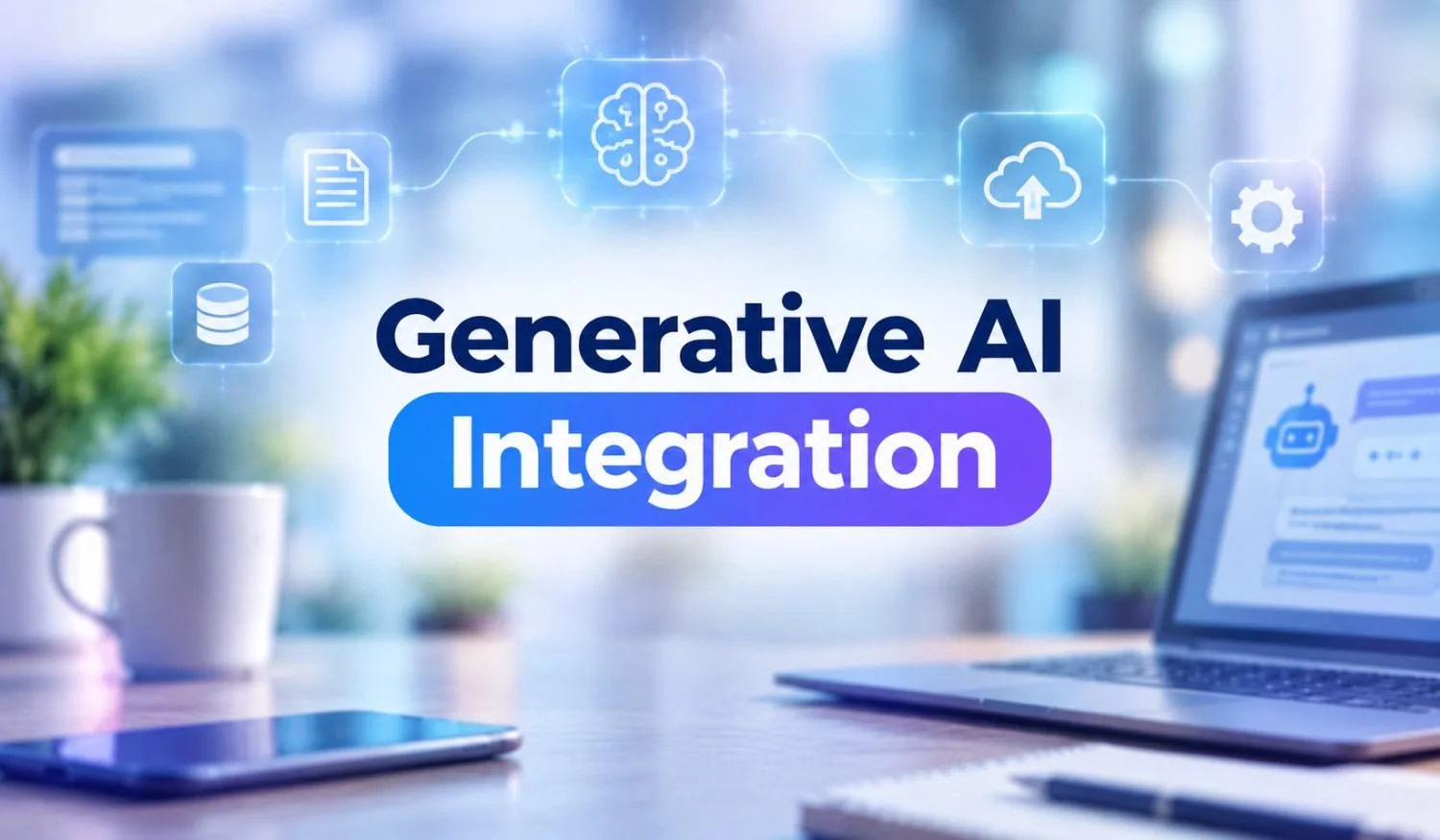
Generative AI is no longer just something people experiment with through standalone chatbots. Businesses are finding practical ways to use it for customer support, content creation, software development, data analysis, and everyday operations.
But there is an important difference between simply using an AI tool and actually making AI part of a business process. A company may have a powerful AI model available, but if that model cannot work with its existing applications or business data, its usefulness can be limited.
This is where Generative AI Integration comes into the picture. It allows businesses to connect generative AI capabilities with the tools and systems they already use. Instead of replacing existing technology, companies can add intelligent features to their current workflows and gradually expand their use of AI.
What Is Generative AI Integration?
Generative AI integration means connecting generative AI models with existing business applications, databases, platforms, and workflows.
Think of a customer support application as an example. Instead of asking employees to manually search through product documents every time a customer asks a question, an integrated AI assistant can find relevant information and generate a response.
The same idea can be applied to many other areas. A software development platform can use AI to assist developers with code, while an eCommerce application can use it to generate product descriptions or answer customer questions.
The main goal is to make AI useful within an existing workflow rather than keeping it as a separate tool.
Why Is Generative AI Integration Important?
Most businesses already depend on several systems for sales, customer service, marketing, operations, and communication. Connecting AI with these systems can make existing processes more efficient without requiring a complete technology overhaul.
Some of the potential benefits include:
- Automating repetitive tasks
- Helping employees find information faster
- Improving customer response times
- Creating more personalized experiences
- Supporting content and software development
- Reducing manual work
- Adding intelligent features to existing applications
The real value comes from finding the right places to use AI. Not every business process needs generative AI, so identifying practical use cases should come before implementation.
How Does Generative AI Integration Work?
There is no single integration process that works for every business. However, most projects follow a few common steps.
1. Start With a Clear Business Problem
Before choosing an AI model, identify what you actually want to improve.
For example, a company may want to reduce the time employees spend answering repetitive questions. Another business may want to automate product descriptions or help developers write routine code.
Starting with a specific problem makes it easier to determine whether AI is the right solution and how success should be measured.
2. Choose the Right AI Model
The most powerful model is not automatically the best option for every application.
Businesses should consider the type of task, expected response quality, processing speed, operating costs, security requirements, and scalability when selecting a model.
For a simple task, a smaller and faster model may be enough. More complex applications may require a more capable model.
3. Connect Relevant Business Data
Generative AI becomes much more useful when it can access reliable information related to the task.
Depending on the application, this could include product details, company documents, customer information, internal knowledge bases, or databases.
However, data access needs to be carefully managed. Sensitive information should only be available to authorized users and systems.
4. Connect AI With Existing Applications
APIs make it possible to connect AI models with websites, mobile apps, CRM systems, enterprise software, and other digital platforms.
For example, an AI assistant can be integrated into a company's customer service platform so employees can receive suggested responses without switching between different applications.
This makes the AI feature feel like a natural part of the workflow rather than another tool employees have to learn.
5. Test Before Going Live
AI systems can behave differently depending on the prompt, data, and situation. Testing should therefore cover a variety of realistic scenarios.
Businesses can evaluate response accuracy, speed, security, cost, and how well the AI handles unexpected questions.
After launch, regular monitoring is important because both business requirements and user behavior can change.
Common Applications of Generative AI Integration
Generative AI can be integrated into many business functions.
Customer Support
AI assistants can answer frequently asked questions, summarize customer conversations, and help support agents find relevant information. More complicated cases can still be handed over to human representatives.
Content Creation
Marketing teams can use AI to create product descriptions, email drafts, social media content, summaries, and other materials. With the right guidelines, businesses can also maintain a consistent brand voice.
Software Development
Developers can use generative AI for code suggestions, documentation, debugging, test creation, and explaining unfamiliar code. Integrating these capabilities into development environments can make them easier to use as part of the normal development process.
Enterprise Knowledge Management
Important business information is often scattered across documents, databases, and internal platforms. Generative AI can make this information easier to access by allowing employees to ask questions using natural language.
Personalized User Experiences
AI can use relevant customer or product information to create more personalized recommendations, messages, and interactions. This can help businesses make digital experiences feel more relevant to individual users.
Challenges of Generative AI Integration
Generative AI integration also comes with challenges that businesses should consider before implementation.
Data security is one of the biggest concerns. AI applications may need access to customer or business information, so organizations need appropriate permissions, security controls, and data-handling practices.
Accuracy is another concern. AI models can sometimes generate incorrect information with confidence. Applications that depend on reliable answers may therefore require validation, monitoring, or human review.
There can also be technical integration challenges, particularly when businesses need to connect AI with older systems or several different platforms.
Finally, companies need to account for ongoing costs related to model usage, infrastructure, monitoring, maintenance, and future improvements.
Best Practices for Generative AI Integration
A successful AI integration starts with a clear objective rather than the technology itself.
Businesses should choose a specific use case, define measurable goals, and use reliable data. Security should be considered from the beginning instead of being added later.
It is also useful to start small. A company can test AI with one workflow, measure the results, identify problems, and then expand the solution once the approach has been proven.
Human oversight should remain part of the process when AI outputs can affect customers, business decisions, or other important outcomes.
Why Choose Moon Technolabs?
Moon Technolabs has experience across mobile app development, web applications, enterprise software, AI/ML, IoT, cloud solutions, blockchain, and other modern technologies.
This broad technical experience can be useful when businesses want to introduce generative AI into an application that already has an existing technology stack. Rather than treating AI as a standalone feature, the integration can be planned around the application's users, data, workflows, and long-term requirements.
Moon Technolabs works on customized software and AI-powered solutions for different business needs. Its experience across mobile, web, and enterprise platforms can support organizations looking to add intelligent capabilities while keeping scalability and usability in mind.
Conclusion
Generative AI integration gives businesses a practical way to bring AI into the systems and workflows they already depend on. From customer support and content creation to software development and internal knowledge management, AI can take on many useful roles.
However, successful integration is not simply about connecting an AI model to an application. Businesses need to choose the right use case, work with reliable data, consider security, select an appropriate model, and continuously evaluate the results.
Starting with a focused use case and expanding gradually can make the transition easier. With the right strategy, generative AI can become a useful part of everyday business operations rather than just another technology experiment.

.webp)