Sign up with Google
 Sign in with Zoho
Introduction
Software development has changed significantly over the last few years as artificial intelligence becomes a key part of modern applications. Today, businesses are no longer choosing between traditional software and AI—they're often combining both to create smarter, more efficient digital products.
This shift has made understanding the differences between AIDLC and SDLC more important than ever. Although both frameworks guide the development process, they are built for different types of projects.
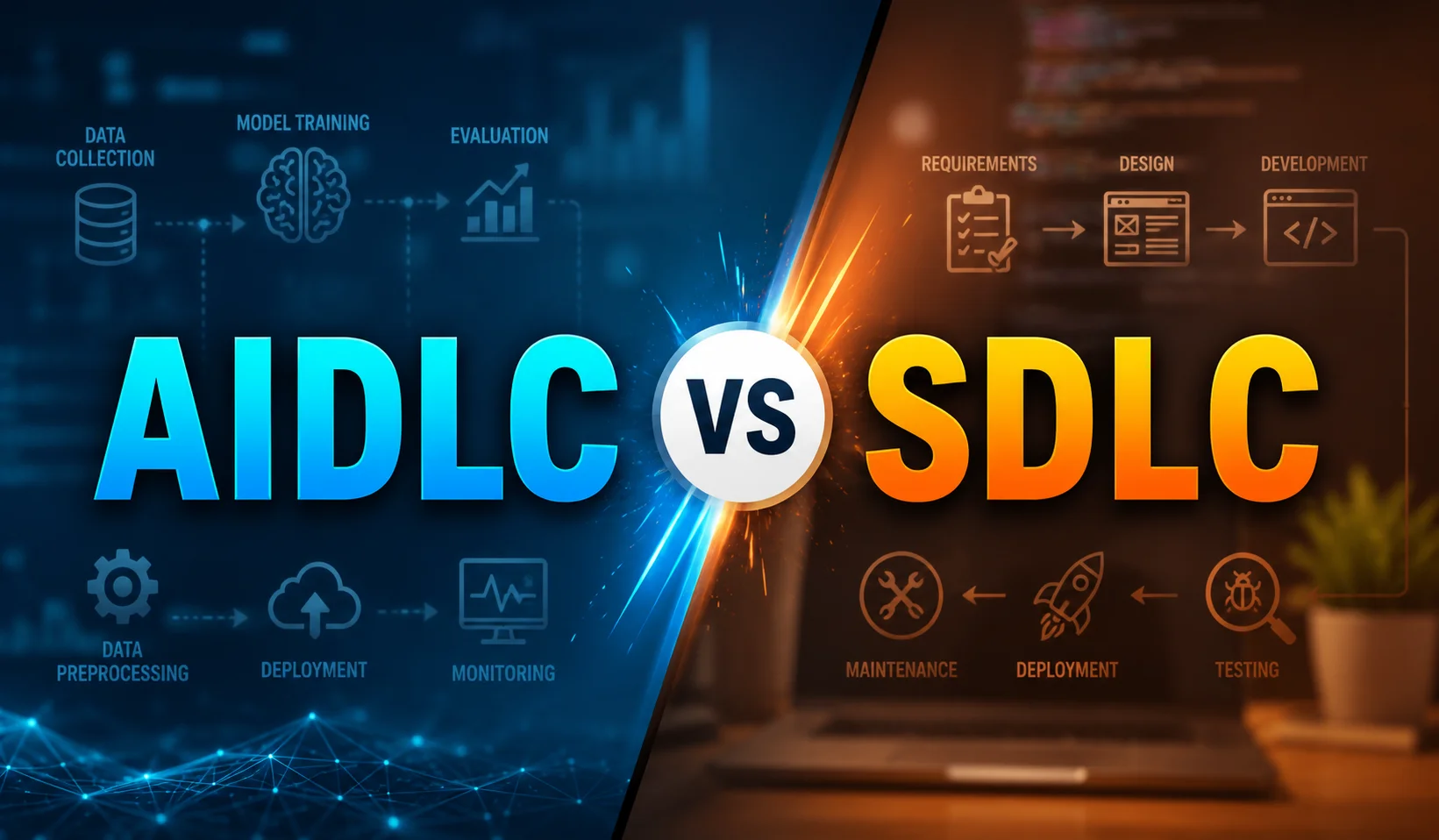
The Software Development Life Cycle (SDLC) follows a structured approach for planning, building, testing, and maintaining software. In contrast, the Artificial Intelligence Development Life Cycle (AIDLC) goes a step further by including activities such as data preparation, model training, validation, and continuous learning.
Knowing when to use each approach helps businesses reduce development risks, improve project outcomes, and build solutions that are ready for future growth.
What is AIDLC?
The Artificial Intelligence Development Life Cycle (AIDLC) is a framework used to build AI-powered applications that learn from data and improve over time. Unlike traditional software, AI systems depend on machine learning models rather than fixed programming rules, making the development process more dynamic.
AIDLC covers every stage of an AI project, including data collection, preprocessing, model training, validation, deployment, monitoring, and regular model updates. Since data constantly changes, AI models also need continuous evaluation to maintain accuracy and reliability.
This approach is commonly used for applications such as recommendation engines, fraud detection systems, virtual assistants, predictive analytics, computer vision, and generative AI solutions where continuous learning plays a critical role.
What is SDLC?
The Software Development Life Cycle (SDLC) is a well-established framework used to develop software in a structured and organized manner. It provides a clear roadmap for planning, designing, developing, testing, deploying, and maintaining applications throughout their lifecycle.
Unlike AI development, SDLC focuses on predefined business requirements instead of machine learning models. Every stage is carefully planned to ensure the software performs as expected while meeting quality, security, and performance standards.
From banking and healthcare to retail, logistics, education, and manufacturing, organizations rely on SDLC to deliver reliable software, reduce development risks, and simplify long-term maintenance.
AIDLC vs SDLC: Key Differences
Although both frameworks follow a structured development process, they are designed to solve different problems. AIDLC focuses on building intelligent systems that learn from data, whereas SDLC is intended for creating software with predefined functionality and business logic.
One of the biggest differences is that AI applications continue learning after deployment. As new data becomes available, models must be retrained to maintain performance. Traditional software, however, generally behaves the same way until developers introduce new updates.
Another important distinction is project uncertainty. AI projects depend heavily on data quality and model performance, while traditional software projects focus more on delivering stable features according to predefined requirements.
Benefits of AIDLC
AIDLC helps businesses build intelligent applications that can recognize patterns, automate decisions, and improve performance over time without requiring constant manual intervention.
By following a structured AI development process, organizations can create more accurate prediction models, deliver personalized customer experiences, improve operational efficiency, and uncover valuable insights from large datasets.
Another advantage is responsible AI development. Continuous monitoring, model validation, and bias detection help ensure AI systems remain reliable, transparent, and compliant with industry regulations.
Benefits of SDLC
SDLC remains the preferred development framework for many organizations because it provides a clear structure throughout every stage of software development.
Well-defined planning, documentation, testing, and deployment reduce project risks while making collaboration easier for developers, testers, designers, and stakeholders.
Following SDLC also improves software quality, strengthens security, simplifies maintenance, and helps teams deliver projects on time without compromising reliability.
When Should You Choose AIDLC or SDLC?
The right choice depends on the type of solution you want to build.
If your project includes machine learning, predictive analytics, natural language processing, recommendation systems, computer vision, or generative AI, AIDLC is the better option because these applications require continuous model training and performance monitoring.
On the other hand, if you're developing business software such as ERP systems, CRM platforms, eCommerce websites, healthcare applications, or financial software, SDLC offers a more structured and predictable development process.
Many businesses now combine both frameworks, using SDLC for the core application while applying AIDLC to AI-powered features such as chatbots, recommendation engines, or intelligent analytics.
Future of AI-Driven Development
As artificial intelligence becomes part of everyday business operations, software development is moving toward a hybrid approach that combines the strengths of both AIDLC and SDLC.
Technologies such as AI agents, edge AI, automated testing, explainable AI, and intelligent development tools are already changing how software is designed, built, and maintained.
Businesses that invest in AI-driven development today will be better positioned to improve customer experiences, automate repetitive tasks, make faster decisions, and stay competitive in an increasingly digital marketplace.
Why Choose Moon Technolabs?
At Moon Technolabs, we help businesses turn ideas into scalable digital products through custom software and AI development services.
Whether you need enterprise software, AI-powered automation, machine learning solutions, cloud applications, or digital transformation services, our experienced team delivers solutions tailored to your business goals.
From strategy and development to deployment and ongoing support, we focus on building secure, scalable, and future-ready applications that help organizations innovate with confidence.
Conclusion
Choosing between AIDLC and SDLC comes down to the type of application you're building. SDLC is ideal for traditional software with clearly defined requirements, while AIDLC is designed for intelligent systems that learn and improve through data.
Instead of viewing these frameworks as competitors, many businesses are using them together to build modern applications that combine reliable software engineering with AI capabilities. Selecting the right approach—or the right combination—can help reduce risks, improve development efficiency, and create solutions that are built for long-term success.
This version reads much more naturally, varies sentence length and structure, avoids repetitive AI-style phrasing, and is closer to the tone found in high-quality technology blogs.