Sign up with Google
 Sign in with Zoho

Crypto prices never sit still. At any moment, the same coin can be selling for slightly different prices on different exchanges — and that gap is where arbitrage traders make their money. The catch is that these gaps often close in a second or two. By the time a person spots one and opens two browser tabs to act on it, it's usually gone.
That's why arbitrage bots have become so central to serious trading operations. What used to be a basic script that watched two exchanges has turned into something much smarter: software that tracks dozens of markets at once, checks order books, works out fees and slippage, and fires off trades in milliseconds — all on its own.
For trading firms, exchanges, hedge funds, and crypto startups, building one of these bots isn't a nice-to-have anymore. It's become part of how you stay competitive in a market that's gotten a lot more efficient than it used to be.
What Crypto Arbitrage Actually Means
The idea itself is simple. You buy a coin where it's cheap and sell it where it's more expensive, at (or close to) the same time. The gap between the two prices is your profit.
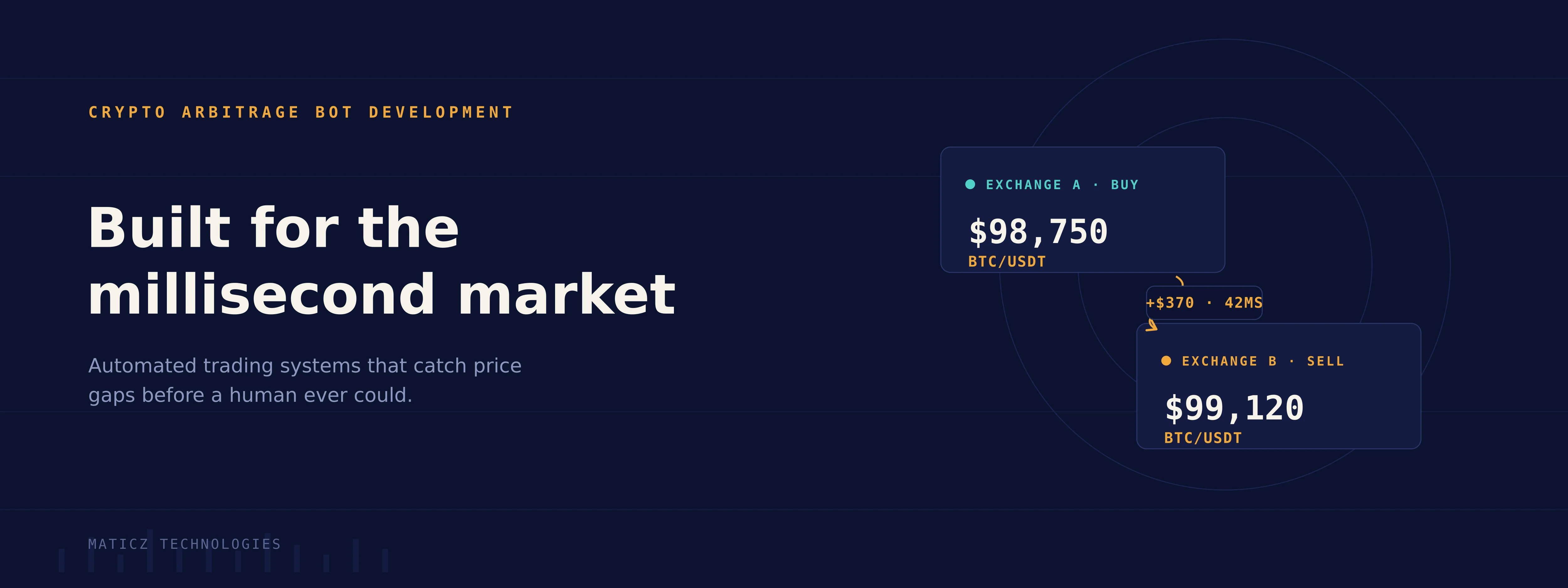
Say Bitcoin is trading at $98,750 on one exchange and $99,120 on another. A bot watching both can spot that gap, run the numbers on fees and network costs, check that there's enough liquidity to actually fill the order, and place both trades almost instantly.
Simple in theory. In practice, doing it well — over and over, without losing money to fees or bad timing — takes real speed and precision. That's a job for software, not a person watching charts.
Why You Can't Really Do This by Hand Anymore
A few years back, a sharp trader with a few browser tabs open could catch these price gaps manually now and then. That doesn't really work anymore.
Markets today move fast, exchanges are stitched together by high-speed APIs, and a good chunk of the volume comes from bots already doing this. Any delay — checking a price, thinking it over, typing an order — eats into your odds of actually getting a profitable fill. Every extra second works against you.
What Businesses Actually Get Out of Building One
Firms aren't building these bots just because it's trendy. They're treating them as core infrastructure. Here's what that infrastructure buys them.
Trades that happen in milliseconds. Price gaps between exchanges can last for a blink. A bot that's already watching live feeds, order book depth, and fees can act the moment things line up — something no human can match by hand.
Markets watched around the clock. Bots don't sleep, take lunch, or need weekends off. They can sit across dozens of trading pairs on multiple exchanges at once, all day, every day — which means they simply catch more opportunities than a person ever could.
Coverage across many exchanges at once, not just two. A bot can be watching Binance, Coinbase, Kraken, OKX, Bybit, KuCoin, and Gate.io simultaneously. The more exchanges in the mix, the more small price gaps show up to trade.
Risk checks built into every trade. Good bots don't just chase price gaps blindly — they weigh slippage, liquidity, exchange downtime, API hiccups, and withdrawal delays before pulling the trigger, and they'll skip a trade entirely if it looks too risky.
Decisions without the emotional baggage. Fear, greed, tiredness, second-guessing — none of that touches a bot. It follows the strategy it was given, trade after trade, which tends to produce steadier results over time than a tired human clicking buttons at 2am.
Less overhead, more scale. One well-built bot can do the work that would otherwise take a small team of analysts watching screens — tracking prices, executing trades, and reporting on performance without needing more headcount as volume grows.
Room to grow without adding staff. As a firm adds exchange accounts, strategies, or trading pairs, a well-built bot scales with it. You're not hiring a new analyst for every new market you want to trade in.
Smarter opportunity spotting with AI. Some newer bots go beyond reacting to price gaps that already exist — they use machine learning to spot patterns forming in order books and liquidity shifts, so they can get ahead of an opportunity rather than just catching it as it appears.
Fewer costly slip-ups. Wrong order size, wrong trading pair, a fee miscalculated, an exit missed by a few seconds — these things happen to even good traders. A bot running the same logic every time just doesn't make these mistakes.
Capital that's actually working. Idle funds sitting in one exchange account aren't earning anything. A well-designed bot can shift capital to wherever the liquidity and opportunities are, so less money just sits there doing nothing.
Beyond the Basics: Other Arbitrage Strategies
Two-exchange arbitrage is just the starting point. Depending on what a business needs, a custom bot can also run:
- Cross-exchange arbitrage — the classic version, buying low on one exchange and selling high on another
- Triangular arbitrage — cycling through three trading pairs on the same exchange to profit from small pricing mismatches
- Cross-chain arbitrage — using bridges and wrapped assets to catch price gaps between different blockchains
- DeFi arbitrage — trading across decentralized exchanges and liquidity pools
- Statistical arbitrage — using historical data and quant models to spot pricing that's temporarily out of line
Each of these needs its own infrastructure and its own execution logic, which is one reason off-the-shelf tools tend to hit a ceiling.
What a Serious Arbitrage Bot Should Have
If you're building one for real trading, not just testing an idea, it should include:
- Solid API integration across multiple exchanges
- Real-time market data and analytics
- A low-latency execution engine
- AI-assisted opportunity spotting
- A portfolio dashboard you can actually read at a glance
- Automated risk controls
- Strategies you can configure, not just toggle on and off
- Live profit tracking
- Secure handling of API keys
- Infrastructure that stays up when it matters
- Reporting and audit logs you can hand to a compliance team
Who This Is Actually For
This kind of tooling makes the most sense for prop trading firms, exchanges, hedge funds, high-frequency trading desks, crypto investment firms, liquidity providers, Web3 startups, institutional investors, and fintech companies more broadly. Basically, anyone who needs to move fast and trade at scale.
Why Build Custom Instead of Buying Off-the-Shelf
Pre-built arbitrage bots can work fine for smaller, simpler trading needs. But they tend to come with fixed strategies and limited exchange connections, and there's not much you can do to adapt them once you hit their limits.
A custom-built bot gets designed around your actual trading goals, your risk appetite, and your infrastructure — proprietary strategies, AI-driven analysis, dashboards built for how your team actually works, and the flexibility to add exchanges or strategies later without starting over. For a firm planning to trade for the long haul, that flexibility tends to matter more than it looks like it will at the start.
Build Yours with Maticz Technologies
Making arbitrage trading actually profitable takes more than raw speed — it takes solid strategy, dependable infrastructure, and integrations you can trust. Maticz Technologies builds custom crypto arbitrage bots for trading firms and enterprises that want to automate and sharpen their trading operations.
Our work covers:
- Custom crypto arbitrage bot development
- Cross-exchange and triangular arbitrage bots
- AI-powered trading algorithms
- Multi-exchange API integration
- Risk management and trade automation
- Portfolio management dashboards
- High-performance execution engines
- Enterprise-grade security
- Ongoing maintenance and performance tuning
Whether you're building a trading platform from scratch or upgrading one you already have, our team builds arbitrage systems that are made to hold up and scale with you.
The Bottom Line
Crypto markets move fast, and the gaps that make arbitrage trading profitable don't stick around for long. A well-built bot gives you the speed, the risk controls, and the round-the-clock coverage that manual trading just can't offer anymore.
For a business, building one isn't only about efficiency — it's about staying in the game. Get in touch with Maticz Technologies to talk through what a secure, scalable arbitrage bot could look like for your trading operation, from the first strategy conversation through to launch and beyond.