Sign up with Google
 Sign in with Zoho

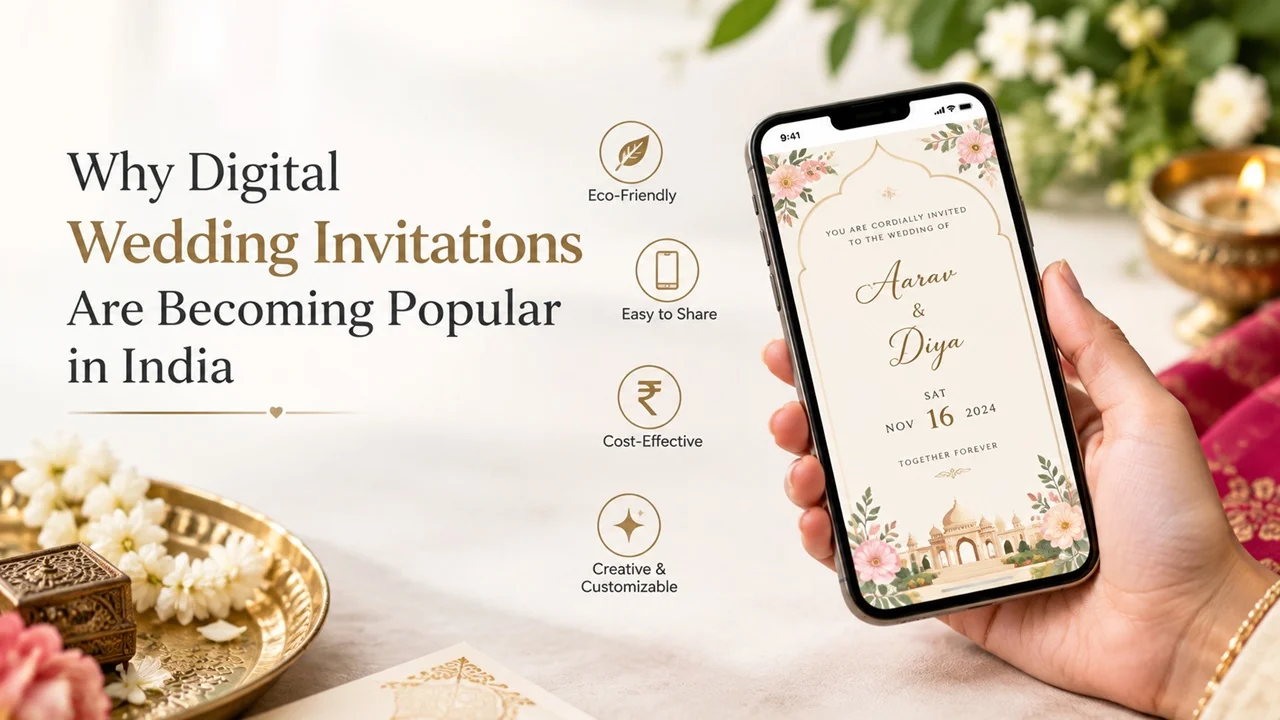
A few years ago, a wedding invitation meant a printed card, hand-delivered or couriered to relatives across the country.
Today, that same news often arrives as a minute-long video on WhatsApp music playing, the couple’s photos fading in and out, and all the details laid out clearly on screen. This shift didn’t happen overnight, but it’s happened fast. Here’s why digital invitation videos have become such a popular choice for Indian weddings.
They Travel Instantly, Across Any Distance
A printed card takes days to reach a relative abroad, sometimes longer during a busy wedding season. A video invitation reaches the same person in seconds over WhatsApp, regardless of whether they’re in the next city or another country entirely.
For families spread across multiple cities or countries increasingly common in India this alone makes video invitations far more practical than relying solely on printed cards.
They Feel More Personal Than a Static Card
A printed card, however beautifully designed, is still just an image. A video can include the couple’s actual photos, a bit of their story, and even a short voice message creating a sense of warmth and personal connection that’s difficult to capture in a static design.
For guests who can’t attend the wedding in person, this often makes them feel more genuinely included in the occasion than a card alone would.
They’re Easier to Update
Wedding plans change. A venue shifts, a date moves, or an event gets added. Updating and resending a video invitation costs nothing extra and takes minutes. Reprinting and redistributing physical cards, on the other hand, is expensive, slow, and often impractical once printing has already begun.
They Fit Naturally Into How People Already Communicate
Most invitations today are shared and viewed on WhatsApp, and video content works particularly well within that format media loads within the chat itself, and can be replayed easily whenever a guest wants to check details again.
Since video invitations are designed for this kind of sharing from the start, they tend to display more clearly and consistently than a printed card design that’s simply been photographed or scanned.
They Work Well for Multi-Event Weddings
Indian weddings often involve multiple events over several days a sangeet, a haldi, a mehendi, the wedding ceremony itself, and a reception. A video invitation can walk guests through the full schedule clearly, using text, music, and visuals together, in a way that’s easier to follow than trying to fit an entire itinerary onto a single printed card.
They Reduce Costs for Larger Guest Lists
For weddings with very large guest lists, printing, packaging, and distributing physical cards to everyone becomes a genuinely significant cost. A video invitation can be shared with hundreds of guests at effectively no additional cost per person, making it a practical option for reaching a wide guest list without the printing and courier expenses.
They Complement Rather Than Fully Replace Printed Cards
Despite their growing popularity, most couples aren’t abandoning printed invitations entirely. Many still send a physical card to close family and elders as a formal, traditional gesture, while using a video invitation for the wider guest list. This combination lets couples keep the tradition where it matters most, while using video for its practical reach.
Frequently Asked Questions
Q1. Are video wedding invitations acceptable for Indian weddings?
Yes, they’re widely accepted today, especially for reaching guests who live far away or for sharing details about multi-day wedding events. Many couples pair a video invitation with printed cards for close family as a more formal gesture.
Q2. What should a digital invitation video include?
At minimum, the couple’s names, the date, venue details, and a schedule of events if the wedding spans multiple days. Many videos also include photos of the couple and a short personal message to make it feel more warm and personal.
Q3. Why are video invitations more popular than static digital cards?
Video invitations tend to feel more personal and engaging, since they can include photos, music, and movement, and they display consistently across devices without the readability issues static images sometimes face once shared and reshared.
Q4. Do video invitations cost more than printed cards?
Costs vary depending on the complexity of the video, but for larger guest lists, video invitations are often significantly more cost-effective than printing and distributing physical cards to a similarly large number of guests.
Final Thought
Digital invitation videos have become popular in India not because printed cards have lost their meaning, but because video solves practical problems distance, cost, and multi-event scheduling that traditional cards simply weren’t built to handle. For many couples today, the best approach isn’t choosing one over the other, but using each where it fits best.