Sign up with Google
 Sign in with Zoho

The plant is built and commissioned. Nameplate capacity is demonstrated on good feedstock. Within months, margins tighten: oil costs more than the model allowed, quality varies, throughput falls, and by-product revenue does not arrive as planned.
Biodiesel plants struggle to remain profitable after installation when investment decisions treat the process unit as the project and feedstock as a purchased input at a steady price. In reality, feedstock cost, quality, logistics and by-product offtake dominate unit economics. Before committing capital, investors should understand the key requirements for setting up a biodiesel manufacturing plant in India and assess whether the planned feedstock supply, production capacity and operating costs support long-term profitability. If these factors are weakly planned, a technically successful plant can still fail commercially.
What Post-Installation Profitability Struggle Means
In practice it shows up as:
- Positive runs on trial oil, weak or negative margins on regular supply
- Frequent process upsets from high FFA, moisture or contaminants
- Capacity under-utilised because secure feedstock does not match plant size
- Higher chemical, energy and maintenance cost than the feasibility model
- Glycerin or other co-products hard to sell at assumed netbacks
- Working capital locked in inventory and quality holds
The equipment can make biodiesel. The business cannot sustain the spread between feedstock and product under real operating conditions.
Why the Gap Appears After Installation
Feasibility often uses indicative feedstock prices and a single quality grade. Plant capacity is chosen for scale efficiency. Location is chosen for land or incentives. Offtake for biodiesel is discussed more than offtake for glycerin. Detailed feedstock contracts, seasonal availability and quality variation are left to operations. After COD, the market and the collection radius teach what the model did not.
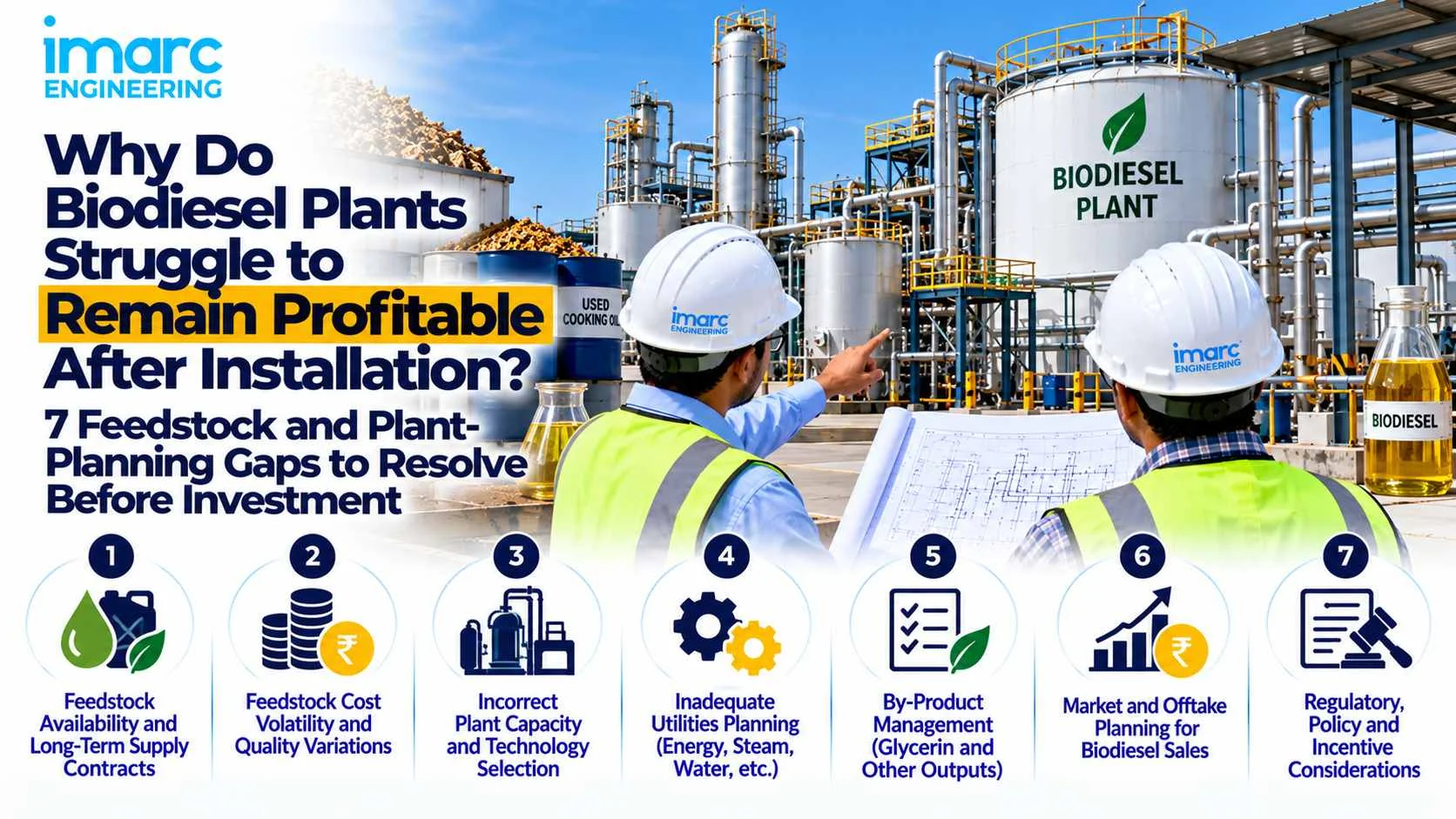
7 Feedstock and Plant-Planning Gaps to Resolve Before Investment
1. Feedstock cost modelled on optimistic or short-term prices
The investment case uses a favourable oil or fat price that does not hold through the cycle. Biodiesel margins are thin relative to feedstock; a sustained shift in feedstock cost can erase modelled profit even when the plant runs well.
2. Quality variation not designed into process and OpEx
Free fatty acids, moisture, gums and contaminants vary by source and season. A plant sized and instrumented for clean feedstock faces higher catalyst or chemical use, longer cycle times and more downtime when real supply is mixed. Quality is a planning input, not only a lab result.
3. Single-feedstock or narrow-supply dependence
The project assumes one stream—used cooking oil, a specific oilseed, or a single aggregator. When that stream tightens, the plant has no flexible process window or qualified alternatives. Dependency is a structural risk, not an operations inconvenience.
4. Capacity larger than the secure feedstock radius can support
Nameplate capacity looks attractive on capital cost per tonne. If reliable, in-spec feedstock within economic transport distance cannot fill the plant, utilisation drops and fixed costs per litre rise. Capacity must follow feedstock reality, not the other way around.
5. Logistics and collection cost understated
Door price of feedstock is not delivered cost. Aggregation, testing, transport, losses and rejection risk sit between the supplier and the reactor. Plants that ignore landed cost misstate both margin and working capital.
6. By-product offtake treated as residual income
Crude glycerin and other co-products need quality, storage and buyers. If netback is assumed high and logistics hard, the revenue line in the model does not appear in the bank account. By-product planning belongs in the investment case.
7. Location and utilities chosen without feedstock–product balance
A site may suit land or power but sit far from feedstock clusters or product markets. Extra freight on both sides compresses margin every month. Utility cost and reliability also move OpEx; they should be stressed before layout freeze.
How to Test Profitability Drivers Before Investment
- Build the margin on landed feedstock cost, not list priceInclude transport, losses, testing and quality discounts in the base case—not only in a downside note.
- Define acceptable feedstock specifications and process responseKnow how the plant handles higher FFA or moisture and what that does to chemicals, time and yield.
- Map secure supply volume within an economic radiusDistinguish theoretical availability from contracted or realistically collectable volume.
- Match nameplate capacity to supply confidencePrefer higher utilisation on a realistic capacity over chronic under-run on an oversized plant.
- Qualify at least one alternative feedstock pathwayTechnical flexibility and commercial qualification reduce single-source shock.
- Price by-product netbacks with logistics and qualityStorage, transport and buyer specs should be explicit before they are counted as income.
- Locate the plant on a feedstock–product logistics logicTest freight both inbound and outbound under realistic dispatch patterns.
- Stress the model for feedstock price and quality swingsIf only the base case works, the project is not robust enough for investment.
Practical Scenarios
Scenario A: Trial success, commercial stressCommissioning uses consistent, in-spec oil. Regular supply is mixed quality. Chemical consumption and rework rise; the feasibility OpEx no longer applies.
Scenario B: Oversized relative to collectionCapacity was set for future growth. Secure feedstock fills only part of the plant. Fixed costs and debt service weigh on every litre produced.
Scenario C: Glycerin left openBiodiesel offtake is contracted; glycerin is “to be sold.” Storage fills, netbacks disappoint, and working capital rises.
Scenario D: Feedstock-first planningLanded cost, quality bands, supply radius, capacity match and by-product path are closed before equipment orders. The plant is sized to a business that can run, not only to a process that can react.
Decision Point: Is the Investment a Plant—or a Feedstock Business with a Plant?
Ask:
- Does the base case use delivered, quality-adjusted feedstock cost?
- Can the process tolerate the quality range you will actually buy?
- Is secure volume enough to run the chosen capacity at healthy utilisation?
- Are alternative feedstocks technically and commercially real?
- Are by-product netbacks evidenced, not assumed?
- Does location minimise combined inbound and outbound logistics cost?
If the honest answers lean on hope, profitability risk is already embedded in the CapEx decision.
Pre-Investment Feedstock and Plant-Planning Checklist
- Landed feedstock cost model (price, freight, loss, quality)
- Feedstock specification range and process impact on OpEx
- Secure volume vs nameplate capacity and utilisation target
- Supply radius and aggregation risk assessed
- Alternative feedstock options identified
- By-product quality, storage and offtake path defined
- Site tested for feedstock and product logistics
- Margin stressed for price and quality variation
- Working capital for inventory and quality holds estimated
When to Resolve These Gaps
Address them:
- before final capacity selection
- before site freeze and major equipment commitments
- before financing based on a single feedstock price deck
- when shifting from one primary feedstock to mixed supply
- before counting by-product revenue in the investment return
After installation, the same gaps become chronic margin pressure rather than design choices.
How IMARC Engineering Can Help
IMARC Engineering supports project developers who need biodiesel and similar process investments tested against feedstock, logistics and plant definition—not only against equipment quotations. Feasibility and project-planning support can challenge capacity, location and operating assumptions before capital is sunk.
Relevant support is available through CapEx and OpEx planning support for industrial projects where feedstock and operating cost drivers determine whether the installed plant can sustain returns.
Talk to IMARC Engineering if a biodiesel project is approaching investment decision and you need feedstock landed cost, capacity match, quality impact and by-product assumptions stress-tested before plant planning is frozen
Conclusion
Biodiesel plants struggle to remain profitable after installation when feedstock cost and quality are optimistically modelled, supply is narrow, capacity exceeds secure volume, logistics are understated, by-products are assumed away and location ignores the feedstock–product balance. A working reactor does not guarantee a working margin.
Seven feedstock and plant-planning gaps explain most post-COD commercial stress that is blamed on “the market” alone. Teams that resolve them before investment size and site the plant for the business they can actually feed. Teams that install first spend the operating years repairing the model.
The practical takeaway is clear: treat feedstock security, quality and landed cost as design inputs equal to the process package—because after installation, they set the profit, not the nameplate.
Contact Us:
IMARC Engineering
Phone: +91-120-433-0800
Email: [email protected]
India: C-130, Sector 2, Noida, Uttar Pradesh 201301
LinkedIn: https://www.linkedin.com/showcase/imarc-engineering/


.webp)