Sign up with Google
 Sign in with Zoho

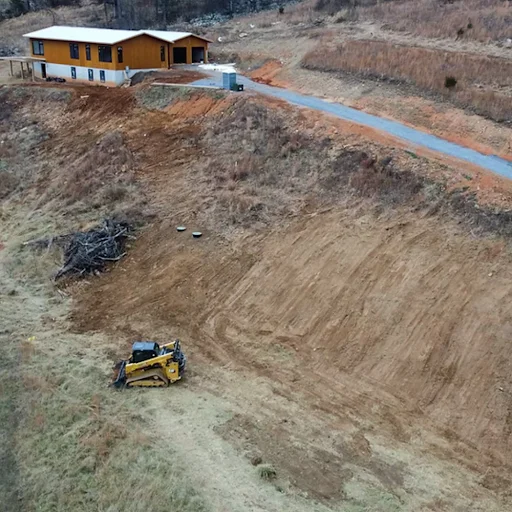
Nobody gets excited about dirt work. The exciting part is watching a house frame up, or a driveway finally get poured, the stuff you can actually see progress on week to week. But everything that comes after depends entirely on what happened before anybody showed up with lumber or concrete, and that's the part most people never think to ask about. Proper site preparation for construction is the whole foundation of the project, literally, and skipping steps here doesn't save time in the long run, it just moves the cost and the headache to later, when it's a lot more expensive to fix. Truth is, a slab that cracks eighteen months after pouring usually didn't fail because of bad concrete work. It failed because of something that happened in the ground months before the concrete truck ever showed up.
What Site Prep Actually Covers
People hear the phrase and think clearing land, maybe leveling a spot. That's part of it but it's a small slice. Real site prep covers rough grading to set the pad elevation correctly, cut and fill work to balance the site instead of hauling excess dirt on or off unnecessarily, compaction in controlled lifts so the ground can actually support what's going on top of it, and utility trenching for water, sewer and electric before any of the visible construction starts. Erosion control has to go in too, and stay in, through the whole process, because bare disturbed soil sitting exposed through a heavy storm can wash out a lot of progress fast. Skip or rush any one of these and the problem doesn't disappear, it just waits for the right moment to show up.
Compaction Is The Step Everyone Underestimates
Dirt that's been dumped and roughly leveled looks solid enough standing on it. It isn't, not really. Fill needs to go down in lifts, usually somewhere around eight to twelve inches at a time, with proper compaction on each lift before the next one goes down on top. Skip that, or rush it because the schedule's tight and everyone wants to move faster, and you end up with loose pockets hiding underneath what looks like a perfectly finished pad. The structure goes up, weight settles unevenly over the following year or two, and cracks start appearing in spots that have nothing to do with the framing crew's work or the concrete itself. The actual problem started in the ground, it just took time working its way up to where anybody could see it.
Grading And Drainage Have To Be Planned, Not Patched Later
Water goes to the lowest point on a property every single time, no exceptions to that rule. If the grading slopes toward the structure instead of away from it, that's a wet basement waiting to happen, and it might take two or three years of storms before it becomes obvious enough that somebody finally investigates. Positive fall away from foundations, swales cut properly so they actually move real volume in a real storm, culverts sized correctly for the area they're serving, all of it has to be part of the plan from the beginning rather than something patched in after construction's already finished and the problem's already showing up.
Utility Trenching Looks Simple And Rarely Is
Running water lines, sewer lines and electrical conduit sounds straightforward on paper, dig a trench, lay the line, backfill it, done. But depth matters for frost protection depending on the region, bedding material matters so the pipe isn't resting directly on rock or debris that'll crack it eventually, and backfill compaction matters so the trench doesn't settle and leave a visible dip in the yard a year down the road. Utility conflicts are a real risk too, hitting an existing line that wasn't marked correctly, which is exactly why calling for locates before digging isn't optional no matter how confident a crew feels about knowing what's already there.
Where Septic Planning Fits Into Site Prep
This is a piece that gets missed constantly, and it shouldn't be. The area needed for a septic drainfield has to factor into the earliest site planning, not get squeezed in as an afterthought once the building footprint's already locked in. Driving equipment or stockpiling fill on top of a planned drainfield area can damage the soil structure that the system depends on to function at all. Coordinating grading and pad placement around where the septic system actually needs to sit, instead of treating them as two completely separate projects sharing the same property by coincidence, avoids one of the more expensive mistakes to correct once concrete's already been poured.
Questions Worth Asking Before Signing Anything
Ask whether they pull an actual soil report or just make a visual call, because that difference matters more than it sounds like it should. Ask how they handle unexpected rock, since in this region that's a fairly common surprise, not a rare one. Ask about compaction testing specifically, whether they're verifying density at each lift or just eyeballing it and moving on. Ask who's responsible for erosion control once a county inspector shows up on site, because that responsibility gets fuzzy between contractors more often than people expect. And ask how familiar they actually are with local soil conditions, since a crew like an excavating company in Woodstock va that's worked this specific terrain repeatedly tends to catch problems that someone unfamiliar with the regional soil would probably miss.
The Equipment Isn't What Makes The Difference
Excavators, dozers, compactors, every company's got some version of the same equipment list. That's not where the real gap shows up between a good job and a mediocre one. It's in the judgment, an operator noticing subgrade feels soft and calling for undercut instead of just covering it and moving on to stay on schedule. Someone recognizing a slope needs to be laid back for stability instead of cut steep to save an hour. Trench collapses still happen every year, and nearly all of them were preventable with proper shoring and somebody competent actually watching the excavation the whole time. That's not a box checked for paperwork. That's the entire point.
Bottom Line
The short answer is that good site prep disappears once the project's finished, and bad site prep announces itself slowly, over months or years, in ways that are annoying and expensive to trace back to their actual cause. Proper site preparation for construction means honest soil assessment before the first shovel goes in, compaction that never gets rushed just to hit a schedule, and drainage planning that accounts for water's entire path across the property, not just the obvious low spot. Whether that's a straightforward driveway job or something bigger, working with a crew that treats this stage seriously, the kind an excavating company in Woodstock VA brings to jobs across the region, makes the difference between a project that holds up and one that starts causing problems the moment everyone thinks it's finished. Ask the hard questions early, and don't let anybody skip the boring steps just because nobody's going to see them once the grass grows back in.