Sign up with Google
 Sign in with Zoho

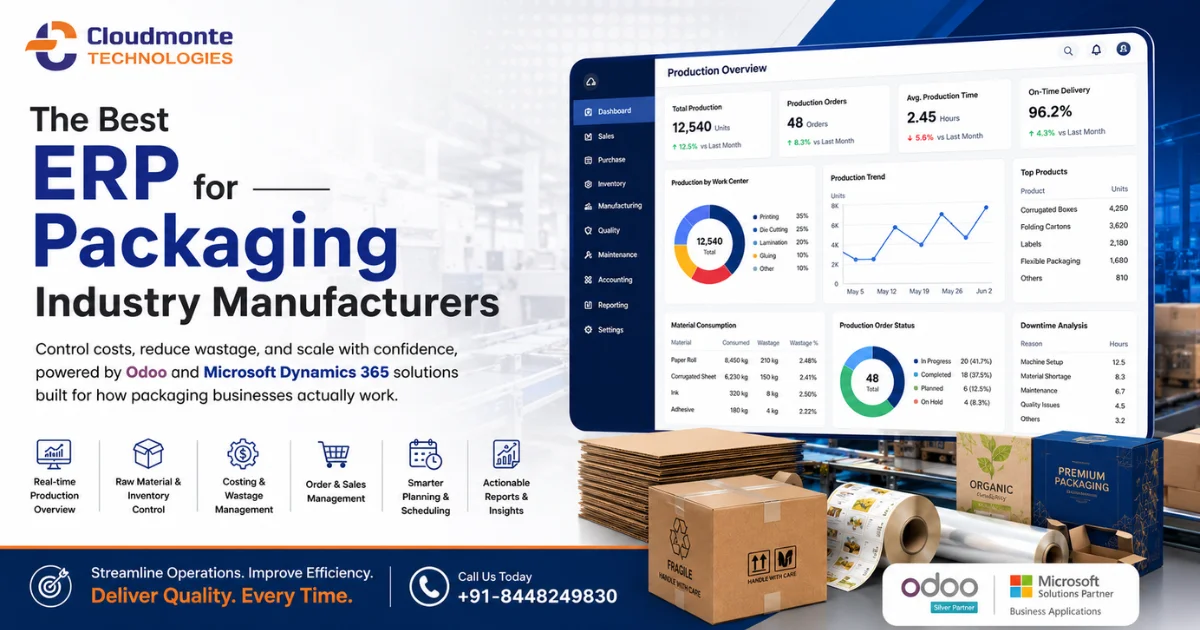
Walk into any packaging unit in India today, whether it is a corrugated box plant in Faridabad or a flexible packaging facility in Vapi, and you will hear the same complaint from the owner's cabin: "Our production runs fine, but our numbers never add up."
Raw material costs are climbing. Customers want shorter lead times. GST compliance leaves no room for error. And somewhere between the die-cutting machine and the accounts department, information keeps getting lost in spreadsheets, WhatsApp messages, and paper job cards.
This is the exact problem an ERP for the packaging industry is built to solve. Not by replacing your people, but by giving every department, from procurement to dispatch, one shared version of the truth.
In this guide, we will break down what the best ERP for packaging industry actually looks like in 2026, the mistakes most manufacturers make while choosing one, and how a well-implemented system pays for itself within months, not years.
Why This Topic Matters in 2026
Packaging is no longer a supporting industry. It is a business in its own right, growing on the back of e-commerce, FMCG, pharma, and export demand. India's packaging sector has consistently ranked among the fastest-growing manufacturing segments in the country, driven by rising consumption and stricter quality expectations from global buyers.
But growth brings complexity. A packaging manufacturer today juggles the following:
- Multiple raw material types (kraft paper, BOPP film, corrugated board, inks, adhesives)
- Custom job specifications that change with every customer order
- Thin margins that leave no room for material wastage
- Compliance requirements under GST, e-way bills, and export documentation
- Pressure to quote faster and deliver faster than competitors
Manual systems and generic accounting software simply cannot keep pace with this. A business still running on Tally plus Excel plus a separate production register is, in effect, running three different versions of reality. Decisions get delayed because nobody trusts the numbers.
An ERP for packaging industry brings procurement, production, inventory, quality, sales, and finance onto a single platform, so decisions are based on live data, not on what the production supervisor remembers from yesterday.
Current Industry Challenges Packaging Manufacturers Face
Before recommending any solution, it helps to name the problem clearly. Here is what we hear repeatedly from packaging business owners across India.
1. Inaccurate Costing Per Job
Packaging is largely a job-order business. Every customer wants a different size, GSM, print design, or lamination. Without an ERP, costing is often done on gut feel or outdated rate cards, which means some jobs are quietly loss-making without anyone noticing until quarter-end.
2. Raw Material Wastage
Board, film, and paper wastage during trimming, printing, and die-cutting is unavoidable to some extent, but it becomes a serious margin killer when it isn't tracked scientifically against standard consumption norms.
3. Disconnected Departments
Sales promises a delivery date without checking machine capacity. Production runs a job without checking if raw material has actually arrived. The accounts find out about a rate change only after the invoice is raised. Each department works in its own silo.
4. Poor Visibility Into Machine and Shift Efficiency
Most packaging units still track machine downtime and shift output on paper registers, which means OEE (Overall Equipment Effectiveness) is a guess, not a measured number.
5. Compliance Overload
GST returns, e-way bills, export documentation, and job-work challans (very common in the packaging trade) require accurate, real-time data. Manual reconciliation increases the risk of penalties and blocked input tax credit.
6. Inventory of Dies, Plates, and Cylinders
Packaging manufacturing depends heavily on tooling, printing plates, cylinders, and dies, which are customer-specific and expensive. Without a proper asset and inventory module, businesses lose track of tooling location, condition, and reorder needs.
These are not small operational irritants. Together, they quietly erode 8 to 15 percent of potential margin in a typical packaging business, based on what we consistently observe during process audits.
What Makes an ERP Truly Built for the Packaging Industry
A generic ERP built for trading or distribution will not solve these problems. The best ERP for packaging industry needs to be configured around how packaging is actually manufactured. Here is what genuinely matters.
1. Multi-Level Bill of Materials (BOM) and Routing
Packaging products, especially corrugated boxes, cartons, and flexible pouches, are built in stages: sheet, corrugation, printing, die-cutting, pasting, and packing. Your ERP must support multi-level BOMs with routing that mirrors your actual shop floor sequence, not a simplified version of it.
2. Job Costing With Real-Time Variance Tracking
Every job order should show planned cost versus actual cost, broken down by material, labor, and machine time, the moment the job is completed. This single feature alone changes how packaging businesses quote future work.
3. Batch and Lot Traceability
For food-grade, pharma, and export packaging, batch traceability is not optional. The system should trace which raw material batch, from which supplier, went into which finished goods batch, for which customer.
4. Scrap and Wastage Management
Standard wastage percentages should be built into the BOM, and any deviation should be flagged automatically. This turns wastage from an accepted cost of doing business into a controllable, measurable variable.
5. Quality Control Checkpoints
GSM variance, bursting strength, print registration, and moisture content need to be logged at defined stages, not just at final dispatch. This protects you from costly customer rejections.
6. Integrated GST and E-Way Bill Compliance
Job-work challans, GST-compliant invoicing, and e-way bill generation should happen inside the ERP itself, not through a separate compliance tool that needs manual data re-entry.
7. Tooling and Die Inventory Management
Dies, cylinders, and plates should be tracked as trackable assets with location, usage history, and maintenance schedules linked to the customer and product they belong to.
8. Demand Forecasting and Production Planning
Seasonal demand, especially around festive and export cycles, should feed into a planning module that helps you schedule machines and procure raw material in advance rather than reactively.
9. Mobile Shop Floor Data Capture
Operators should be able to log production, downtime, and quality data from a tablet or handheld device on the shop floor itself, instead of a paper register that gets transcribed hours later.
10. CRM and Sales Order Integration
Sales teams need visibility into machine capacity and material availability before promising delivery dates to customers. This alone prevents a large share of customer escalations.
Comparing ERP Approaches for Packaging Manufacturers
Benefits of Implementing the Right ERP for Packaging Industry
The return on an ERP investment is rarely about one big win. It comes from dozens of small improvements compounding across the business.
- Accurate margins: You know which customers and products are actually profitable, not just which ones generate the most revenue.
- Reduced wastage: Real-time tracking against standard consumption norms typically brings material wastage down significantly within the first year.
- Faster quoting: Sales teams quote based on real historical costing data, not outdated rate cards, which shortens the sales cycle.
- On-time delivery: Production planning tied to actual machine and material availability reduces missed delivery commitments.
- Audit-ready compliance: GST returns, e-way bills, and job-work documentation are generated directly from transaction data, reducing the risk of notices and blocked credit.
- Better decision-making at the top: CEOs and CFOs get live dashboards instead of month-end reports that arrive too late to act on.
- Improved customer trust: Consistent quality checkpoints mean fewer rejections and stronger long-term relationships with brand owners and exporters.
Common Mistakes Packaging Businesses Make When Choosing an ERP
Even businesses that recognize the need for an ERP often go wrong at the selection or implementation stage.
- Choosing a generic ERP because it is cheaper upfront. The real cost shows up later in endless customization requests that generic systems cannot handle well.
- Ignoring shop floor input during selection. Machine operators and production supervisors understand real workflow gaps better than most decision-makers realize.
- Underestimating data migration effort. Historical BOMs, customer rate cards, and inventory records need to be cleaned before migration, not after.
- Skipping proper user training. An ERP is only as good as the people entering data into it. Poor adoption on the shop floor defeats the entire investment.
- Treating ERP as an IT project instead of a business transformation. The most successful implementations are led by operations and finance, with IT as an enabler, not the other way around.
- Not planning for scale. Choosing a system that fits today's single-plant operation but cannot support a second facility or export compliance later.
Real Business Example: A Corrugated Box Manufacturer's Turnaround
Consider a mid-sized corrugated box manufacturer supplying to FMCG and pharma clients across North India, running two plants with a combined workforce of over 300 people.
Before implementing an ERP, this business relied on Tally for accounts, a separate production register maintained by hand, and Excel sheets for costing. Job costing was done at month-end, by which time loss-making orders had already been repeated multiple times for the same customer.
After moving to an ERP configured specifically for packaging operations, with multi-level BOMs, batch traceability, and real-time job costing, the business achieved measurable improvements within two quarters:
- Material wastage tracking exposed a specific machine line that was running nearly double the standard scrap rate, allowing targeted maintenance instead of blanket cost-cutting.
- Job-level costing revealed that a category of small-batch, high-customization orders was consistently unprofitable, leading to a pricing revision that improved overall margin.
- E-way bill and job-work challan generation moved from a manual, error-prone process to an automated one, cutting compliance-related delays significantly.
The lesson here is straightforward. The value of ERP for packaging companies does not come from the software alone. It comes from the visibility it creates into decisions that were previously being made blind.
Best Practices for Packaging Manufacturers Implementing ERP
- Start with a process audit, not a software demo. Understand your actual workflow gaps before evaluating vendors.
- Involve production supervisors and machine operators early. They will tell you where paper-based tracking is failing.
- Prioritize industry-specific modules over generic customization. A packaging-specific BOM and routing structure saves years of workarounds.
- Clean your master data before migration. Rate cards, BOMs, and customer records should be verified, not copied as-is.
- Roll out in phases. Start with inventory and production, then extend to CRM, quality, and advanced planning.
- Set measurable KPIs before go-live. Wastage percentage, on-time delivery rate, and job costing accuracy should be tracked before and after implementation to prove ROI.
- Choose a partner with packaging domain experience, not just generic ERP implementation experience.
Step-by-Step Implementation Guide
Step 1: Process Discovery and Gap Analysis
Map your current procurement, production, quality, and dispatch workflow end-to-end. Identify where data currently breaks down or gets duplicated.
Step 2: Define Requirements by Department
List specific needs from production, sales, accounts, and quality separately, then consolidate into a single requirement document.
Step 3: Select the Right ERP Platform and Partner
Evaluate platforms like Odoo and Microsoft Dynamics 365 specifically for their packaging industry capability, not just general ERP features. Choose an implementation partner with proven packaging sector experience.
Step 4: Master Data Preparation
Clean and structure BOMs, routing, customer rate cards, supplier records, and inventory data before migration begins.
Step 5: Configuration and Customisation
Configure multi-level BOMs, job costing rules, quality checkpoints, and compliance settings specific to your product lines.
Step 6: Pilot Run on One Product Line
Test the configured system on one production line or one plant before a full rollout, so issues are caught early and corrected.
Step 7: Training and Change Management
Train shop floor operators, supervisors, sales staff, and accounts teams separately, based on their specific role in the system.
Step 8: Go-Live and Stabilisation
Run parallel tracking for the first few weeks if needed, monitor data accuracy closely, and resolve configuration gaps quickly.
Step 9: Continuous Improvement
Review KPIs quarterly and extend the system to advanced modules like demand forecasting and business intelligence once the core system is stable.
Future Trends Shaping ERP for the Packaging Industry
- AI-driven demand forecasting: Predictive models that factor in seasonal FMCG and export cycles are becoming standard rather than a premium add-on.
- IoT-integrated machine monitoring: Direct machine data feeding into the ERP for real-time OEE tracking, reducing dependence on manual shift reporting.
- Sustainability and material traceability: Buyers, especially export clients, increasingly demand documented proof of recycled content and responsible sourcing, which ERP-driven traceability supports directly.
- Cloud-first deployment: More packaging manufacturers are moving away from on-premise servers toward cloud ERP for better uptime, security, and remote accessibility across multiple plants.
- Deeper CRM and e-commerce integration: As packaging manufacturers serve e-commerce brands directly, tighter integration between CRM, sales, and production planning is becoming a competitive necessity.
Why Businesses Choose Cloudmonte Technologies
Cloudmonte Technologies works as a Microsoft Dynamics 365 and Odoo Certified Partner, which means we are not selling a one-size-fits-all product. We configure ERP systems around how your packaging business actually runs on the shop floor.
Here is what sets our approach apart:
- Packaging industry domain knowledge: We understand corrugated box manufacturing, flexible packaging, and rigid packaging workflows, not just ERP theory.
- Certified expertise on both Odoo and Dynamics 365: We recommend the platform that genuinely fits your business size and complexity, rather than pushing a single product.
- End-to-end implementation: From process discovery to go-live and post-implementation support, our team stays involved through the entire journey.
- AI and business intelligence integration: Beyond core ERP, we help businesses layer in demand forecasting, dashboards, and automation that generic implementations often skip.
- Managed services support: Our relationship does not end at go-live. We provide ongoing support so your system evolves as your business scales.
For CEOs, CFOs, and operations leaders in the packaging sector, this means one dependable partner across ERP, CRM, cloud, and AI, instead of juggling multiple vendors who do not understand your industry.
Conclusion
The packaging industry in India is growing, but so is the complexity of running it profitably. The businesses that will lead this decade are not necessarily the ones with the biggest machines, but the ones with the clearest visibility into their costs, their capacity, and their customers.
The best ERP for packaging industry is not simply a piece of software. It is the operating system for a modern, data-driven packaging business, one that turns scattered information into confident decisions.
If you are still running your packaging business on disconnected spreadsheets, paper registers, and end-of-month guesswork, the cost of waiting is higher than the cost of switching.
Ready to see what a purpose-built ERP can do for your packaging business? Contact Cloudmonte Technologies today for a free consultation and a personalized ERP demo tailored to your production line.


.webp)