Sign up with Google
 Sign in with Zoho

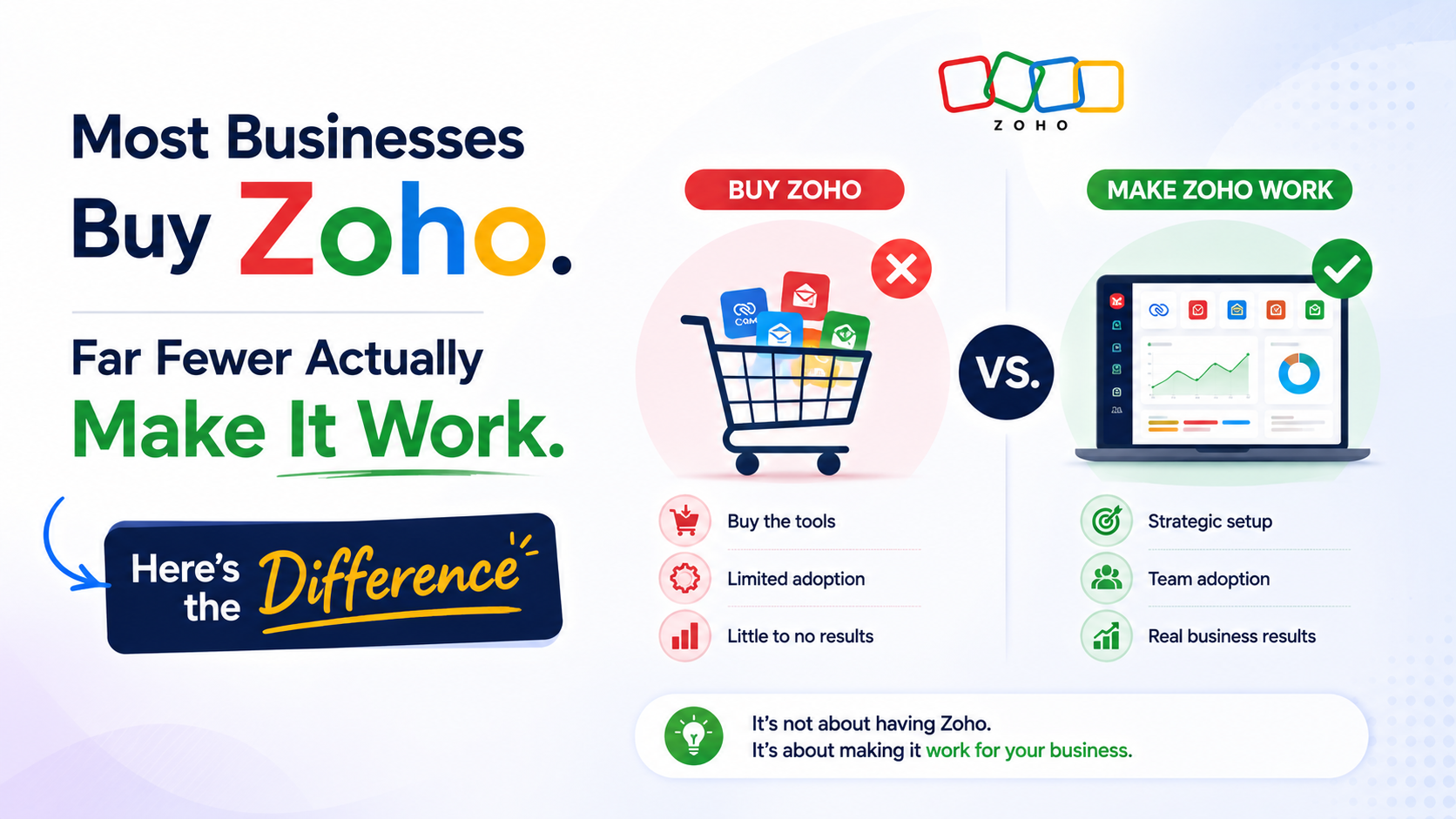
There is a pattern that plays out with remarkable consistency across businesses that invest in Zoho. The subscription is purchased with genuine ambition, a vision of streamlined sales pipelines, automated workflows, connected business data, and a team that spends less time on administration and more time on the work that actually drives growth. The implementation begins. The basics get configured. And then, somewhere between the initial setup and the realization of that vision, the gap appears.
The CRM gets used as a contact database. The automation sits untouched. The custom modules never get built. The integrations remain disconnected. And the subscription renews every year while the platform quietly delivers a fraction of what it is capable of.
This is not a Zoho problem. The platform is genuinely powerful. Zoho CRM commands an 8.4% share of the global CRM market and is used by over 250,000 businesses worldwide, with 60% of users reporting that their sales productivity increased directly as a result of its automation features. The CRM market itself is expected to reach $126.2 billion in 2026, growing at a CAGR of 12.4%, reflecting industry-wide recognition that CRM done properly is one of the highest-returning technology investments a business can make. The gap between what most businesses get and what the platform can deliver is exactly what expert Zoho CRM consulting services are designed to close.
Why Most Zoho Implementations Underdeliver
The barrier to getting started with Zoho is deliberately low. The interface is intuitive enough that a motivated team member can get the basics running within a few days. And that accessibility (one of Zoho's genuine strengths) is also the reason so many implementations plateau at the surface level.
Getting started is not the same as getting it right. The decisions that determine whether a Zoho implementation delivers its full commercial potential are not made in the interface; they are made before anyone opens the platform. How will the CRM data architecture map to the actual business process? Which workflows should be automated, in what sequence, and with what logic? How will Zoho integrate with the existing tools the business depends on, the accounting platform, the project management system, and the marketing automation stack? What does the reporting structure need to look like for leadership to make confident, data-driven decisions?
These are strategic and technical questions. Most businesses answer them informally, under time pressure, without the benefit of experience across multiple implementations. The result is a Zoho environment built around assumptions rather than architecture, one that works well enough in the short term and creates compounding inefficiencies as the business grows.
Professional Zoho CRM consulting services address this gap at the structural level, beginning with business process mapping before any configuration begins, designing an architecture that reflects how the business actually operates, and building a system that is scalable, maintainable, and genuinely used by the teams it was built for. Without that expertise, even the most capable platform stays stuck at the surface level.
Zoho CRM Implementation Services: Where Strategy Becomes System
The most important phase of any Zoho project is the one most frequently rushed: the discovery and architecture phase that precedes implementation. Most CRM implementations fail because they treat technology as the solution instead of understanding the business problem first, a reality that experienced Zoho CRM implementation services providers understand and build their entire methodology around.
A properly structured engagement begins with a detailed analysis of the business's current processes, data flows, team structures, and commercial objectives. It maps the customer journey from first contact to closed deal to post-sale relationship, identifying every touchpoint where the CRM should be capturing data, triggering actions, or surfacing insights. It evaluates the existing technology stack and designs integration points that eliminate data silos rather than adding to them.
Only after that foundation is laid does the technical configuration begin. And when it does, the output is fundamentally different from a self-directed implementation. Custom modules that reflect the business's actual sales process rather than a generic template. Workflow automation that handles the routine tasks (lead assignment, follow-up reminders, stage progression, internal notifications) that currently consume hours of manual effort every week. Dashboards and reporting that give leadership real visibility into pipeline health, team performance, and revenue forecasting without requiring a data analyst to interpret them.
The difference between a Zoho installation and a Zoho system is the difference between software that sits on the desktop and software that shapes how the business operates every day. It is precisely the difference that quality Zoho CRM consulting services are built to deliver.
Zoho Creator Services: Building What the Platform Doesn't Have Out of the Box
One of the most underutilized capabilities in the Zoho ecosystem is also one of its most powerful: Zoho Creator, the platform's low-code application development environment. While Zoho CRM handles sales and customer relationship management with exceptional depth, most businesses have operational requirements that fall outside what any standard CRM can address, such as field service workflows, client onboarding portals, asset management systems, compliance tracking tools, or industry-specific processes that have never been mapped to a generic platform feature.
Zoho Creator services allow businesses to build these custom applications within the Zoho ecosystem, using the same data infrastructure as the CRM and operating seamlessly alongside it. The commercial implication is significant: instead of maintaining a separate, disconnected tool for every operational need (with the data duplication, manual reconciliation, and visibility gaps), businesses can consolidate their operational stack around Zoho's unified platform, with custom applications built exactly to their specifications.
SMEs account for approximately 75% of the demand for Zoho consulting services, according to Verified Market Reports, reflecting the reality that growing businesses with specific operational needs benefit disproportionately from the flexibility that Zoho Creator delivers. A custom application built through this approach does not just solve a specific problem. It eliminates the category of workaround that, in its absence, consumes the time and attention of people who should be focused on higher-value work.
Zoho Projects Integrations: When the CRM and the Work Connect
Sales teams and delivery teams frequently operate in parallel universes. A deal is won in the CRM (with all its context, requirements, and client history captured in detail) and then handed off to a project team that starts from scratch in a separate system, often with nothing more than an email thread and a spreadsheet to go on. The information that was meticulously captured during the sales process disappears at the moment of handover. The project team builds from memory. And the client notices the gap.
Zoho Projects integrations close this gap by connecting the CRM directly to the project management environment, ensuring that the context of the sale travels seamlessly into the delivery process. When a deal is marked as won in Zoho CRM, a project is created in Zoho Projects with the relevant client data, contract details, and agreed deliverables already populated. Tasks are assigned based on pre-configured templates. Timelines are set. And the client relationship that the sales team spent weeks building continues without interruption into the delivery phase.
The operational impact extends in both directions. Project status data flowing back into the CRM gives account managers and customer success teams real-time visibility into delivery progress without chasing project managers for updates. Time tracking and milestone data inform invoicing workflows, reducing the manual reconciliation that currently sits between project completion and payment. And the historical project data that accumulates over time becomes a strategic asset, informing resource planning, pricing decisions, and the delivery estimates that the sales team makes in the next generation of client conversations.
What to Look for in a Zoho CRM Consulting Services Partner
The Zoho consulting service market was valued at $1.2 billion in 2024 and is growing at a CAGR of 9.5%, reflecting the scale of demand for expert Zoho implementation support across businesses of every size and sector. That market growth has produced a wide range of providers, and the quality difference between them is significant.
The right Zoho CRM consulting services partner brings three things that separate a transformative implementation from a disappointing one. The first is a strategy-first methodology, a structured discovery process that maps business requirements before touching any configuration, rather than jumping straight to the platform. The second is cross-product depth: genuine expertise not just in Zoho CRM but across the full Zoho ecosystem (Creator, Projects, Analytics, Campaigns, Desk, and Books) because the highest-value implementations are those that connect these products into a unified operational system rather than deploying them in isolation. The third is a track record of measurable outcomes: reduced manual processes, improved pipeline visibility, faster deal cycles, and higher user adoption, not just a list of features configured.
Businesses that use CRM software report a 61% increase in sales, according to HubSpot research cited by Verified Market Reports. But that figure reflects CRM used properly, with the right architecture, the right automation, and the right integration into how the business actually operates. It does not reflect CRM as a contact database with untouched workflows and disconnected data.
The platform is capable of transforming how a business operates. The Zoho CRM consulting services that unlock that transformation are the ones that begin with the business (understand its processes, its people, and its commercial objectives) and build the technology around it, not the other way around.