Sign up with Google
 Sign in with Zoho

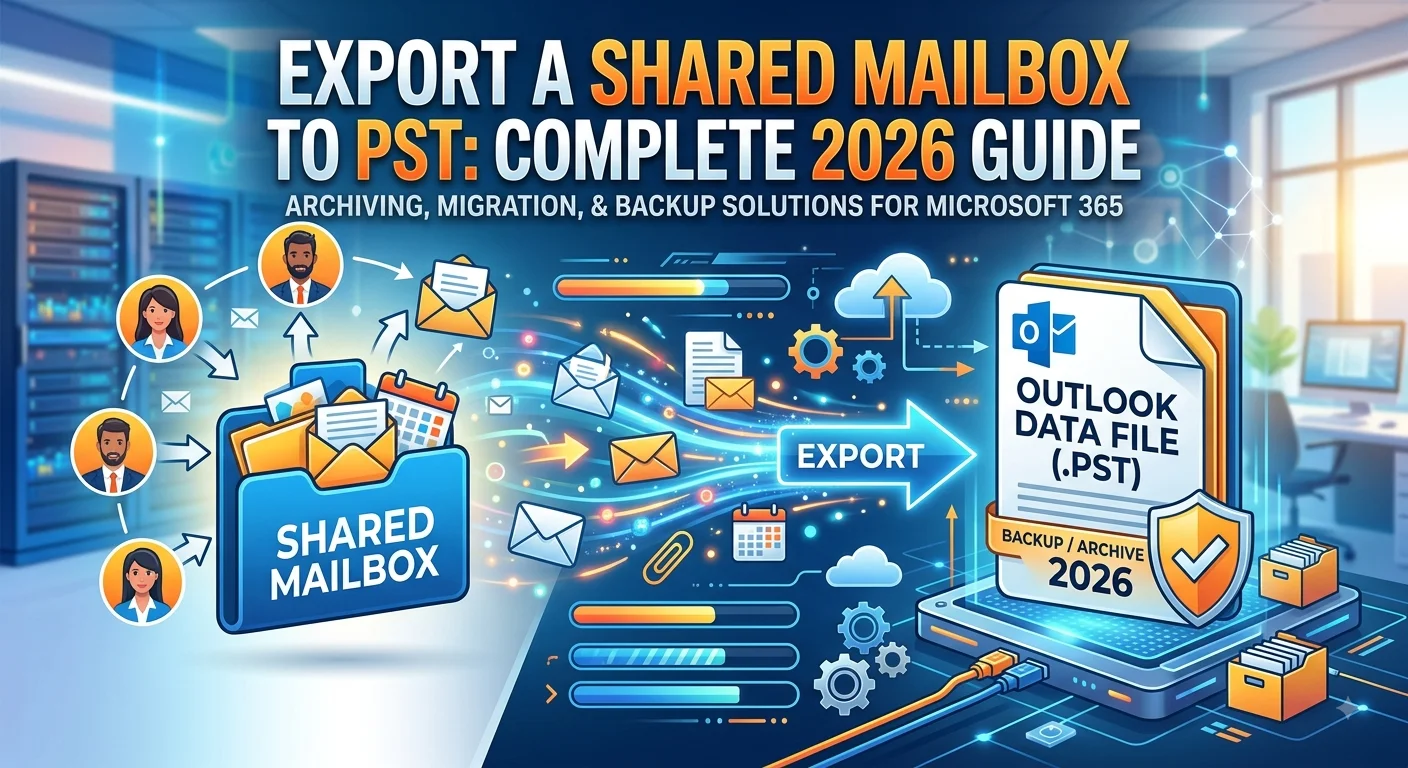
Organizations rely on shared mailboxes for team collaboration, customer support, and departmental communication. Over time, these mailboxes accumulate large volumes of emails, attachments, and records that need to be backed up, archived, or migrated. Converting a shared mailbox into a PST file is one of the most common ways businesses safeguard this data — whether for compliance, storage management, or moving to a new environment.
This guide walks through both manual and automated methods to export a shared mailbox to PST, along with their pros, cons, and answers to common questions.
Download Now - SysInfo Microsoft 365 Tenant to Tenant Migration
Why Export a Shared Mailbox to PST?
Shared mailboxes often hold critical business communication that multiple team members depend on. Exporting them to PST format offers several advantages:
- Data backup – Protects against accidental deletion, corruption, or service outages.
- Regulatory compliance – Many industries require email retention for audits or legal purposes.
- Storage management – Frees up mailbox space by archiving older data locally.
- Migration readiness – Makes it easier to move mailbox content between tenants, platforms, or Outlook profiles.
Manual Method: Exporting via Outlook
Outlook's built-in Import/Export wizard can move shared mailbox data into a PST file without any third-party software. The general steps are:
- Open Outlook and add the shared mailbox to your profile if it isn't already visible.
- Go to File > Open & Export > Import/Export.
- Choose Export to a file, then select Outlook Data File (.pst).
- Pick the shared mailbox folder(s) you want to export.
- Choose a save location and finish the wizard.
Limitations of the Manual Approach
While this method works for small tasks, it comes with real drawbacks:
- Risk of data loss – Incorrect settings or an interrupted export can corrupt or skip data.
- Time-consuming – Large mailboxes can take hours, especially with limited bandwidth or hardware.
- No automation – Every export has to be triggered manually; there's no built-in scheduling.
- Size constraints – Very large mailboxes can hit performance issues or PST size limits.
For a single small mailbox, the manual route may be fine. But for larger or multiple mailboxes, it quickly becomes impractical.
Automated Method: Using a Dedicated Migration Tool
For businesses handling large or multiple shared mailboxes, a dedicated Office 365 migration tool offers a faster, safer, and far more reliable alternative. These tools remove the guesswork from the process and are built to handle bulk data without the risk of interruption-related loss.
A typical automated workflow looks like this:
- Install and launch the migration tool, then select the mailbox export option.
- Sign in with your Microsoft 365 admin or account credentials.
- Select the shared mailbox(es) you want to export from the user list.
- Choose a destination folder where the PST files will be saved.
- Apply filters if you only need specific folders, date ranges, or item types.
- Start the export and let the tool handle the conversion securely.
Once complete, most tools generate a summary report so you can verify that everything transferred correctly.
Benefits Over the Manual Process
- Handles large mailboxes (20GB+) without failure
- Supports batch exports for multiple mailboxes at once
- Includes filtering options to export only what's needed
- Reduces the technical know-how required
- Provides detailed logs/reports after completion
A Practical Example
Many IT teams and administrators managing shared mailboxes for marketing, support, or sales departments run into the same wall: manual exports that fail partway through on large data sets. Switching to a purpose-built migration tool typically resolves this — bulk transfers complete in a single pass, data integrity stays intact, and filters ensure only the relevant folders or date ranges get exported.
Conclusion
Exporting a shared mailbox to PST is essential for backup, compliance, and migration needs. The manual Outlook method can handle small, one-off jobs, but it isn't built for scale — it's slow, risky, and offers no automation. For anything beyond a small mailbox, a dedicated migration tool is the more dependable choice, offering speed, bulk support, and safeguards against data loss.
Frequently Asked Questions
Q1. Can I export an Office 365 shared mailbox to PST without Outlook? Yes. Dedicated migration tools can export shared mailboxes directly to PST without requiring Outlook to be installed, and they generally handle large mailboxes more reliably.
Q2. How do I export only specific folders from a shared mailbox? Most migration tools let you preview the folder structure and select exactly which folders — Inbox, Sent Items, Calendar, etc. — to include before starting the export.
Q3. What if the resulting PST file exceeds size limits? Look for a "split PST" feature, which automatically divides large exports into smaller files once a size threshold (commonly 50GB) is reached, keeping the archive organized and within limits.
Q4. Can I export unlicensed shared mailboxes to a local PST archive? Typically, a temporary license needs to be assigned to the shared mailbox before export. Using reliable software during this process helps avoid duplicate items in the final archive.
Q5. Will data stay intact if I migrate the same mailbox to PST a second time? Yes, when using tools that support incremental sync — only new or changed data is transferred on subsequent runs, and emails, attachments, and metadata remain fully preserved.