Sign up with Google
 Sign in with Zoho
If you’re planning to start a packaged drinking water or mineral water business in India, one of the earliest and most important decisions you’ll face is choosing the right kind of Reverse Osmosis (RO) plant. Most new entrepreneurs immediately think of an ISI-certified plant, assuming it’s the only credible option. But depending on your business model, target market, and budget, a Non-ISI RO Plant can be an equally practical — and often more flexible — choice.
What Is a Non-ISI RO Plant?
An ISI mark, issued by the Bureau of Indian Standards (BIS), is mandatory only for products sold under the “packaged mineral water” or “packaged drinking water” category with certain labeling and quality claims. A Non-ISI RO plant, on the other hand, is designed for businesses that don’t require BIS certification — for example, industrial water treatment, bulk water supply, institutional use, captive consumption, or supply to bottlers and distributors who handle their own certification and branding downstream.
In simple terms, a Non-ISI plant uses the same core Reverse Osmosis technology and purification stages as an ISI plant, but without the added compliance layer, paperwork, and certification costs that come with BIS registration. This makes it a faster, more cost-effective route to market for many operators.
Who Actually Needs a Non-ISI Plant?
- Bulk water suppliers who sell purified water to bottling units, hotels, or industries rather than directly to end consumers under their own brand.
- Industrial and commercial users who need high-quality purified water for manufacturing processes, laboratories, pharmaceuticals, or food processing, where ISI mineral water labeling isn’t relevant.
- New entrepreneurs testing the market who want to start with a smaller investment before scaling into a fully ISI-certified, branded operation.
- Dialysis centers and hospitals that require RO-treated water for medical use but fall under different regulatory frameworks than packaged drinking water.
- Export-oriented or B2B operations where the buyer’s own quality standards, not BIS, govern acceptance.
How the Purification Process Works
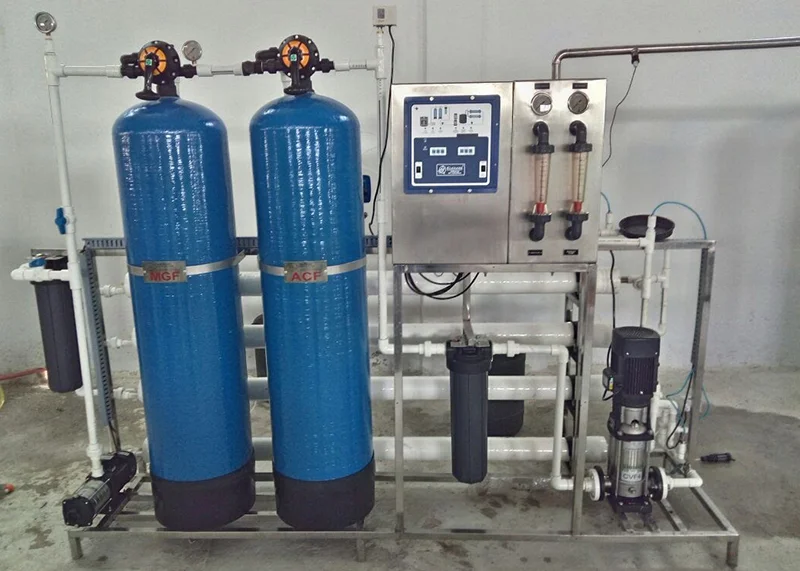
Regardless of certification status, a well-built Non-ISI RO plant should still deliver consistent, safe, and high-quality water. A typical treatment train includes several critical stages:
- Chlorination of raw water to disinfect and control microbial load before it enters storage.
- Multi-Grade Filtration (MGF) to remove suspended solids and turbidity.
- De-chlorination, usually using sodium meta-bi-sulphite, to protect downstream membranes from chlorine damage.
- Iron removal filtration, especially important for borewell or groundwater sources with high iron content.
- Activated carbon filtration to strip out residual chlorine, color, and odor.
- Antiscalant dosing to prevent scaling and fouling of the RO membranes, particularly where silica and bicarbonate levels are high.
- Micron cartridge filtration (typically 5–10 microns) to catch any remaining fine particles before the water reaches the RO membrane.
- The RO module itself — spiral-wound, thin-film composite membranes capable of rejecting dissolved salts, ions, and contaminants down to sub-micron levels.
- UV sterilization as a final safeguard against bacteria and viruses without adding further chemicals.
This multi-barrier approach means a Non-ISI plant is fully capable of treating challenging source water — including brackish or bore well water with TDS levels reaching tens of thousands of parts per million — and bringing it down to usable, high-purity output.
Cost and Flexibility Advantages
One of the biggest draws of a Non-ISI setup is customization. Because there’s no fixed certification template to follow, manufacturers can tailor the plant’s capacity, automation level, and component selection precisely to your feed water quality, production targets, and budget. This is particularly valuable for businesses in regions where groundwater is highly saline or contaminated, since the plant can be engineered around that specific challenge rather than a generic standard.
It also means a shorter runway to installation and commissioning, since you’re not waiting on certification approvals before you can begin operations (assuming your use case doesn’t legally require ISI marking).
What to Look for in a Manufacturer
Even without mandatory certification, the quality of components and workmanship still matters enormously. Look for manufacturers who:
- Use reputable pump brands and food-grade or NSF-approved dosing chemicals.
- Offer stainless steel (SS 304/316) or FRP construction options depending on your water chemistry.
- Provide compact, space-efficient plant layouts.
- Have a track record of installations across varied water conditions, including high-TDS and industrial applications.
For businesses evaluating suppliers, it’s worth reviewing detailed technical specifications and manufacturing capabilities before committing. Companies like Unitech Water Solution publish clear breakdowns of their Non-ISI RO plant components — from raw water pumps to UV sterilization systems — which makes it easier to compare offerings and understand exactly what you’re investing in.
Final Thoughts
A Non-ISI RO plant isn’t a lesser alternative to an ISI-certified system — it’s simply built for a different segment of the water treatment market. For bulk suppliers, industrial users, and businesses not selling branded packaged water directly to consumers, it offers a faster, more customizable, and often more economical path to reliable water purification. As always, match the plant specification to your actual feed water quality and end-use requirements, and choose a manufacturer with a proven engineering track record rather than the lowest quoted price.