Sign up with Google
 Sign in with Zoho
You can find out in about a minute, and you should do it before you fall for a house. A USDA loan offers zero down payment, but only for homes in approved locations. Location is just one of several usda loan requirements, and it's the one that can end a deal fastest. Here's how to check an address, what else has to line up, and what to do if the answer is no.
USDA Loan California Basics: What "Eligible Area" Means
1. The Location Comes First
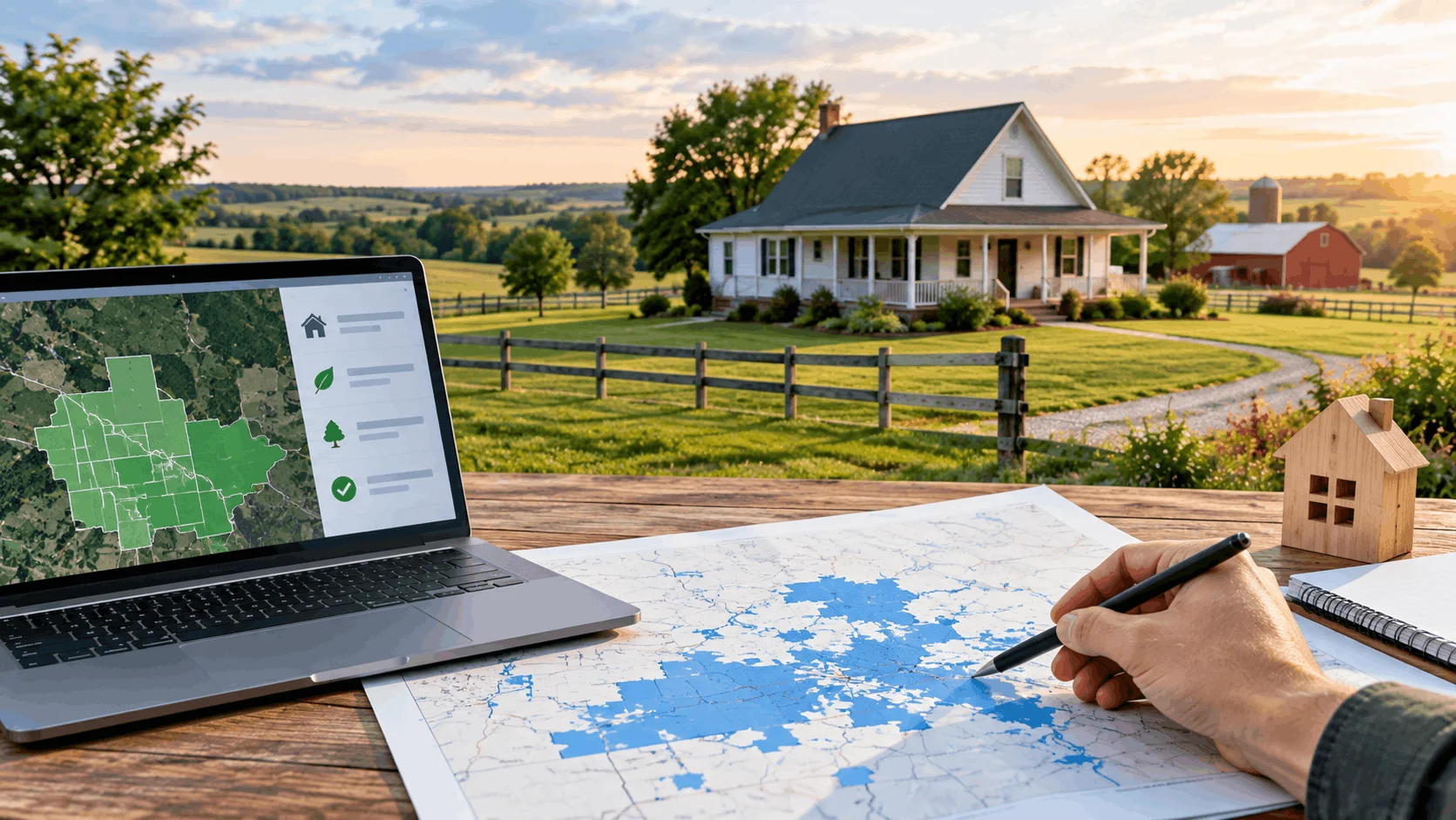
The program is built for rural and some suburban communities. Before anything else, the property itself has to sit inside a boundary the USDA has approved. Your income, credit, and savings don't matter until the address passes this test. Think of it like a venue with a guest list. Doesn't matter how great you look if your name isn't on it.
2. Rural and Some Suburban Areas
Many people assume "rural" means farmland only. It doesn't. The loans are designed for homes in rural and certain suburban communities, and some neighborhoods near major metropolitan areas may qualify. That means a home that feels like a regular suburb could still be eligible. A home that feels rural could sit just outside the line. The only way to know is to check the specific address. For a USDA loan California buyers hope to use, dense urban areas usually won't qualify, but smaller towns and outer edges of some counties may.
How to Check an Address Step by Step
1. Use the Official USDA Map
Go to the USDA's own property eligibility tool. You enter the property address and the site tells you right away whether the location falls in an eligible rural area. Stick with the official source. Third-party sites can lag behind updates.
2. Enter the Full Property Address
Type in the street address, city, and ZIP. Don't use a general neighborhood name or a nearby landmark. Boundaries can cut through the middle of a town, and two houses on opposite sides of the same road can get different answers.
3. Read the Result
If the Address Is Eligible
Great. Screenshot the result and share it with your lender and agent. Eligibility maps get updated from time to time, so ask your lender to confirm the status on your loan file too. That way nothing surprises you close to closing.
If the Address Is Not Eligible
Don't panic, and don't try to argue with the map. Some buyers assume a borderline address can be "made eligible" with a phone call, but the lender can't override the boundary. Move on to your other options, which we cover below.
What Else the Property Must Meet
A green light on the map is step one. The home itself has to check a few boxes too.
1. A Primary Residence
The home must be your primary residence. Investment properties and second homes don't qualify. If you plan to rent it out or buy a vacation place, look at a different program.
2. Condition and Safety Standards
The property has to be safe, sound, and in decent shape. Like an FHA loan, an appraisal checks value and condition. Expect flags for things like a failing roof, exposed wiring, or a lack of working heat. Repairs may be required before closing, so factor that into your offer.
3. Condos and Manufactured Homes
Condos and manufactured homes can qualify in some cases, but eligibility is limited and the guidelines for manufactured homes are stricter. If you're eyeing one of these, ask your lender before you write an offer.
Borrower Rules That Go With the Location
Even in a perfect location, you still have to qualify as a borrower. These usda loan requirements are the ones lenders check next.
1. Household Income Limits
Household income generally has to be at or below 115% of the area median income. In 2026, that commonly works out to around $119,850 for households of one to four people and $158,250 for larger households, though limits vary by location. One catch many buyers miss: the count includes all household income, not only the borrower's. If a roommate or family member lives with you, their income may count too.
2. Credit and Debt
Lenders want a stable job history and a manageable debt load. A credit score of 640 or higher typically allows streamlined processing, while lower scores may qualify through manual underwriting. Each lender sets its own overlays, so shop around.
3. Citizenship or Residency
Borrowers generally need to be U.S. citizens or permanent legal residents. There's no first-time buyer requirement, so past homeowners can qualify as long as they meet the other rules.
What a USDA Loan Costs: A Quick Example
These numbers are illustrations, not quotes.
1. The Upfront Fee
USDA loans skip mortgage insurance and instead charge a 1% upfront guarantee fee and a 0.35% annual fee on the remaining balance. Say you buy a $400,000 home with nothing down. The 1% fee is $4,000, which many borrowers roll into the loan, bringing the balance to $404,000.
2. The Annual Fee
Now the annual fee. At 0.35% of $404,000, that's about $1,414 a year, or roughly $118 a month, and it shrinks as your balance drops. Compare that with a program that charges more in monthly mortgage insurance and you can see why buyers like this option. Want to test your own numbers? Try our mortgage calculators.
What to Do if the Property Is Not Eligible
1. Look at Nearby Areas
A short drive can change the answer. Ask your agent to search listings just outside the current area, then check each address on the map. Trade a few extra minutes of commute for zero down, and the math might work out.
2. Compare Other Loan Programs
If nothing eligible fits, look at other low-down-payment options. An FHA loan needs as little as 3.5% down, and a VA loan offers zero down for those who served. A lender who offers many programs can run the numbers side by side. You can see the USDA loan program and its alternatives on the Taylor Weiner Team site.
Conclusion
1. Your Next Step
To know if a property is in a USDA-eligible area, enter its full address into the official USDA eligibility map before you make an offer. Then confirm the rest of the usda loan requirements: primary residence, property condition, household income under the limit, and solid credit. If the property qualifies, you could buy with no down payment. If it doesn't, you still have options. For a USDA loan California purchase, start by checking the address, then talk with a lender who can walk through your numbers. Taylor Weiner has 20 years of mortgage experience, a 5.0 rating on Google, and 450+ five-star reviews. Call the team in Seal Beach at (714) 658-4912 or apply online to get started.
FAQs
1. Where do I check if a property is USDA eligible?
Use the official USDA property eligibility map and enter the full address.
2. Can a suburban home qualify?
Yes, some suburban areas near cities qualify, but you have to check each address.
3. Do income limits apply?
Yes. Household income generally must be at or below 115% of the area median.
4. Can I use a USDA loan for a rental property?
No. The home must be your primary residence.
5. Do eligible areas ever change?
Yes. Maps get updated, so confirm eligibility with your lender before closing.