Sign up with Google
 Sign in with Zoho

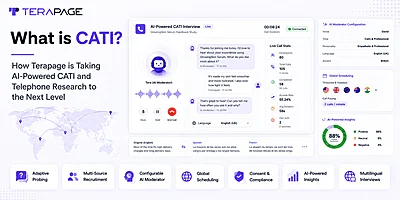
Table of Contents
1. What Is CATI? Understanding AI-Moderated CATI
2. How Terapage Is Taking AI-Moderated CATI to the Next Level
3. The Future of Telephone Research Is Conversational
Your organisation operates across multiple regions, each with its own time zone, language, and dialect — and you need telephone interviews completed in every one of them within six months. The traditional path means hiring regional research teams and local moderators in each market.
AI-Moderated CATI changes the equation entirely.
The traditional path to global telephone research means hiring regional research teams and local moderators in each market a process that eats up budget, time, and coordination before a single call is even made.
Platforms like Terapage let you tap into a telephone directory, recruit participants through multiple channels, and deploy AI moderators that speak any language or dialect fluently, all while conducting the deep, probing interviews that used to require a trained human on every call. No regional hiring sprees, no scheduling around time zones, no compromise on the depth of what your organisation is collecting.
What Is CATI? Understanding AI-Moderated CATI
CATI stands for Computer-Assisted Telephone Interviewing. It is a modern qualitative market research method in which interviewers conduct surveys over the phone while using computer software to guide the questions, record responses in real time, and manage survey logic throughout the interview (Gourlay et al., 2021).
Its key characteristics are:
● A live interviewer speaks with respondents by phone, which allows for clarification, higher completion rates, and reaching people who are not easily surveyed online.
● The interview script and question flow are managed through software, reducing manual errors and speeding up data entry.
● Responses are fed directly into the database, so results can be analysed almost immediately after fieldwork ends.
● It is commonly used for large-scale market research, political polling, customer satisfaction studies, and government or public health surveys.
AI-powered CATI (Computer Assisted Telephone Interviewing) re-imagines the traditional phone survey by replacing the human moderator with intelligent AI agents, enabling faster, more automated, and more efficient telephone data collection.
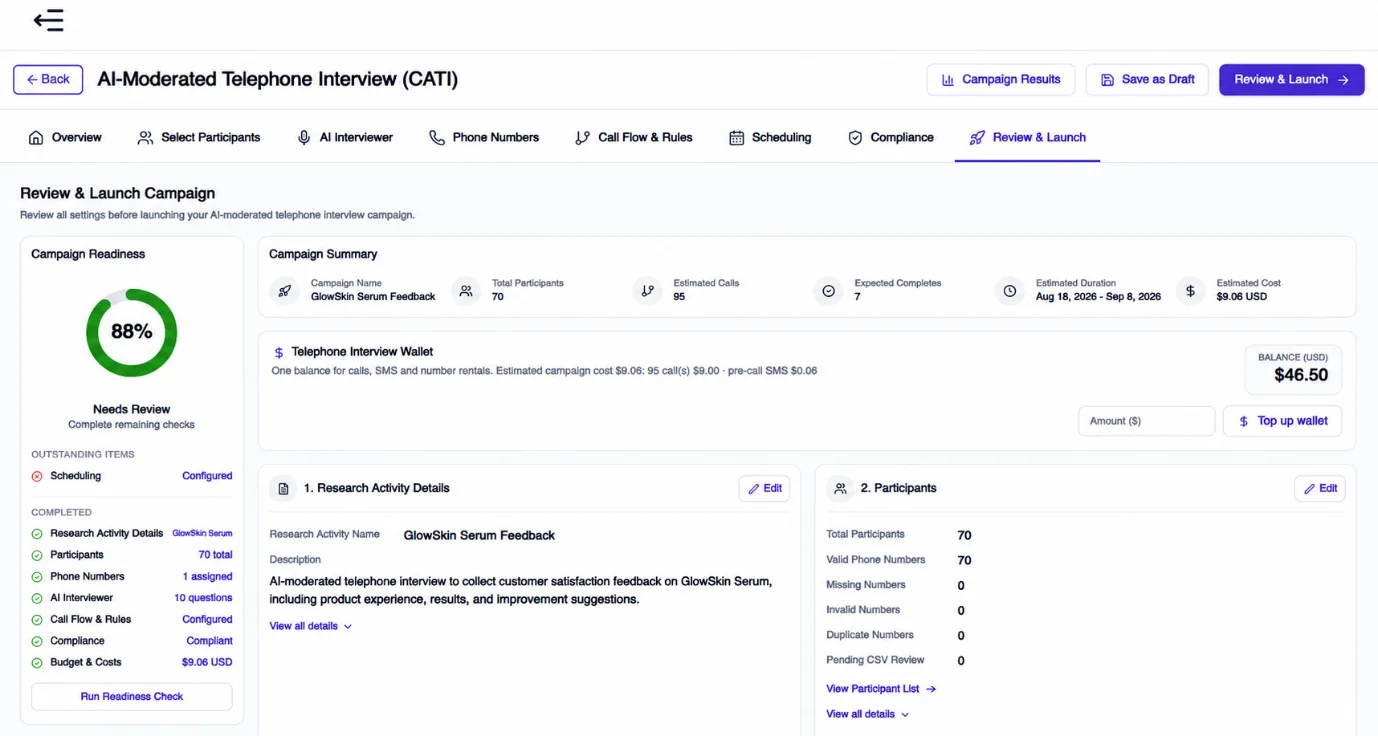
Modern research platforms like Terapage are no longer applying AI to just one part of the process; they have integrated it into every stage of CATI. AI-Moderated CATI by Terapage depends on AI to identify and qualify the right respondents during recruitment, conduct adaptive phone interviews that respond naturally to what people say, monitor call quality in real time, and turn raw responses into structured insight almost as soon as fieldwork wraps. That end-to-end coverage, from recruitment through analysis, is what separates a genuinely AI-powered platform from tools that only automate a single step.
How Terapage Is Taking AI-Moderated CATI to the Next Level
Telephone interviews have been a trusted research method for decades. They give researchers something traditional surveys often cannot: a real conversation where participants can explain their experiences, opinions, and motivations in their own words. In our previous article, Old Tricks. New Tools: How AI Is Scaling Traditional Telephone Interviews in Smarter Ways, we explored how AI can modernise traditional telephone interviews. Now, the next step is bringing those capabilities together.
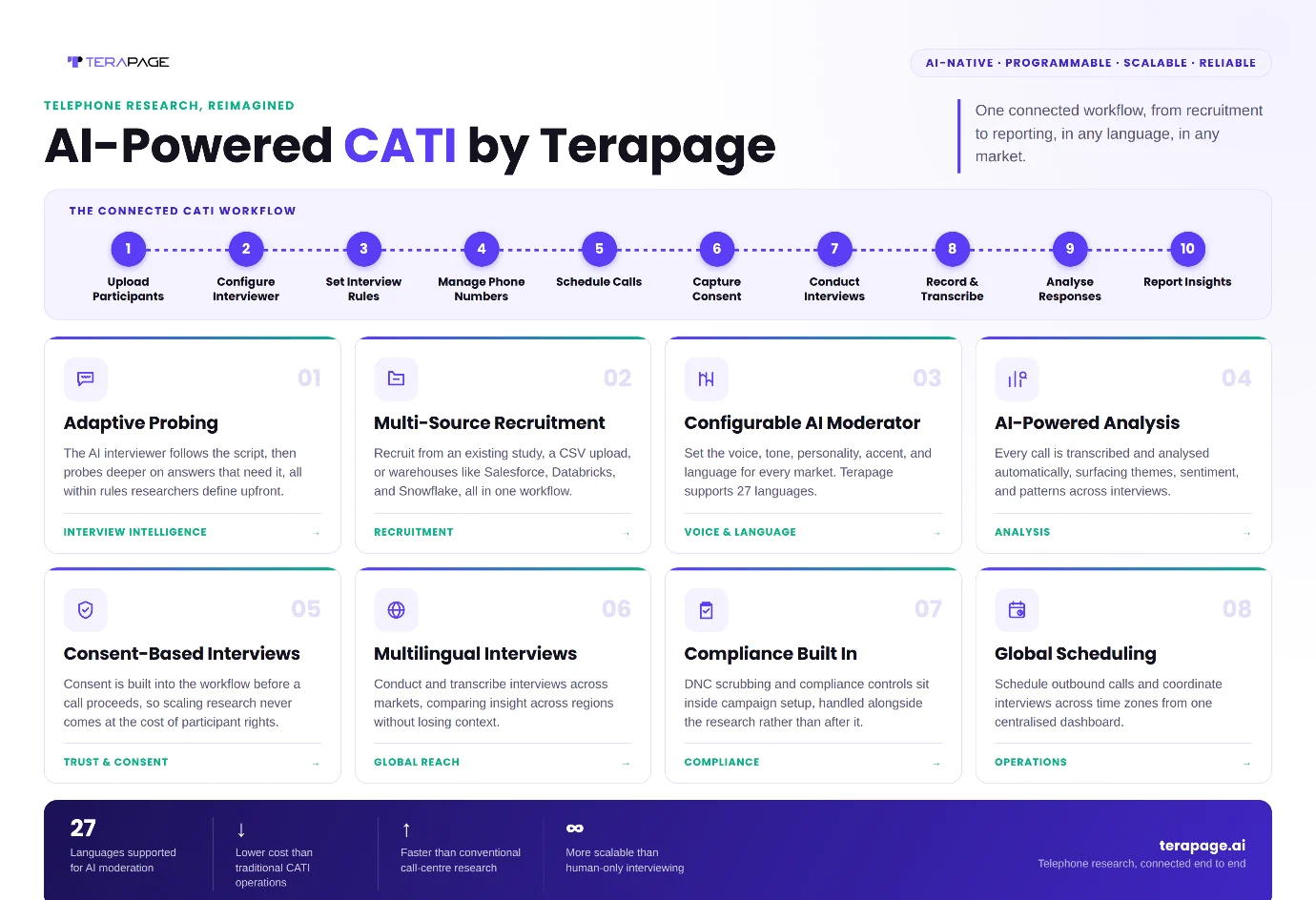
Terapage AI-Moderated CATI combines programmable telephony, AI moderation, participant recruitment, scheduling, consent, recording, transcription, analysis, and reporting in one research ecosystem. The goal is not to replace researchers. Igives research teams a smarter,keeping researchers in control.
1. AI-Powered CATI with Adaptive Probing
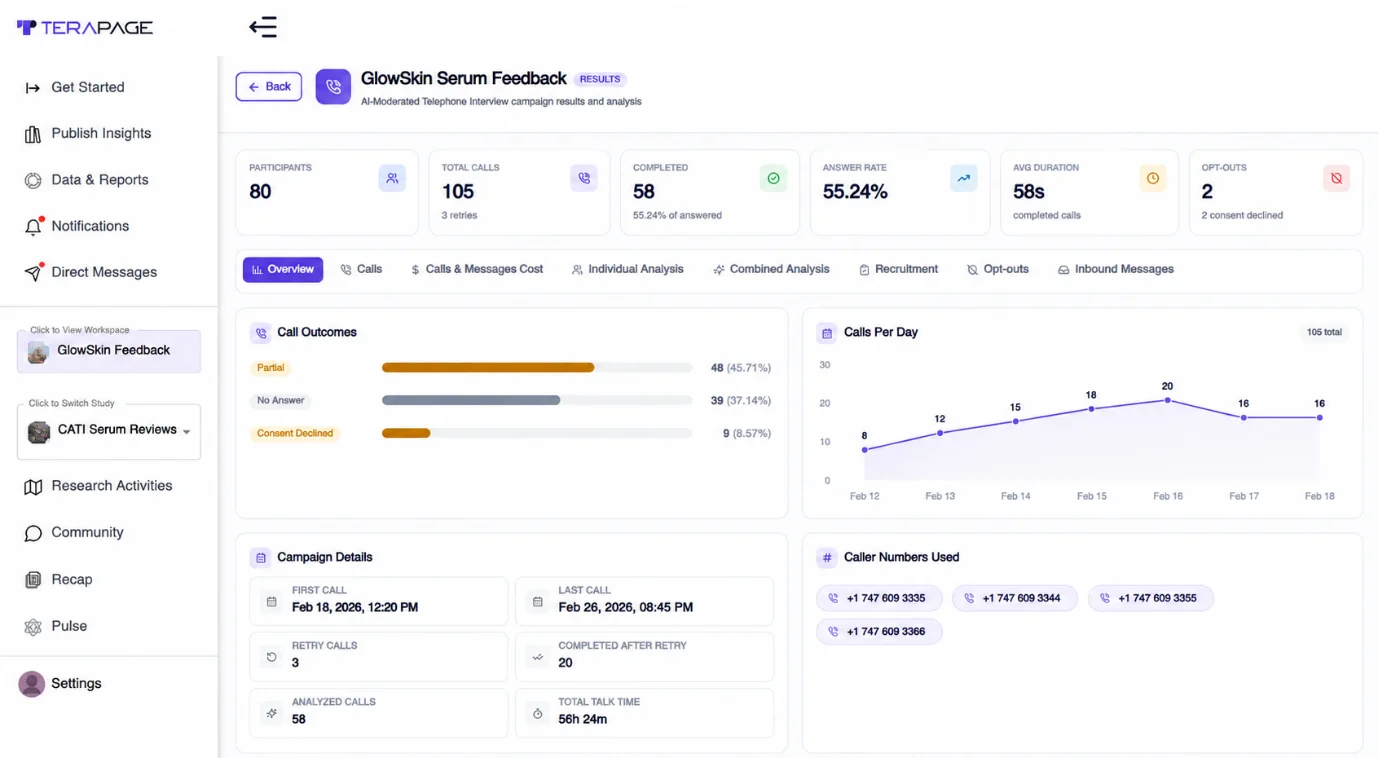
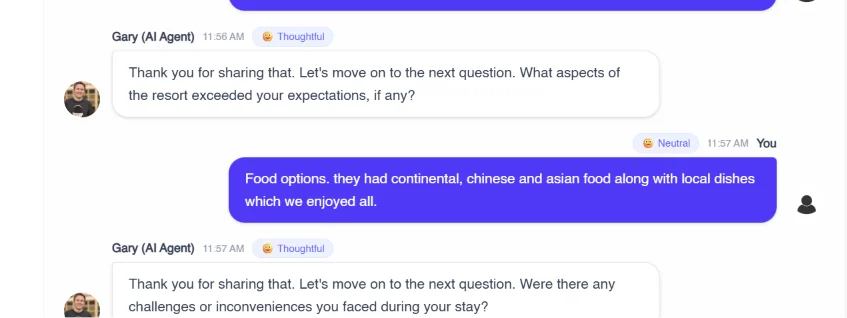
Traditional telephone interviews rely on predefined scripts. Modern CATI is powered by AI based on the principle of adaptive probing. Researchers can configure interview scripts and define rules for follow-up questions. During the conversation, the AI interviewer can respond to participant answers and probe further when a response requires clarification or deeper exploration (Williams & Ingleby, 2025). This creates a balance between structured research and natural conversation. Instead of asking every participant exactly the same sequence of questions regardless of what they say, the AI interviewer can follow the research framework while adapting the conversation within the rules defined by the researcher.
2. Recruit Participants from Multiple Sources in One Platform
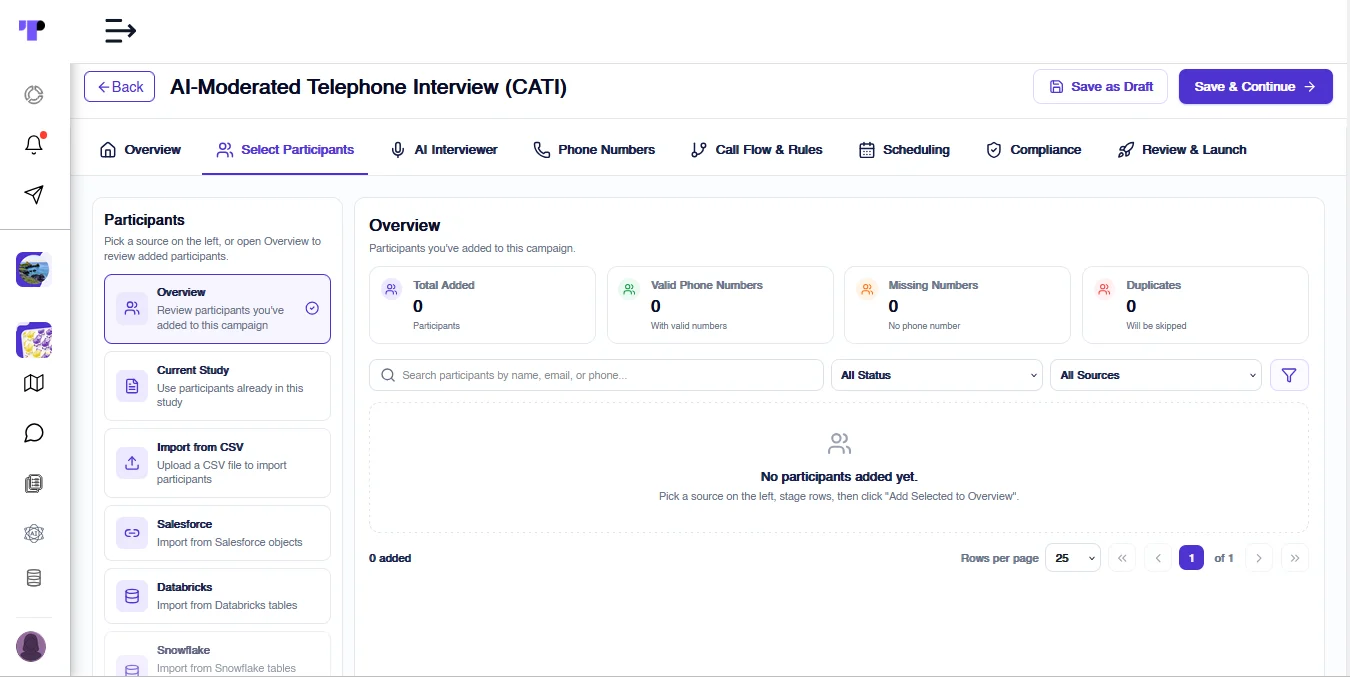
Participant recruitment is another important part of telephone qualitative research. Traditionally, researchers have a participant list as a CSV file, which they upload manually to the computer for research purposes. Terapage has entirely eliminated this bottleneck from the telephone research process, bringing participant recruitment and telephone interviewing into the same workflow.
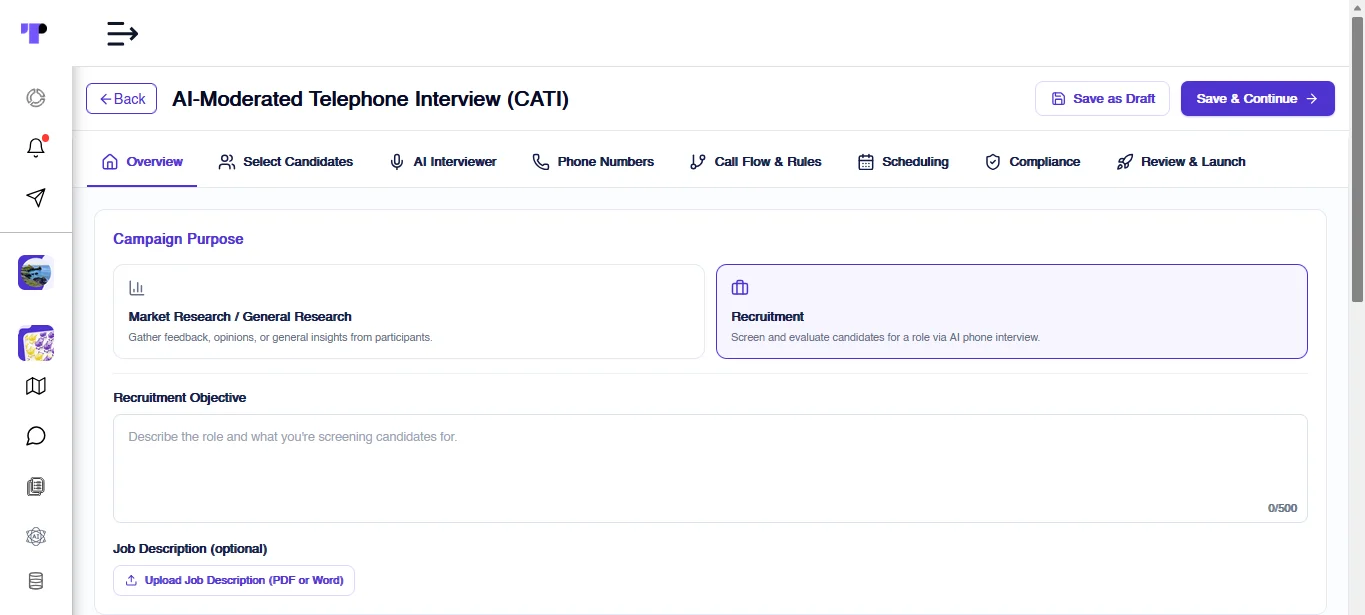
At Terapage, researchers can recruit participants by:
● Using participants from an existing study
● Uploading CSV files
● Importing from large warehouses such as Salesforce, Databricks, and Snowflake
Terapage checks phone number quality, country code, duplicate records, missing numbers, and source before calls are queued. Instead of treating recruitment and CATI as separate processes, Terapage integrates both within the same research environment.
Press enter or click to view image in full size
3. Configure the Interviewer for Different Markets
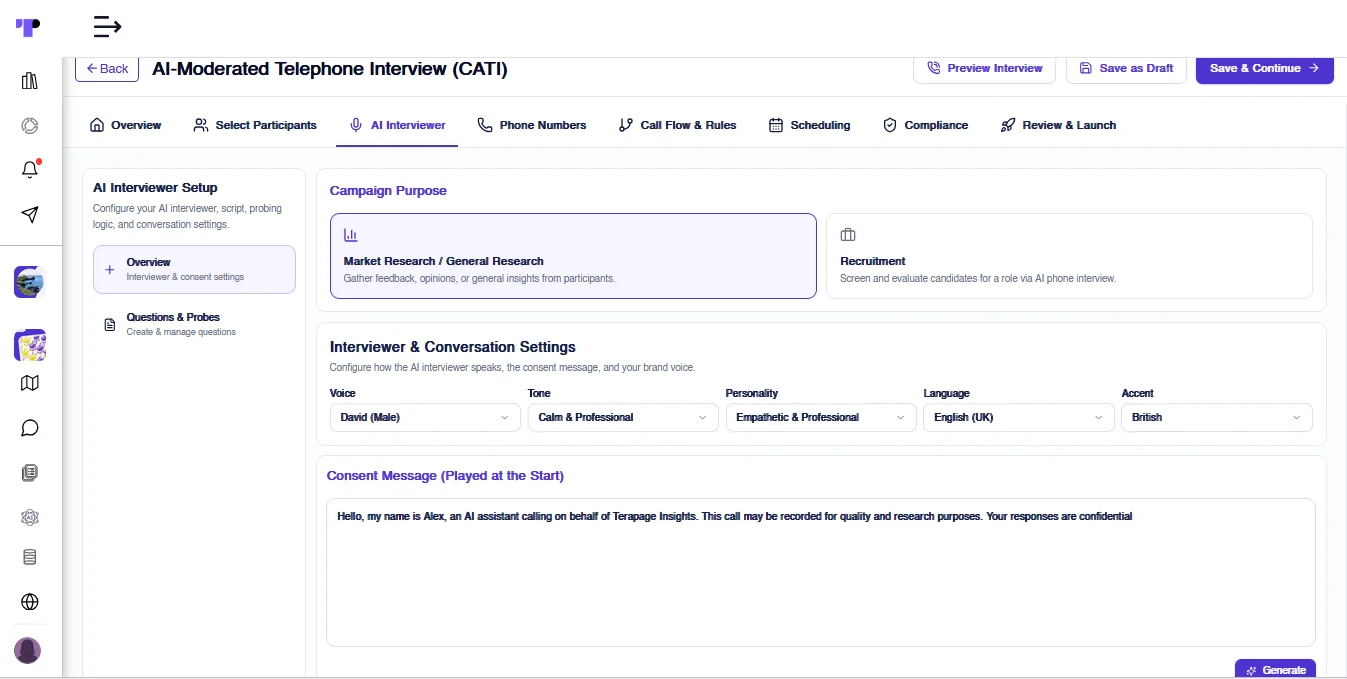
Traditional CATI involves human moderators. Modern CATI is AI-powered and uses AI moderators for calls. To reach global participants, research firms can configure the AI moderators to match their research study and targeted market requirements. At Terapage, researchers can design their AI moderators by configuring:
● Voice (Male/Female)
● Language (Terapage supports 27 languages)
● Accent (British, American, Indian, etc.)
● Tone (Calm, Professional, Enthusiastic, Formal, Informal, etc.)
● Personality (Empathetic, Professional, Neutral, etc.)
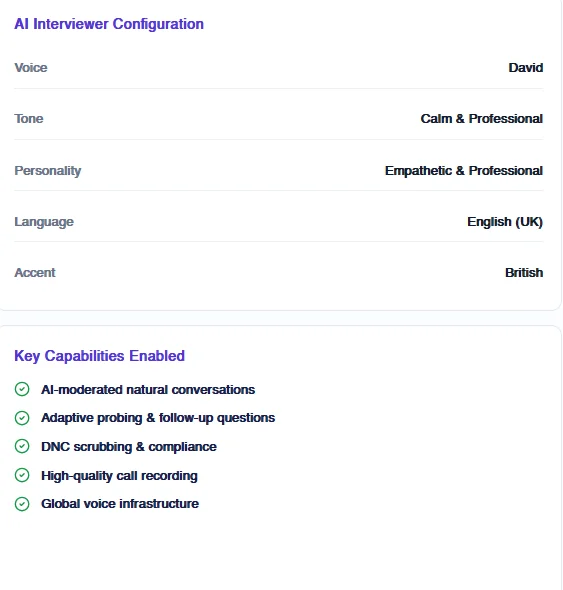
For example, an interviewer can be configured with a calm and professional tone, an empathetic personality, English (UK), and a British accent. These settings help research teams create a consistent interviewing experience while adapting the interviewer to different regional requirements.
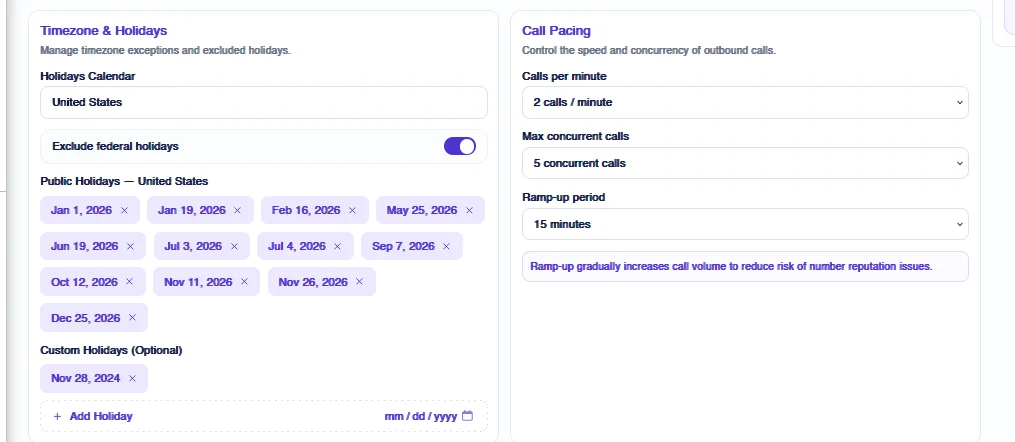
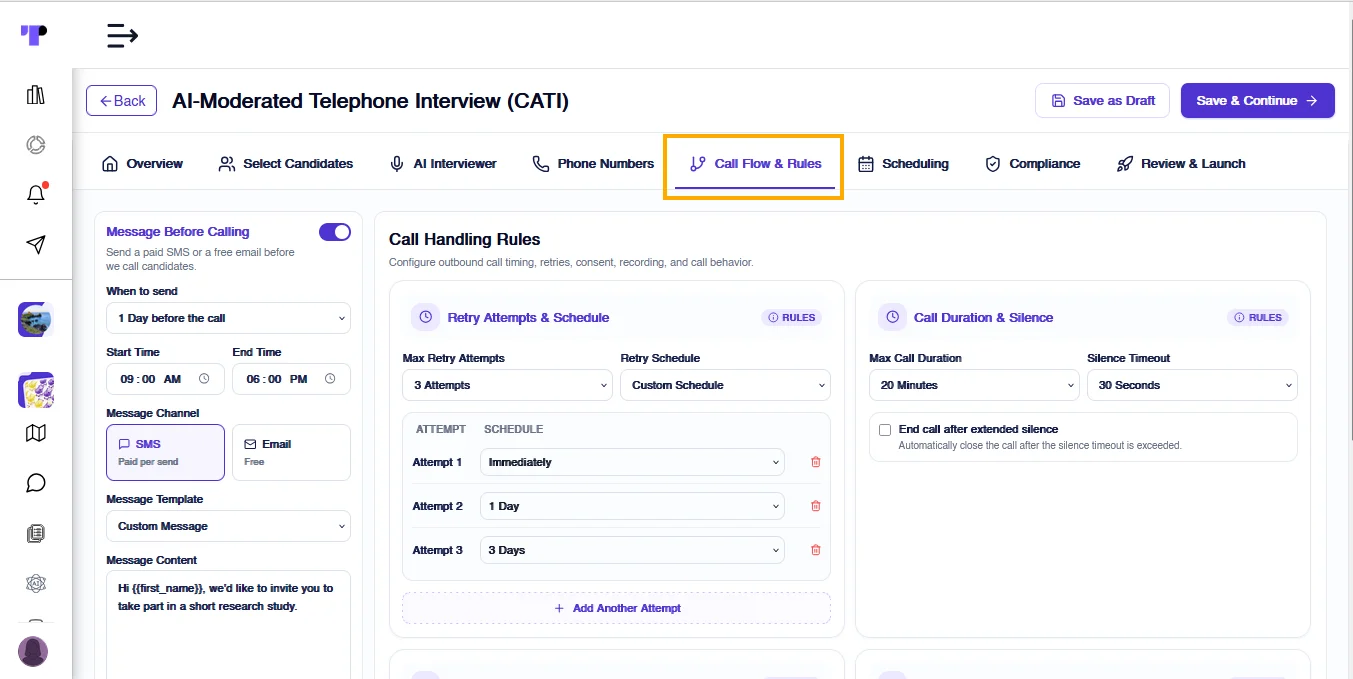
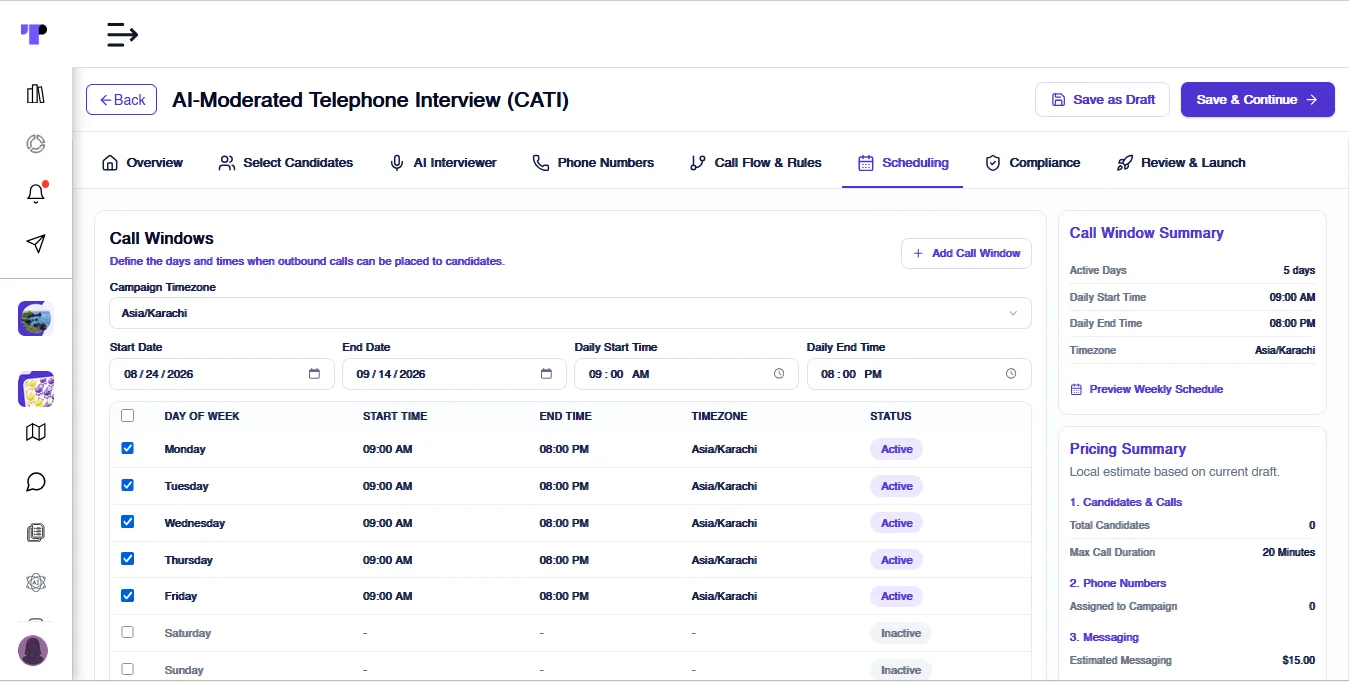
4. Schedule Telephone Research Globally
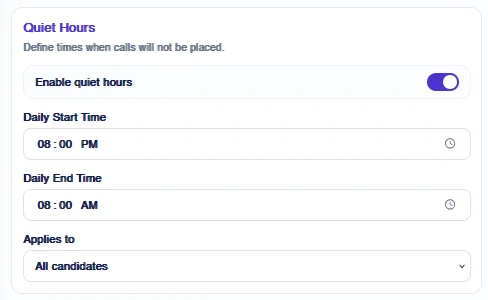
Managing telephone interviews across multiple regions has become complicated. Participants are located in different time zones, have different availability, or require multiple call attempts. Managing these details manually slows down research operations. Terapage makes global scheduling part of the CATI workflow — research teams can schedule outbound calls, manage campaign activity, and coordinate interviews across regions from a centralised platform as part of the broader research project management workflow.
The platform can also help teams track operational metrics such as:
● Campaign time zone
● Call duration
● Active days
● Message costs
This gives research teams greater visibility into both the research and operational performance of their telephone campaigns.
5. Consent-Based Telephone Interviews
Scaling telephone research also requires a responsible approach to participant consent. Terapage supports consent-based interviews, making it an important part of the research workflow before the interview proceeds. This gives participants an opportunity to understand and agree to the interview process. By incorporating consent into the workflow, researchers can scale their studies without treating participant rights and research controls as separate processes.
6. Turn Recorded Interviews into AI-Powered Insights
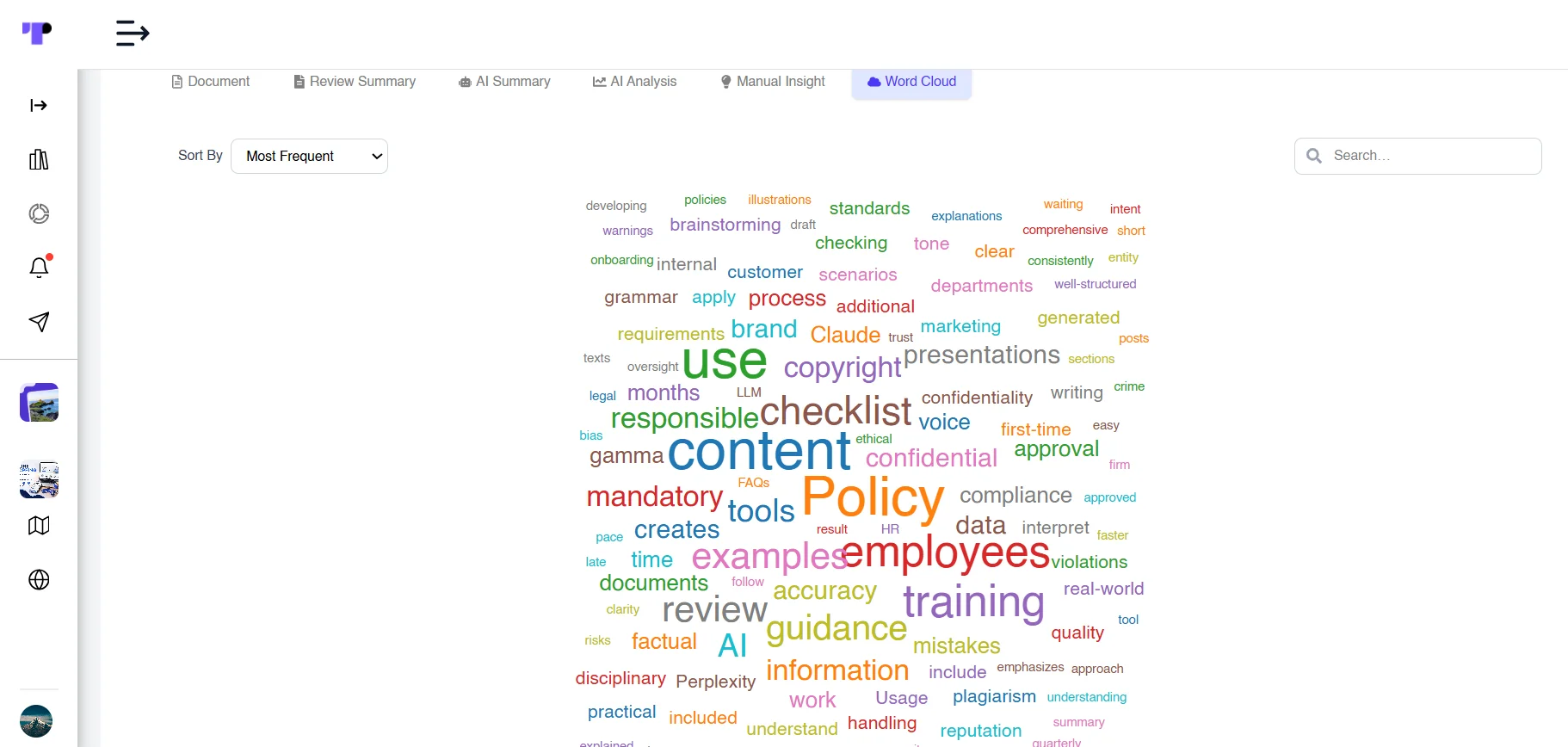
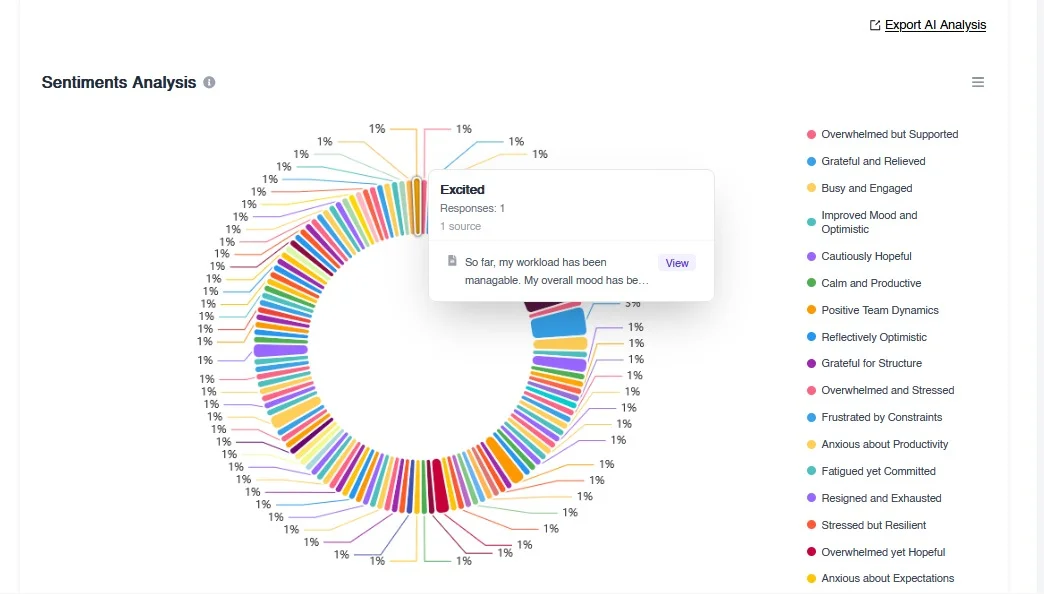
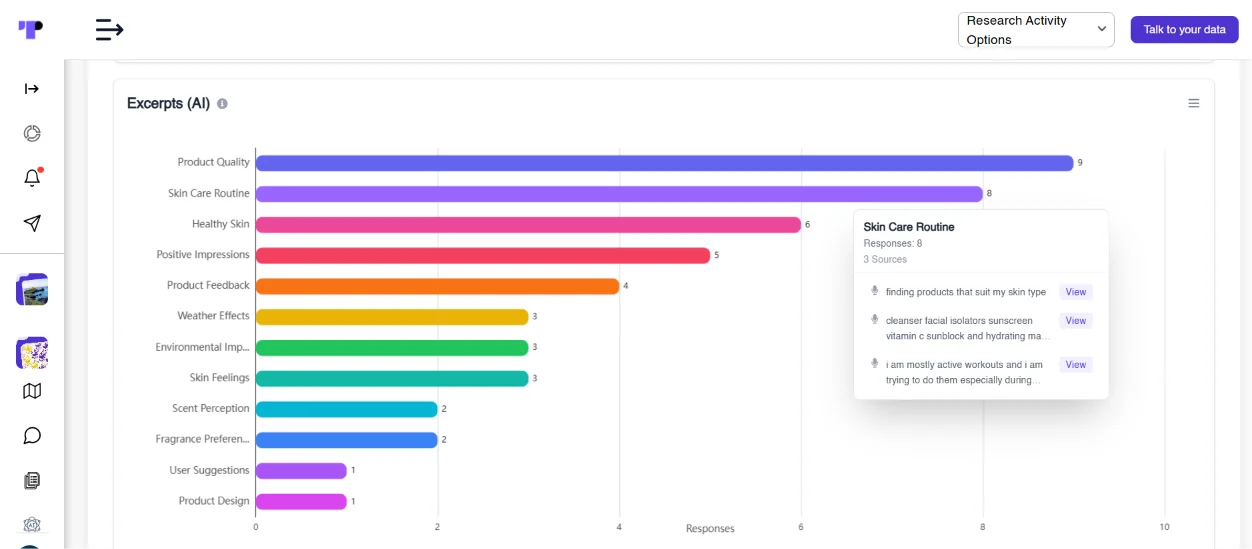
Once interviews have been completed, research teams still need to process recordings, understand participant responses, identify recurring themes, and extract meaningful insights. Terapage connects recorded telephone interviews with its existing AI-powered insight tools. Calls are recorded and transcribed, giving researchers a searchable textual representation of each conversation. These transcripts and recordings then feed into the broader analysis workflow. AI-powered analysis helps researchers identify themes, patterns, sentiments, and recurring perspectives across interviews, significantly reducing the manual effort involved in reviewing large volumes of telephone conversations and helping teams move faster from raw interviews to actionable insights.
7. Multilingual Interviews and Transcripts
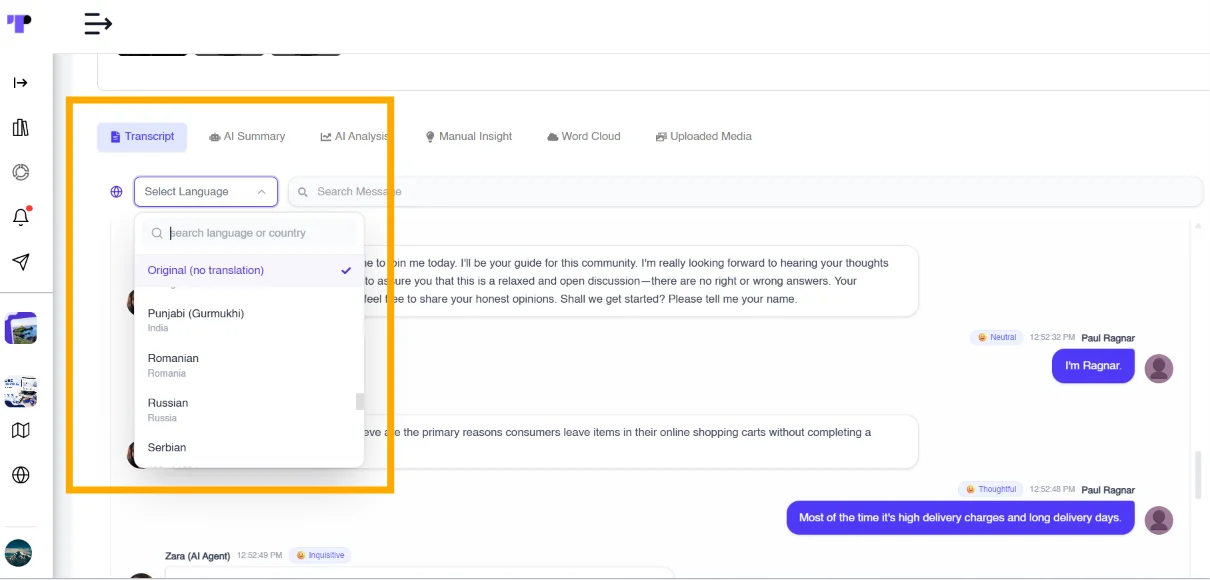
Global research means working across languages. Terapage supports multilingual telephone research and transcription, helping teams conduct interviews across different markets and bring the resulting conversations into a connected research workflow. Combined with configurable interviewer language and accent settings, this makes it easier to adapt telephone research for international participants. Researchers can conduct interviews in the language appropriate to each market and use transcripts to support consistent analysis across the study — particularly valuable for global research where insights need to be compared across regions without losing the context of individual conversations.
8. Compliance Management Built into CATI
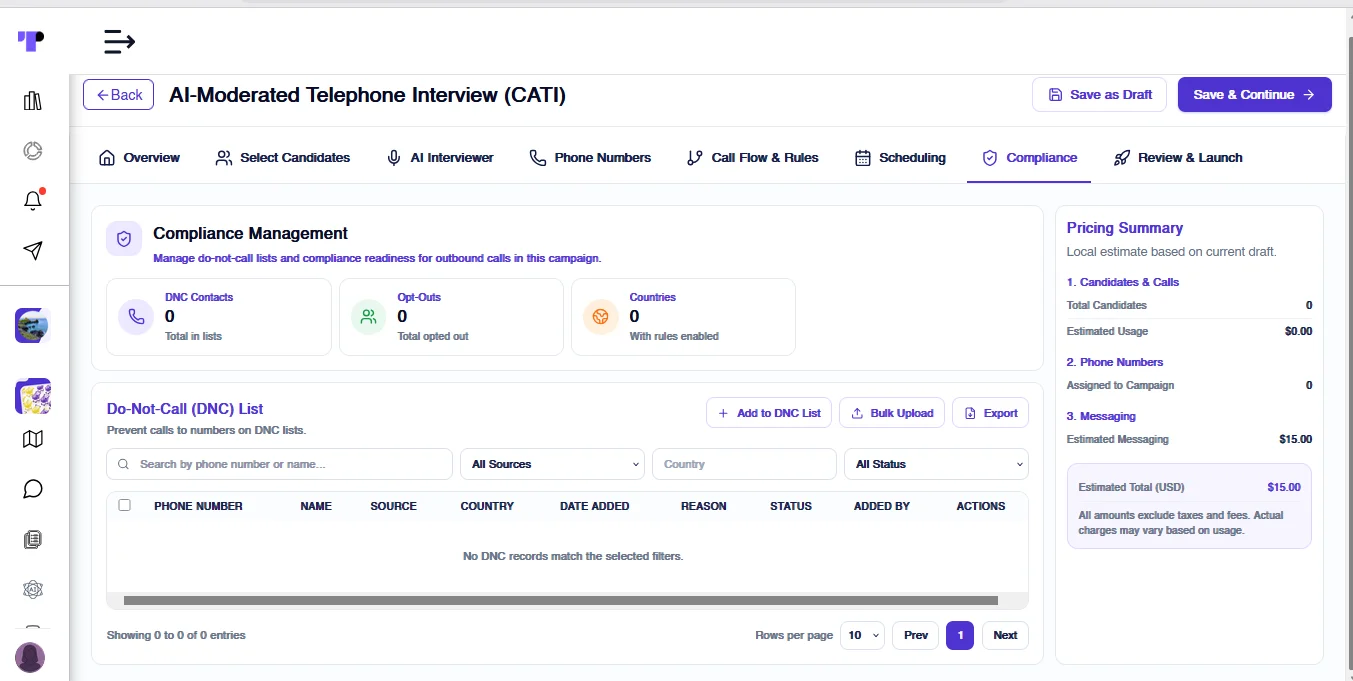
Traditional telephone research involves several operational considerations, including consent, participant data, calling practices, and compliance requirements. Terapage includes a dedicated compliance stage within its AI-moderated telephone interview workflow. The platform also supports capabilities such as DNC scrubbing and compliance controls, helping research teams incorporate important requirements into campaign setup rather than managing them separately.
Why Terapage Is Taking CATI to the Next Level
Traditional CATI brought structure and consistency to telephone interviewing. Terapage adds AI-powered moderation, adaptive conversations, global configuration, integrated recruitment, automated calling, and AI analysis. The result is a telephone research workflow that is:
● Lower cost than traditional CATI operations
● Faster than conventional call-centre operations
● More scalable than human-only interviewing
● More natural than fixed-response surveys
● More structured than ad hoc telephone calls
● Integrated with recruitment, analysis, reporting, and insight workflows inside Terapage
Press enter or click to view image in full size
The Future of Telephone Research Is Conversational
Telephone research remains valuable because people can explain what they think, why they think it, and what they experienced. AI-powered CATI does not remove that human element. Instead, it gives research teams a way to conduct more structured conversations across more participants and markets.
With adaptive probing, configurable interviewer voices and personalities, multilingual transcription, consent management, global scheduling, compliance controls, and AI-powered analysis, Terapage turns traditional telephone interviewing into a connected research workflow — going beyond what scheduled live interviews or automated interviews alone can offer. The future of CATI is not simply more calls. It is smarter conversations, better scalability, and faster paths from participant responses to research insights.
Ready to run your next telephone research study with AI-moderated CATI? Start a free trial with Terapage or book a demo today. Need help planning your setup? Our support services team is here for you.