Sign up with Google
 Sign in with Zoho

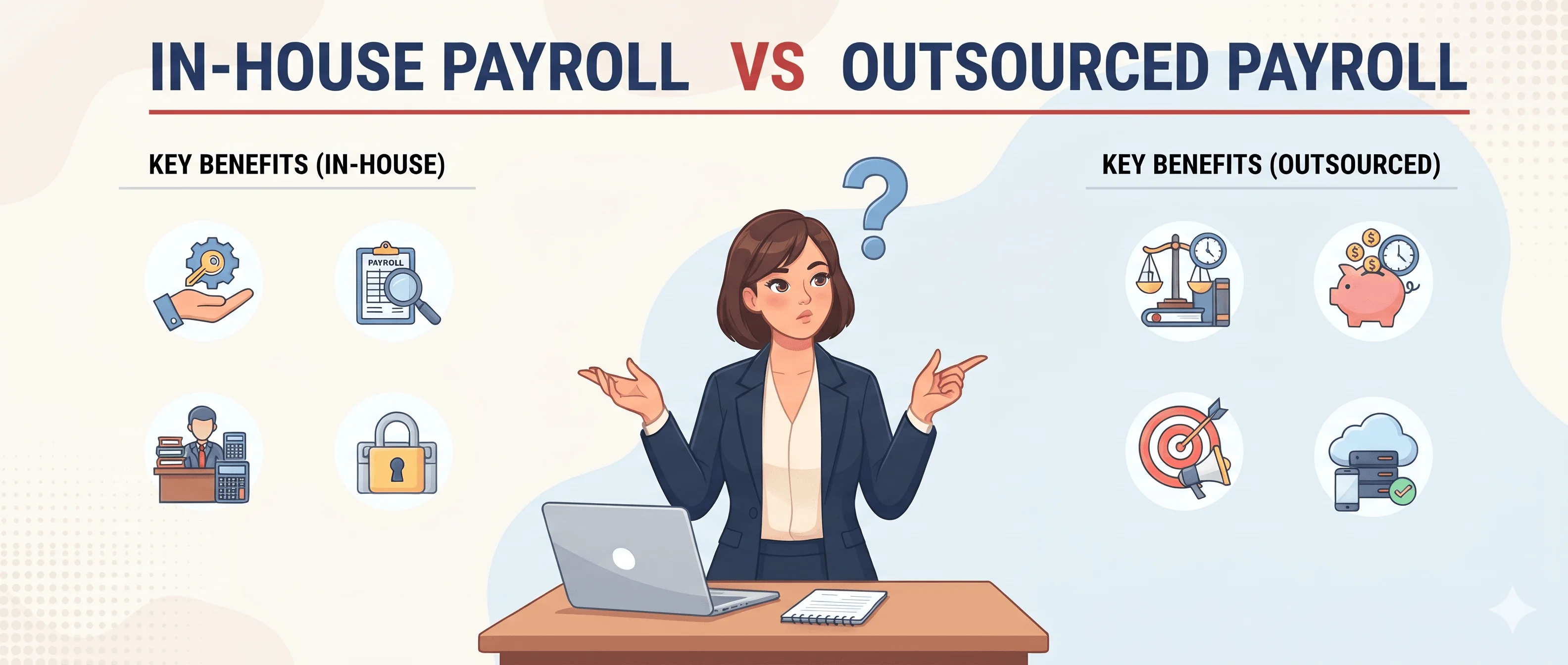
Payroll is an important part of running a business. Employees expect their salaries to be paid on time, payroll deductions need to be calculated correctly, and salary records must be maintained properly. While payroll may seem straightforward for a small team, managing it becomes more challenging as a business grows.
HR and finance teams often have to manage attendance, salary revisions, reimbursements, deductions, payslips and statutory requirements every month. These tasks can take time, especially when the team has other responsibilities to handle.
This is why many businesses consider outsourcing their payroll, while others prefer to keep the entire process in-house. Both options have advantages and disadvantages, and choosing between them depends on the company's size, budget, internal resources and payroll needs.
Understanding how each approach works can help businesses make a better decision and choose a payroll process that suits their day-to-day operations.
What Is In-House Payroll?
In-house payroll means a business manages its salary processing through its own HR, finance or payroll team. The company is responsible for collecting employee information, calculating salaries, managing deductions, processing payments and maintaining payroll records.
Some businesses use payroll software to manage these activities, while smaller companies may use spreadsheets and manual calculations.
How In-House Payroll Works
When payroll is managed internally, the HR or finance team generally handles:
- Collecting attendance, leave and overtime details.
- Calculating monthly salaries.
- Managing deductions such as PF, ESI, TDS and Professional Tax, where applicable.
- Processing salary payments.
- Preparing employee payslips.
- Maintaining payroll records.
- Managing applicable statutory payments, filings and reporting.
The company handles these activities internally, although it may use software or consult external professionals when required.
Advantages of In-House Payroll
1. Greater control over payroll
Businesses can manage payroll according to their own processes. HR and finance teams can review salary calculations, approve payments, make adjustments and respond to employee queries without depending entirely on an external provider.
2. Easy access to payroll information
When payroll is managed internally, employee salary records and payroll reports are available to authorised HR and finance employees. This can make it easier to review salary history, deductions and payroll-related information.
3. Better coordination with internal teams
HR, finance and department managers can communicate directly about attendance, salary revisions, reimbursements and employee changes. This can help manage payroll adjustments more quickly when the internal process is well organised.
4. Potential cost savings
Businesses with a large workforce and an established payroll team may find in-house payroll cost-effective. However, the overall cost also depends on employee salaries, payroll software, training, maintenance and the time spent managing payroll activities.
Disadvantages of In-House Payroll
1. Requires time and resources
Payroll processing involves several monthly activities. HR teams may spend hours collecting employee inputs, checking calculations, correcting mistakes and preparing reports.
2. Compliance can be difficult to manage
Businesses need to understand the applicable payroll and employment requirements. Keeping track of contribution rules, tax requirements, statutory deadlines and documentation can be challenging.
3. Payroll errors can happen
Incorrect attendance records, manual data entry, outdated salary structures or calculation mistakes can lead to incorrect salary payments and additional work for the payroll team.
4. Requires trained employees
Payroll employees need to understand salary structures, deductions, reporting and applicable compliance requirements. If the person responsible for payroll leaves or is unavailable, the business may struggle unless another trained employee can take over.
What Is Payroll Outsourcing?
Payroll outsourcing means hiring an external service provider to manage some or all of a company's payroll activities.
Instead of handling every payroll task internally, the business shares employee details, attendance information, salary changes and other required inputs with the payroll provider. The provider then processes payroll based on the agreed services.
Depending on the agreement, payroll outsourcing may include salary calculations, payslip generation, payroll reports, statutory contribution calculations, compliance support and other payroll-related activities.
How Payroll Outsourcing Works
The process generally works in the following way:
- The business shares employee information, attendance records and salary changes with the payroll provider.
- The provider uses the information to process monthly payroll.
- Salary calculations and applicable deductions are prepared.
- Payslips and payroll reports are generated.
- Statutory compliance-related tasks are handled according to the service agreement.
- The business reviews and approves the payroll output and payment process.
The services provided may vary. Some providers only process salaries, while others offer broader payroll and statutory compliance support.
Advantages of Payroll Outsourcing
1. Saves time for HR teams
Payroll outsourcing can reduce the amount of work HR teams need to handle every month. Instead of spending hours on salary calculations, payroll reports and repetitive administrative tasks, HR employees can focus on recruitment, employee engagement and other responsibilities.
This can be particularly useful for businesses with small HR teams.
2. Access to payroll expertise
Payroll providers often have professionals who regularly work with salary processing, payroll documentation and related compliance requirements.
Businesses may benefit from this experience, particularly when they don't have employees with specialised payroll knowledge. However, the scope of expertise and support should always be checked before choosing a provider.
3. Reduces the need to manage payroll software
Some payroll providers use their own payroll systems to calculate salaries, prepare payslips and generate reports. This may reduce the need for businesses to purchase, configure or maintain a separate payroll platform for the outsourced activities.
4. Supports business growth
As a business hires more employees, payroll processing can become more time-consuming. Outsourcing may help manage the additional workload without immediately expanding the internal payroll team.
5. Creates a more organised payroll process
Payroll providers often follow established processes for collecting employee inputs, processing salaries, preparing reports and managing payroll tasks.
Having a defined process can help businesses manage monthly payroll activities more consistently.
Disadvantages of Payroll Outsourcing
1. Less direct control
When payroll activities are handled externally, businesses may depend on the provider for corrections, changes and certain reports. The turnaround time may depend on the provider's process and service agreement.
2. Service costs
Payroll outsourcing comes with service charges. Providers may charge per employee, per payroll cycle or through a fixed package. Additional charges may apply for special requests, registrations, extra reports or other services.
3. Employee data must be shared
Payroll providers may need access to confidential employee information, including salary details, bank information and identification or tax-related records.
Businesses should carefully review the provider's data security practices, confidentiality terms and data handling arrangements before sharing employee information.
4. Dependence on an external provider
If a payroll provider experiences delays, technical issues or communication problems, payroll processing may be affected. Businesses should understand the provider's support process, backup arrangements and service commitments.
5. Employer responsibilities remain
Outsourcing payroll doesn't automatically remove the employer's legal responsibilities. Businesses still need to ensure that payroll is processed correctly, applicable obligations are met, payments are approved and records are maintained.
Key Factors to Consider Before Choosing
Payroll outsourcing and in-house payroll both have benefits. However, businesses should consider several factors before making a decision.
1. Business Size and Number of Employees
The number of employees can influence how a business manages payroll.
For a small business with a limited workforce, outsourcing may be convenient because it reduces the need to manage payroll calculations and reporting internally.
For a larger organisation with an established HR and finance department, in-house payroll may be practical because the company already has the resources and systems to manage the process.
However, employee numbers alone shouldn't determine the decision. Payroll complexity, employee locations, salary structures and the number of payroll changes also matter.
2. Payroll Cost
Businesses should compare the total cost of managing payroll internally with the cost of outsourcing.
In-house payroll costs may include:
- Payroll team salaries.
- Payroll software subscriptions.
- Software implementation and training.
- Maintenance and support.
- Time spent managing payroll activities.
Payroll outsourcing costs may include:
- Monthly service charges.
- Per-employee processing fees.
- Additional compliance services.
- Implementation or setup fees.
- Charges for special payroll requests.
The cheapest option isn't always the best one. Businesses should also consider the time spent by internal employees and the quality of the service they receive.
3. Payroll Complexity
A business with straightforward salary structures may find payroll easier to manage internally.
However, payroll can become more complicated when a company has multiple locations, different salary structures, variable pay, overtime, reimbursements, employee transfers or different statutory requirements.
If payroll becomes difficult to manage internally, outsourcing may help the business organise these processes more efficiently.
4. Compliance Requirements
Payroll involves more than paying employees. Businesses may need to manage statutory deductions, contributions, records, deposits and reporting based on applicable laws.
For organisations with limited payroll knowledge, outsourcing may provide access to professionals who regularly handle payroll-related work.
Businesses should still review the provider's services carefully. They should understand which compliance tasks are included, which remain their responsibility and how compliance-related changes are communicated.
5. Data Security
Payroll contains sensitive employee information, so data security should be an important consideration.
Businesses managing payroll internally should ensure that employee records are stored securely and accessible only to authorised people.
When outsourcing payroll, businesses should review the provider's security measures, confidentiality policies, data storage arrangements, access controls and procedures for handling data breaches.
6. Time and Workload
HR teams often have several responsibilities apart from payroll.
If payroll processing takes up a large part of their working time, outsourcing may help reduce administrative work and allow them to focus on recruitment, employee development and other HR activities.
On the other hand, businesses with dedicated payroll professionals and efficient internal systems may not need to outsource the entire process.
Is Payroll Outsourcing Better for Small Businesses?
Payroll outsourcing can be a practical option for small businesses that don't have a dedicated payroll team.
Many small businesses rely on their HR manager, accountant or business owner to manage salaries. As the company grows, these responsibilities can become difficult to handle alongside daily operations.
Choosing professional payroll services in India can help businesses manage salary processing, employee records, payroll calculations and applicable compliance-related tasks without handling every activity internally. It may be a useful option for businesses that want support with payroll but don't have the resources to maintain a dedicated payroll department.
Outsourcing may help small businesses:
- Reduce repetitive payroll work.
- Access payroll processing expertise.
- Organise salary calculations and payslips.
- Manage applicable statutory compliance-related tasks.
- Avoid the need to maintain a dedicated payroll team immediately.
- Spend more time on business operations and employee management.
However, outsourcing isn't automatically the right choice for every small business. Companies should compare service costs, the quality of support, the security of employee data and their own internal capabilities before making a decision.
Can Businesses Use a Hybrid Payroll Model?
Yes. Businesses don't necessarily have to choose between managing everything internally and outsourcing the entire payroll process.
A hybrid payroll model allows a company to manage certain payroll activities internally while outsourcing others.
For example, a business may keep employee records, attendance management, salary approvals and payroll inputs within its HR department while outsourcing salary calculations, payslip generation or compliance-related reporting.
This approach allows businesses to retain control over important employee information and approvals while receiving external support for more technical or repetitive payroll tasks.
A hybrid model may be useful for businesses that already have an HR team but need additional payroll expertise or support with specific compliance requirements.
Common Mistakes Businesses Make When Choosing Payroll Services
Businesses should avoid making payroll decisions based only on cost or convenience. Some common mistakes include:
- Choosing a provider without checking its experience.
- Focusing only on the monthly service fee.
- Not understanding which services are included.
- Assuming the provider will handle every statutory obligation.
- Sharing employee information without reviewing security measures.
- Not checking how payroll corrections and employee queries are handled.
- Failing to maintain internal payroll records and approvals.
- Not reviewing payroll reports before approving salary payments.
Taking the time to evaluate payroll providers and internal processes can help businesses avoid unnecessary problems later.
Frequently Asked Questions (FAQs)
What Is the Difference Between Payroll Outsourcing and In-House Payroll?
In-house payroll means the company's own HR, finance or payroll team manages salary calculations, deductions, payments and payroll records. Payroll outsourcing means an external provider handles some or all of these activities based on an agreed service.
Is Payroll Outsourcing Cheaper Than In-House Payroll?
It depends on the business's size, employee count, payroll complexity, software costs and staffing requirements. Outsourcing may be cost-effective for businesses with small HR teams, while larger businesses with established payroll systems may find in-house payroll more economical.
Is Payroll Outsourcing Suitable for Small Businesses?
Yes. Payroll outsourcing can be useful for small businesses that don't have a dedicated payroll team or need help with salary calculations, payslips, reporting and applicable statutory compliance-related tasks.
Does Payroll Outsourcing Include Statutory Compliance?
Some payroll outsourcing providers offer statutory compliance services, but the scope varies. Businesses should confirm whether the service includes applicable contribution calculations, statutory deposits, filings, registrations and reporting or whether certain responsibilities remain with the company.
Can a Business Change from In-House Payroll to Outsourcing?
Yes. Businesses can move from in-house payroll to outsourcing by transferring relevant payroll records, employee information, salary structures and historical data to the provider. The transition should be planned carefully to avoid payroll delays or missing information.
Does Payroll Outsourcing Remove the Employer's Legal Responsibility?
No. Outsourcing payroll doesn't automatically remove the employer's legal responsibilities. Businesses should ensure that payroll is processed correctly, payments are made, applicable compliance requirements are met and records are maintained.
Conclusion
Choosing between payroll outsourcing and in-house payroll depends on how a business operates, the resources it has and the amount of payroll work it needs to manage.
In-house payroll provides greater control over employee information and internal processes, but it requires time, knowledge and resources. Payroll outsourcing can reduce administrative work, provide access to payroll expertise and help businesses manage routine payroll activities, although it comes with service costs and dependence on an external provider.
For some businesses, a hybrid approach may offer the right balance between internal control and external support.
Before making a decision, businesses should compare costs, payroll complexity, compliance requirements, data security and the time their HR teams spend managing payroll. The right approach is the one that helps the business pay employees accurately, manage its responsibilities and maintain a payroll process that works reliably as the company grows.