Sign up with Google
 Sign in with Zoho

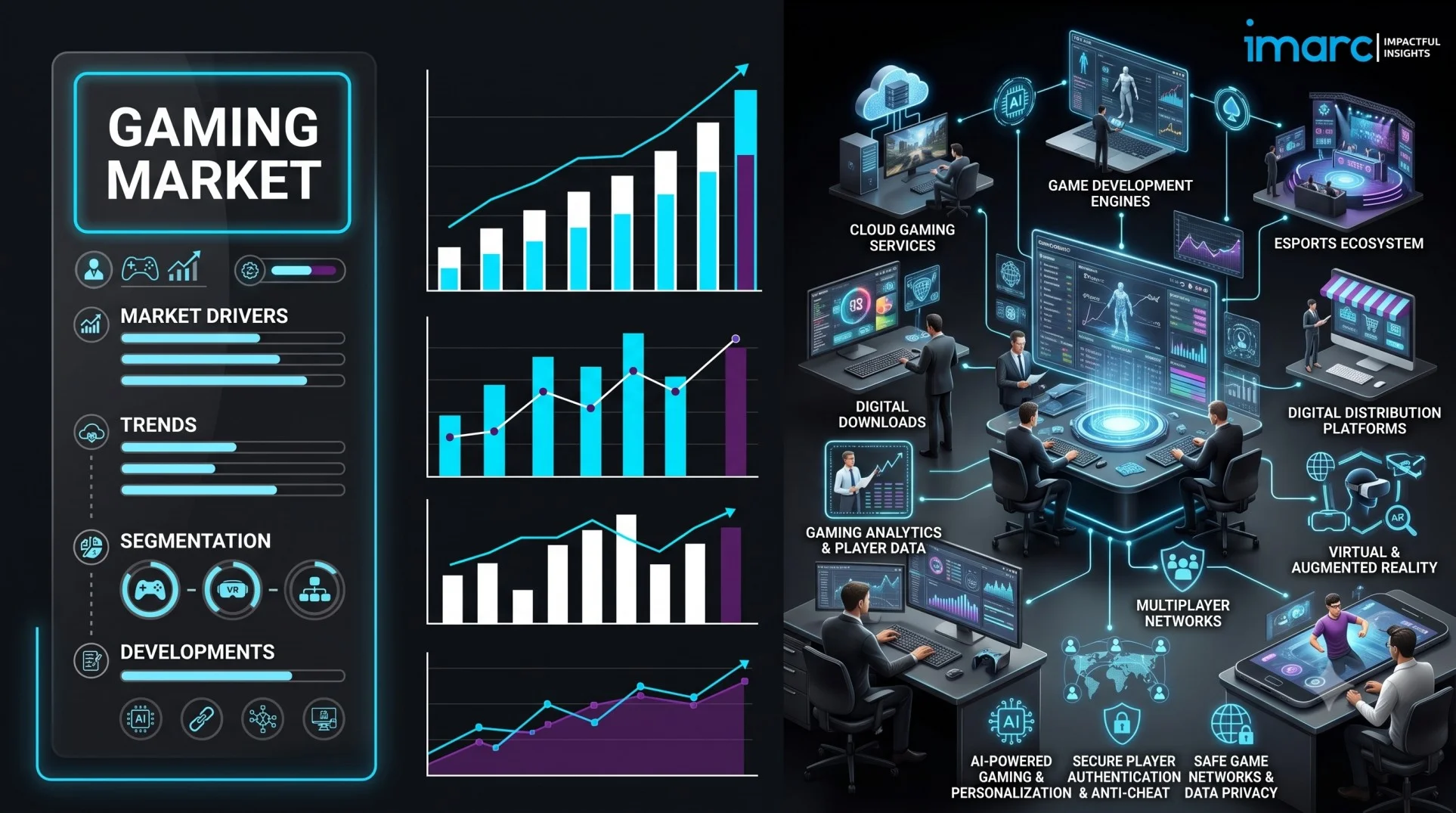
IMARC Group, a leading global market research and management consulting firm, has published its latest market intelligence report on the gaming market. The global gaming market size was valued at USD 261.1 Billion in 2025. Looking forward, IMARC Group estimates the market to reach USD 539.0 Billion by 2034, exhibiting a CAGR of 8.22% during 2026-2034, with Asia Pacific commanding the largest share at over 49.5% of global revenue. Growth continues to be driven by the rising popularity of gaming among young individuals, the emergence of esports and multiplayer competitions, and the widespread use of smartphones, tablets, and laptops for gaming.
The industry is being reshaped by consolidation at the very top of the value chain. A consortium led by Saudi Arabia's Public Investment Fund (PIF), together with Silver Lake and Affinity Partners, completed a USD 55 Billion leveraged buyout of Electronic Arts in August 2026, the largest leveraged buyout in history and the second largest video game M&A deal ever recorded, bringing franchises such as FIFA/EA Sports FC, Battlefield, The Sims, and Need for Speed under Saudi-backed ownership. Mobile continues to anchor overall market volume, with mobiles and tablets holding the largest device-type share at around 51.4%, while offline single-player experiences retain a slight edge over online formats at approximately 53.6% share.
Gaming Market at a Glance
- Market Size: USD 261.1 Billion
- Forecast Size 2034: USD 539.0 BillionGrowth Rate 2026-2034: CAGR of 8.22%
- Leading Device Type: Mobiles and Tablets, approximately 51.4% share
- Leading Platform: Offline, approximately 53.6% share
- Leading Revenue Type: In-Game Purchase, approximately 63.4% share
- Leading Genre: Adventure/Role Playing Games, approximately 41.1% share
- Dominant Region: Asia Pacific, over 49.5% revenue share
- United States Share of North America: approximately 92.10%
How AI is Reshaping the Gaming Market
- AI-Driven Live Ops and Personalization: Platform operators are leaning on AI for content discovery and matchmaking. Roblox has stated a long-term ambition to move from roughly 3.4% to 10% share of the global gaming content market, leaning partly on AI-driven personalization to surface a wider range of experiences to its 130-Million-plus daily active users rather than relying on a handful of blockbuster titles.
- AI-Optimized Hardware for Gamers: Hardware makers are embedding AI directly into gaming devices. HP's Victus 15 gaming laptop and Acer's Nitro V line both ship with AI-enhanced processors aimed at improving in-game performance and accessibility for entry-level and student gamers, reflecting how AI features are moving down-market rather than staying confined to premium rigs.
- AI-Assisted Content Creation Tools: Game engines are opening up AI-assisted creation to broaden developer ecosystems. Epic Games' Unreal Engine for Fortnite (UEFN) toolset and Google Cloud's expanded partnership with Solana Labs' GameShift platform both aim to simplify how independent studios layer advanced technology, including AI-assisted workflows, into new titles without large in-house engineering teams.
Gaming Market Trends and Drivers
Mobile gaming remains the single largest growth engine, powered by rising smartphone penetration and increasingly affordable data plans. In India alone, mobile gaming accounts for around 90% of total gaming revenue, driven by a tech-savvy population of more than 600 Million individuals under the age of 35; the sector is projected to create around 250,000 new jobs domestically over the coming decade. Globally, individuals spend an average of 6.5 hours online daily, with younger age groups spending markedly more time connected than older cohorts, directly expanding the addressable audience for mobile titles.
Esports and competitive online multiplayer formats continue to command rising investment. Saudi Arabia's Savvy Games Group, wholly owned by the PIF, has built one of the most extensive gaming and esports investment portfolios of any sovereign entity, with holdings spanning Scopely, ESL FACEIT Group, and Steer Studios, and a reported investment mandate in the tens of billions of dollars. Scopely's prior acquisition of Niantic's gaming business, including Pokemon GO, extended that portfolio's reach across hundreds of millions of players worldwide.
Platform competition is intensifying around creator economies and cross-title ecosystems. Epic Games has reported that its Fortnite ecosystem has paid out more than USD 1 Billion cumulatively to creators and developers, while its Epic Games Store reached an all-time high of 78 Million monthly active users across PC and mobile, with South Korea climbing to third place globally by revenue behind only the United States and China.
Global Regulatory, Trade, and Sustainability Landscape Shaping Demand
- Age Verification and Player Safety Compliance: Regulatory scrutiny on age verification for online platforms has begun to weigh on sign-up and engagement metrics for user-generated content platforms, pushing operators toward stronger identity and safety infrastructure even where doing so introduces near-term growth friction.
- Cross-Border Antitrust and App Store Rules: Following collaboration with the European Commission, Apple has moved to unify its business terms for developers distributing apps and alternative marketplaces across the European Union, part of a broader regulatory push affecting how gaming platforms monetize through mobile app stores.
- Foreign Investment Screening on Gaming M&A: Large cross-border gaming acquisitions, including the Electronic Arts buyout and Saudi-backed pursuits of studios such as Moonton, are increasingly subject to national security and foreign investment review processes as sovereign wealth capital becomes a larger force in the sector.
- Responsible Gaming and Consumer Protection Standards: Industry-backed initiatives such as the Game Safety Institute, founded with early investment from Underdog Fantasy's GuardDog fund, are working to establish product-safety standards and responsible gaming education, reflecting growing self-regulatory pressure across the U.S. market.
Key Government Schemes and Policy Programs Supporting the Industry
- India, AVGC Content Creator Labs and Sector Allocation: India's Union Budget dedicated a first-time allocation toward the Animation, Visual Effects, Gaming and Comics (AVGC) sector, funding Content Creator Labs across 15,000 secondary schools and 500 colleges through the Indian Institute of Creative Technologies, Mumbai, aimed at building a talent pipeline for a sector projected to need nearly 2 Million professionals.
- Tamil Nadu, AVGC-XR Policy: Tamil Nadu approved a five-year AVGC-XR policy targeting over 200 startups and a dedicated Centre of Excellence in Chennai, alongside a dedicated Research and Technology Fund and startup grants for gaming, animation, and extended-reality companies, while formally banning online money games under the same framework.
- United States, State-Level Production Tax Credits: More than 22 U.S. states now offer some form of tax credit for video game production, ranging from Texas's tiered 5 to 20% incentive structure based on spending thresholds to Louisiana's transferable 25% credit on qualifying investment, with several states adding further incentives for hiring local residents.
- European Union, Creative Europe MEDIA Games Funding: The European Commission's Creative Europe MEDIA strand runs a dedicated video games and immersive content development call offering funding of up to EUR 200,000 per project at a 60% funding rate, aimed at strengthening the global competitiveness of European studios and helping them retain intellectual property rights.
- Saudi Arabia, National Gaming and Esports Strategy: Saudi Arabia operates the world's only National Gaming and Esports Strategy as part of Vision 2030, executed through Savvy Games Group, with the Qiddiya Esports and Gaming District targeting 10 Million annual visitors and incubation support for 30 leading game development companies by 2030.
Gaming Industry Segmentation
The report has segmented the market into the following categories:
Breakup By Device Type:
- Consoles
- Mobiles and Tablets
- Computers
Mobiles and tablets stand as the largest device-type segment, holding around 51.4% share, driven by widespread smartphone adoption, improved mobile internet connectivity, and the convenience of gaming on the go, alongside a vast library of free-to-play titles.
Breakup By Platform:
- Online
- Offline
Offline gaming leads with around 53.6% share, associated largely with single-player, narrative-driven experiences that let players engage without needing a stable internet connection, particularly relevant for handheld and portable devices.
Breakup By Revenue Type:
- In-Game Purchase
- Game Purchase
- Advertising
In-game purchases lead with around 63.4% share, having become the dominant monetization model for free-to-play titles by letting developers sell cosmetic items, virtual currency, and gameplay content on an ongoing basis.
Breakup By Type:
- Adventure/Role Playing Games
- Puzzles
- Social Games
- Strategy
- Simulation
- Others
Adventure/role-playing games lead with around 41.1% share, owing to immersive storytelling, expansive open worlds, and deep character-customization systems that encourage long play sessions.
Breakup By Age Group:
- Adult
- Children
Adults lead with around 75.1% share, supported by mature, immersive game design, the growth of esports and competitive online formats, and rising disposable income available for hardware and subscriptions.
Breakup By Region:
- Asia Pacific
- North America
- Europe
- Middle East and Africa
- Latin America
Asia Pacific leads with over 49.5% share, powered by dense populations in China and India, rapid mobile gaming adoption, and thriving esports scenes in South Korea and China. Within North America, the United States accounts for approximately 92.10% of regional revenue.
Competitive Landscape
The competitive landscape is defined by rapid consolidation, exclusive content strategies, and heavy investment in cloud gaming infrastructure. Companies profiled in the report include:
- Activision Publishing, Inc.
- Apple Inc.
- Electronic Arts Inc.
- Epic Games Inc.
- KRAFTON, Inc.
- Microsoft Corporation
- NetEase, Inc.
- Nintendo Co., Ltd.
- Sony Corporation
- Tencent Holdings Limited
The buyout of Electronic Arts for USD 55 Billion has reset expectations for scale in the sector, while Saudi Arabia's Savvy Games Group continues an active acquisition pace, including a majority stake in Turkish studio Loom Games valued at up to USD 1 Billion and advanced discussions to acquire ByteDance's Moonton Technology in a deal reported in the USD 5 to 7 Billion range. Supercell's acquisition of mobile developer Metacore is expected to close by the end of September 2026, underscoring continued mid-market consolidation among mobile-first studios alongside the mega-deals at the top of the market.
Market Concentration Analysis
- Sovereign Capital Reshaping the Top of the Market: Saudi Arabia's PIF has transferred approximately USD 12 Billion in gaming equity stakes, including Nintendo, Take-Two, and Bandai Namco holdings, into Savvy Games Group, consolidating sovereign gaming exposure under a single strategic vehicle rather than spreading it across passive portfolio positions.
- Creator-Economy Platforms Competing for the Same Developer Base: Roblox and Epic Games are both racing to expand creator payouts and toolsets, with Roblox citing roughly USD 1.5 Billion paid to developers and Epic surpassing USD 1 Billion in cumulative Fortnite ecosystem payouts, showing that developer loyalty, not just player numbers, is now a key competitive battleground.
- Regional Champions Anchored by Public Investment: Government-backed vehicles such as Savvy Games Group in Saudi Arabia and the AVGC push in India demonstrate that public capital, not just private venture funding, is becoming a durable structural feature of gaming market concentration.
Recent News and Developments in the Gaming Market
- September 2026: Supercell's acquisition of Finnish mobile developer Metacore is expected to close by the end of the month, extending Supercell's push to broaden its mobile game portfolio.
- September 2026: Growth-acquisition firm Chosen, which previously acquired Nexus Mods, moved to acquire platform tracking service SteamDB, consolidating ownership of key third-party gaming data and community infrastructure tools.
- August 2026: The PIF-led consortium completed its USD 55 Billion leveraged buyout of Electronic Arts, delisting EA from the Nasdaq and bringing major franchises including FIFA/EA Sports FC and Battlefield under Saudi-backed private ownership.
- February 2026: Saudi Arabia's Savvy Games Group advanced acquisition talks for ByteDance's Moonton Technology, the studio behind Mobile Legends: Bang Bang, in a deal reported to be valued between USD 5 Billion and 7 Billion.
- February 2026: India's Union Budget allocated dedicated funding toward the AVGC sector, including Content Creator Labs across 15,000 schools and 500 colleges, positioning gaming and animation skilling as a national economic priority.
- March 2025: Morocco and France jointly launched the "Video Game Incubator" program, offering a five-month training course covering business administration, production supervision, and marketing strategy to nine video game startups.
- October 2024: SuperGaming, a leading India-based video game developer, released its mobile battle royale title Indus, featuring a distinctive double win-condition and a new "Grudge" rematch mechanic.
Note: If you require specific details, data, or insights that are not currently included in the scope of this report, we are happy to accommodate your request. As part of our customization service, we will gather and provide the additional information you need, tailored to your specific requirements.
Key Questions This Report Answers
- What is the current global gaming market size?
- Which device type and platform segments hold the largest share in the global gaming market?
- What are the key drivers of global gaming market growth?
- Which region dominates the global gaming market and why?
- How are government AVGC, esports, and gaming tax-incentive programs reshaping investment worldwide?
- Who are the top companies in the global gaming market and what are their competitive strategies?
About Us
IMARC Group is a global management consulting firm that helps the world's most ambitious changemakers create a lasting impact. The company provides a comprehensive suite of market entry and expansion services, including thorough market assessment, feasibility studies, company incorporation assistance, factory setup support, regulatory approvals and licensing navigation, branding, marketing and sales strategies, competitive landscape and benchmarking analyses, pricing and cost research, and procurement research.
Media and Sales Contact
IMARC GroupEmail: [email protected] States: +1-201-971-6302India: +91-120-433-0800United Kingdom: +44-753-714-6104