Sign up with Google
 Sign in with Zoho

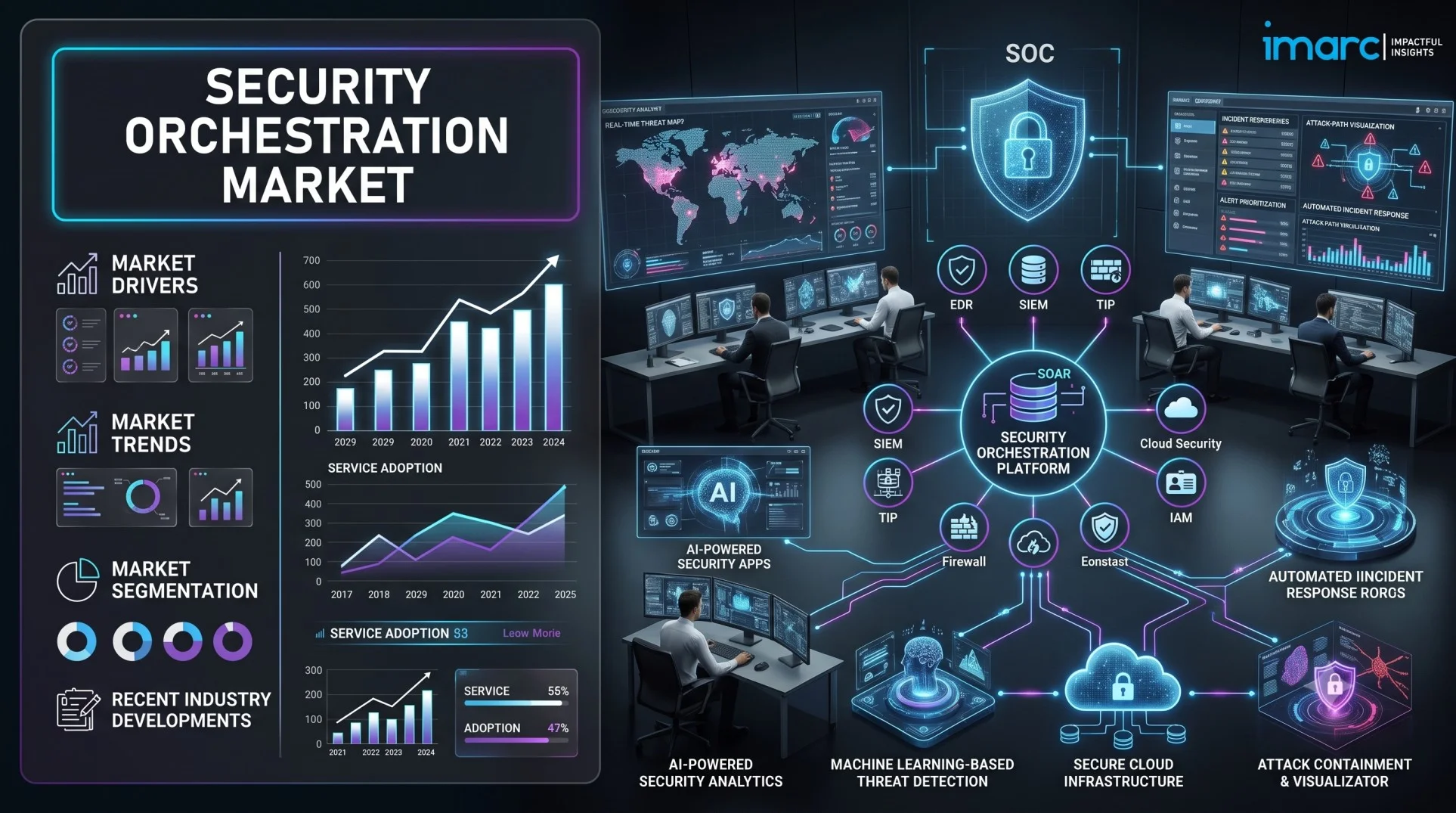
IMARC Group, a leading global market research and management consulting firm, has published its latest market intelligence report on the security orchestration market. The global security orchestration market size reached USD 4.1 Billion in 2025. Looking forward, IMARC Group expects the market to reach USD 12.8 Billion by 2034, exhibiting a growth rate (CAGR) of 12.95% during 2026-2034, with North America currently dominating global revenue share. Growth is being driven by the rising traction of bring your own device (BYOD) practices, frequent changes in network infrastructure, and the increasing availability of cost-efficient cloud-based orchestration platforms.
Security teams worldwide are consolidating fragmented tool stacks into unified platforms as alert volumes overwhelm manual triage. Palo Alto Networks closed its acquisition of IBM's QRadar SaaS assets in September 2024, migrating QRadar customers onto its Cortex XSIAM platform, which centralizes SIEM, SOAR, attack surface management, and extended detection and response into a single system, and the two companies went on to establish a joint Security Operations Center under the deal. Software continues to represent the largest share of the market by type, while large enterprises hold the majority share by organization size, reflecting the scale of tooling and headcount needed to run a modern SOC.
Security Orchestration Market at a Glance
- Market Size: USD 4.1 Billion
- Forecast Size 2034: USD 12.8 Billion
- Growth Rate 2026-2034: CAGR of 12.95%
- Leading Type: Software
- Leading Deployment Mode: Cloud-based
- Leading Organization Size: Large Enterprises
- Leading Application: Threat Intelligence
- Leading End Use Industry: IT and Telecommunication
- Dominant Region: North America
How AI is Reshaping the Security Orchestration Market
- AI-Powered Alert Consolidation: Palo Alto Networks' Cortex XSIAM platform uses AI-driven analytics to automatically consolidate raw security data into a reduced number of high-priority incidents, with case studies citing up to a 98% reduction in mean time to respond and 75% less manual work for SOC analysts.
- AI-Augmented Threat Intelligence Integration: Cisco's Splunk SOAR has been integrating Cisco Talos threat intelligence directly into its Enterprise Security and Attack Analyzer products, giving analysts AI-informed context on emerging threats without needing to manually cross-reference separate intelligence feeds.
- AI Account Visibility as a New SOC Discipline: Security researchers now flag that when an AI tool is implicated in an incident, the first SOC question is what data or systems it can access, a discovery problem distinct from traditional playbook-driven orchestration, pushing SOAR vendors to extend visibility mapping to OAuth grants and AI integrations rather than only human and machine identities.
Security Orchestration Market Trends and Drivers
Cloud-based deployment continues to gain ground over on-premises installations, as organizations of all sizes look for cost-efficient ways to integrate disparate security tools without heavy upfront infrastructure investment. This is compounding with a broader industry estimate that the global cybersecurity market is projected to approach USD 345 Billion by the close of 2026, even as spending alone cannot resolve analyst burnout driven by fragmented tools and manual alert triage.
Regulatory pressure is becoming a direct driver of orchestration adoption. The UK's Cyber Security and Resilience Bill mandates stricter incident reporting and oversight, pushing organizations to implement SOAR platforms that can automatically document every mitigation step to produce compliant, consistent audit trails. Similarly, the European Union's NIS2 Directive requires entities across 18 critical sectors to maintain risk-management measures and meet strict incident reporting timelines, a compliance burden that is accelerating demand for Managed Security Operations Center services, particularly among small and medium organizations that lack the resources to build internal security teams.
Funding momentum in the sector remains healthy, with a reported 12.9% year-over-year rise in funding for SOAR-focused companies. Meanwhile, established platform vendors continue to fold in orchestration capability through acquisition, following the pattern set by Arctic Wolf's purchase of Revelstoke to integrate its SOAR platform into a broader managed detection and response offering.
Global Regulatory, Trade, and Sustainability Landscape Shaping Demand
- EU Cybersecurity Package and NIS2 Amendments: The European Commission proposed a major new cybersecurity package in January 2026, including targeted amendments to the NIS2 Directive intended to simplify compliance for more than 28,000 companies while maintaining stricter cybersecurity resilience requirements across critical sectors.
- UK Cyber Security and Resilience Bill: The UK's incoming legislation mandates stricter incident reporting and oversight obligations, directly increasing demand for orchestration platforms capable of producing automated, audit-ready documentation of security incidents.
- India's Digital Personal Data Protection Act Enforcement: Strict enforcement of the DPDP Act is now underway, introducing significant financial penalties for data fiduciaries that fail to prevent breaches, a compliance driver pushing Indian enterprises toward stronger SOC and orchestration capabilities.
- EU Cyber Solidarity Act and Cybersecurity Reserve: The EU Cyber Solidarity Act established an EU Cybersecurity Reserve, a centrally funded mutual assistance mechanism that allows member states to draw on pre-contracted, standby incident response capacity during major cross-border cyber incidents.
Key Government Schemes and Policy Programs Supporting the Industry
- India, National Cybersecurity Strategy: India launched its National Cybersecurity Strategy in February 2026, mandating coordination among CERT-In, state police cyber units, and private sector stakeholders to strengthen detection, reporting, and response across banking, power, telecommunications, healthcare, and government services, alongside a goal of building a cybersecurity workforce of more than 500,000 professionals.
- India, SEBI Cybersecurity and Cyber Resilience Framework: SEBI's Cybersecurity and Cyber Resilience Framework requires all SEBI-regulated entities, including exchanges, brokers, and asset managers, to establish Security Operations Centres or equivalent monitoring arrangements and report cyber incidents within prescribed timelines.
- European Union, Cybersecurity Legislation Implementation Support: The EU's Support for Implementation of EU Cybersecurity Legislation and National Cybersecurity Strategies program provides direct grants to member state authorities, industry, and SMEs to build capacity around NIS2, the Cybersecurity Act, and the Cyber Resilience Act.
- European Union, National Recovery and Resilience Facility Cybersecurity Funding: EU public institutions can access Recovery and Resilience Facility funding for cybersecurity services including Managed SOC services, security audits, and certification support, though the funding must be utilized within program deadlines set for 2026.
- United States, Federal Research and Development Tax Credit: U.S. companies developing security automation and orchestration technology can claim the federal Research and Experimentation Tax Credit under Internal Revenue Code Section 41, covering qualified research expenses tied to building new detection, orchestration, and automation capabilities.
Security Orchestration Industry Segmentation
The report has segmented the market into the following categories:
Breakup By Type:
- Software
- Services
Software represents the largest share of the market, reflecting continued enterprise investment in unified orchestration platforms that centralize SIEM, SOAR, and extended detection and response capabilities rather than relying on point solutions.
Breakup By Deployment Mode:
- Cloud-based
- On-premises
Cloud-based deployment exhibits clear dominance, driven by lower upfront infrastructure costs and faster time to value compared to traditional on-premises SOC builds.
Breakup By Organization Size:
- Small and Medium-sized Enterprises
- Large Enterprises
Large enterprises hold the majority share, given the scale of security operations, headcount, and compliance obligations that justify comprehensive orchestration investment, though managed SOC offerings are increasingly extending similar capability to smaller organizations.
Breakup By Application:
- Compliance Management
- Threat Intelligence
- Ticketing Solutions
- Network Forensics
- Others
Threat intelligence represents the largest share, as organizations prioritize enriching alerts with contextual data from multiple sources to accelerate triage and reduce false positives.
Breakup By End Use Industry:
- BFSI
- IT and Telecommunication
- Government and Defense
- E-Commerce
- Others
The IT and telecommunication industry accounts for the majority of total market share, reflecting the sector's high exposure to sophisticated cyber threats and its need for advanced security to protect critical business applications.
Breakup By Region:
- North America
- Asia Pacific
- Europe
- Latin America
- Middle East and Africa
North America currently dominates the global market, supported by a dense concentration of major cybersecurity vendors and stringent regulatory requirements across finance, healthcare, and critical infrastructure sectors.
Competitive Landscape
The competitive landscape is characterized by continuous platform consolidation, with vendors acquiring point solutions to build unified security operations suites. Companies profiled in the report include:
- Accenture plc
- Amazon Web Services Inc. (Amazon.com Inc.)
- Cisco Systems Inc.
- Forescout Technologies Inc.
- International Business Machines Corporation
- Optiv Security Inc.
- Palo Alto Networks Inc.
- Swimlane Inc.
- Tufin
Palo Alto Networks has been among the most acquisitive players in the space, with its Cortex platform built on a series of purchases including Demisto for SOAR capability, Evident.io for cloud security posture management, and, more recently, IBM's QRadar SaaS assets. Cisco's Splunk SOAR continues to extend its automation footprint through integrations with Cisco Talos threat intelligence, while Arctic Wolf's acquisition of Revelstoke shows mid-market managed security providers pursuing the same consolidation logic as the larger platform vendors.
Market Concentration Analysis
- Platform Consolidation Outpacing Point Solutions: Vendors are increasingly bundling SIEM, SOAR, attack surface management, and extended detection and response into single platforms such as Cortex XSIAM, making it harder for standalone orchestration point products to compete on breadth alone.
- Regulatory Compliance as a Sales Driver: Vendors positioning their platforms around NIS2, the UK Cyber Security and Resilience Bill, and India's DPDP Act enforcement are converting compliance deadlines directly into purchasing urgency, particularly among small and medium organizations facing SOC build-versus-buy decisions.
- Managed SOC Models Gaining Ground Over In-House Builds: Analysis of EU public sector funding patterns shows Managed SOC services are increasingly viewed as more rational than building internal security teams for small and medium organizations, a trend likely to extend into the private sector as compliance pressure grows.
Recent News and Developments in the Security Orchestration Market
- August 2026: Splunk SOAR confirmed that its release scheduled for September 2026 would end support for Python 3.9, requiring all customer automations, playbooks, and custom apps to migrate to Python 3.13 or later to remain functional.
- February 2026: India launched its National Cybersecurity Strategy, mandating coordination among CERT-In, state police cyber units, and private sector stakeholders to strengthen detection, reporting, and response capabilities across critical sectors.
- January 2026: The European Commission proposed a major new cybersecurity package, including a revised Cybersecurity Act and targeted NIS2 Directive amendments, aimed at strengthening EU-wide cyber resilience while easing compliance for smaller enterprises.
- December 2025: Cisco and Splunk demonstrated a zero-touch clear text password incident response workflow at GovWare 2025, combining Splunk Enterprise Security detections with Splunk SOAR automation to fully automate the incident response process.
- September 2024: Palo Alto Networks completed its acquisition of IBM's QRadar SaaS assets, migrating customers to its Cortex XSIAM platform and establishing a joint Security Operations Center with IBM Consulting for ongoing managed security services.
Note: If you require specific details, data, or insights that are not currently included in the scope of this report, we are happy to accommodate your request. As part of our customization service, we will gather and provide the additional information you need, tailored to your specific requirements.
Key Questions This Report Answers
- What is the current global security orchestration market size?
- Which type and deployment mode segments hold the largest share in the global security orchestration market?
- What are the key drivers of global security orchestration market growth?
- Which region dominates the global security orchestration market and why?
- How are government cybersecurity strategies and compliance mandates reshaping investment worldwide?
- Who are the top companies in the global security orchestration market and what are their competitive strategies?
About Us
IMARC Group is a global management consulting firm that helps the world's most ambitious changemakers create a lasting impact. The company provides a comprehensive suite of market entry and expansion services, including thorough market assessment, feasibility studies, company incorporation assistance, factory setup support, regulatory approvals and licensing navigation, branding, marketing and sales strategies, competitive landscape and benchmarking analyses, pricing and cost research, and procurement research.
Media and Sales Contact
IMARC Group
Email: [email protected]
United States: +1-201-971-6302
India: +91-120-433-0800
United Kingdom: +44-753-714-6104