Sign up with Google
 Sign in with Zoho

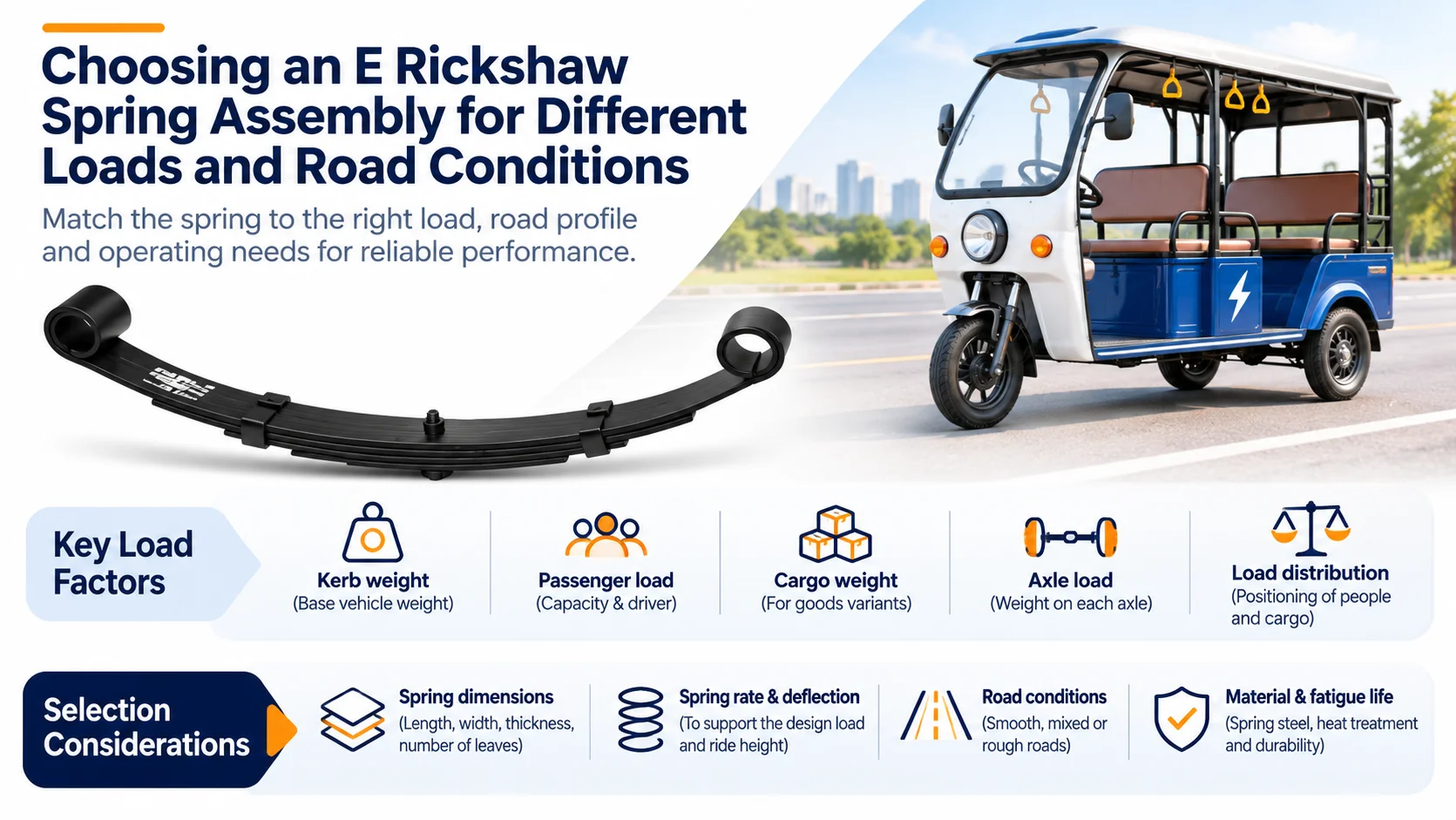
Electric rickshaws operate under changing load conditions throughout the day. A vehicle carrying passengers on a relatively smooth urban road experiences different suspension demands from one transporting heavy goods over uneven surfaces. These variations influence how the suspension responds to weight, repeated movement and road impact.
Selecting an E-rickshaw spring assembly therefore requires an understanding of the vehicle's kerb weight, intended passenger capacity, cargo requirements and typical operating conditions. The objective is to establish a suspension configuration that supports the intended load while maintaining adequate deflection, ride height, tyre clearance and predictable handling.
E Rickshaw Spring Assembly: Understanding the Load Requirements
The first step is to establish the vehicle's actual operating weight rather than relying only on its unloaded condition. Kerb weight, driver weight, passenger capacity, cargo weight and battery weight must be accounted for according to the vehicle's applicable specifications.
Load distribution is equally important. Two vehicles with similar gross weights may place different demands on their rear suspension because of variations in passenger seating, cargo placement and axle loading.
For manufacturers and component buyers, the following information provides a useful starting point:
● Kerb weight: The vehicle's weight in its specified unladen condition.
● Passenger load: The maximum intended passenger capacity, including the applicable driver allowance.
● Cargo weight: The expected goods-carrying load for cargo-oriented configurations.
● Axle load: The proportion of the vehicle's total weight supported by each axle.
● Load distribution: How passengers and cargo are positioned relative to the vehicle's axles.
These values help establish the design load and the operating range against which spring performance should be evaluated.
How Spring Dimensions Influence Suspension Performance
Spring dimensions directly influence the mechanical behaviour of a leaf spring. Important parameters include leaf width, thickness, length, number of leaves, free camber and spring rate.
Spring rate describes the relationship between the applied load and the resulting deflection. A higher spring rate means that greater force is required to produce a given amount of deflection.
However, selecting a spring simply because it has more leaves or thicker sections is not a reliable approach. The complete geometry, material properties, assembly configuration and intended loading conditions must be considered together.
Free camber, which describes the unloaded curvature of the spring, also matters. The difference between its unloaded and loaded profiles helps determine the resulting ride height and available suspension travel.
For accurate comparison, manufacturers should obtain dimensional drawings and load-deflection data rather than assessing compatibility through external dimensions alone.
Matching Spring Characteristics to Different Road Profiles
Road conditions influence how frequently and how severely a suspension system experiences dynamic loading. An e-rickshaw operating on smooth, maintained roads may encounter a different duty cycle from one regularly travelling over potholes, uneven surfaces and speed breakers.
Repeated impacts can increase the stresses experienced by suspension components. The available suspension travel and clearance must therefore be considered alongside the vehicle's static load.
An excessively stiff configuration may transmit more road disturbance to the vehicle structure and passengers. Conversely, insufficient spring support can lead to excessive deflection, reduced clearance and the possibility of suspension bottoming under demanding conditions.
The appropriate configuration should account for typical road surfaces, operating speeds, frequency of heavy loading and expected service life. It should also be evaluated with the actual mounting arrangement, tyre dimensions and surrounding body clearances.
Material Quality and Fatigue Life in Leaf Springs
A leaf spring experiences repeated loading and unloading throughout vehicle operation. Its ability to withstand these cycles depends on material properties, stress levels, manufacturing quality and the conditions in which it is installed.
Spring steel selection should consider the required strength, toughness and fatigue performance. Heat treatment, surface condition, shot peening and manufacturing consistency can also influence the finished spring's performance.
Fatigue evaluation is particularly important for vehicles operating with frequent passenger changes, repeated starts and stops, and variable road conditions.
Manufacturers should examine load-deflection characteristics and fatigue test results against the intended application. Permanent deformation, changes in free camber, cracks and unusual wear should also be investigated during inspection and validation.
Practical Checks Before Approving a Spring Assembly
A spring assembly should be evaluated as part of the complete suspension system. Even a correctly manufactured spring may perform poorly if its mounting geometry or installation conditions differ from the approved design.
Before approving a component or supplier substitution, manufacturers should verify:
● Spring length, width, thickness and free camber against the approved drawing.
● Spring rate and load-deflection behaviour against the design requirements.
● Mounting points, bush dimensions, fasteners and axle alignment.
● Loaded ride height, tyre clearance and available suspension travel.
● Material specifications, manufacturing records and relevant test documentation.
Prototype validation should include representative loading conditions. Comparing unloaded and loaded ride heights, checking suspension movement and examining the assembly after repeated operation can reveal issues that dimensional inspection alone may not identify.
Frequently Asked Questions
1. Why should an e-rickshaw spring be selected according to axle load?
The axle load determines how much weight the suspension must support. Selecting a spring using only the vehicle's total weight can overlook uneven load distribution and result in unsuitable suspension performance.
2. Does increasing the number of leaves always improve load capacity?
No. Load capacity depends on the complete spring design, including material properties, leaf dimensions, geometry, spring rate and assembly configuration. Increasing the number of leaves without evaluating these factors does not guarantee improved performance.
3. How do potholes and speed breakers affect leaf spring performance?
Repeated road impacts create additional dynamic loading and suspension movement. Depending on their severity and frequency, these conditions can increase fatigue stresses and place greater demands on spring travel and clearance.
4. What should manufacturers check when replacing an existing leaf spring?
Manufacturers should compare the replacement against the approved specifications, including dimensions, camber, spring rate, mounting geometry and material requirements. Loaded ride height and suspension clearance should also be verified before the replacement is approved.
Conclusion
Selecting a suitable suspension configuration involves more than matching a component to the vehicle's external dimensions. Passenger capacity, cargo requirements, axle loading, road conditions and expected operating cycles must collectively inform the engineering decision. Each factor contributes to how the spring responds to static weight and repeated road-induced movement.
A properly evaluated E Rickshaw Spring Assembly should meet the vehicle's specified load and suspension requirements while maintaining appropriate geometry and fatigue performance. Combining dimensional inspection, load-deflection evaluation and representative vehicle trials provides a more dependable basis for component approval, replacement and long-term suspension reliability.