Sign up with Google
 Sign in with Zoho

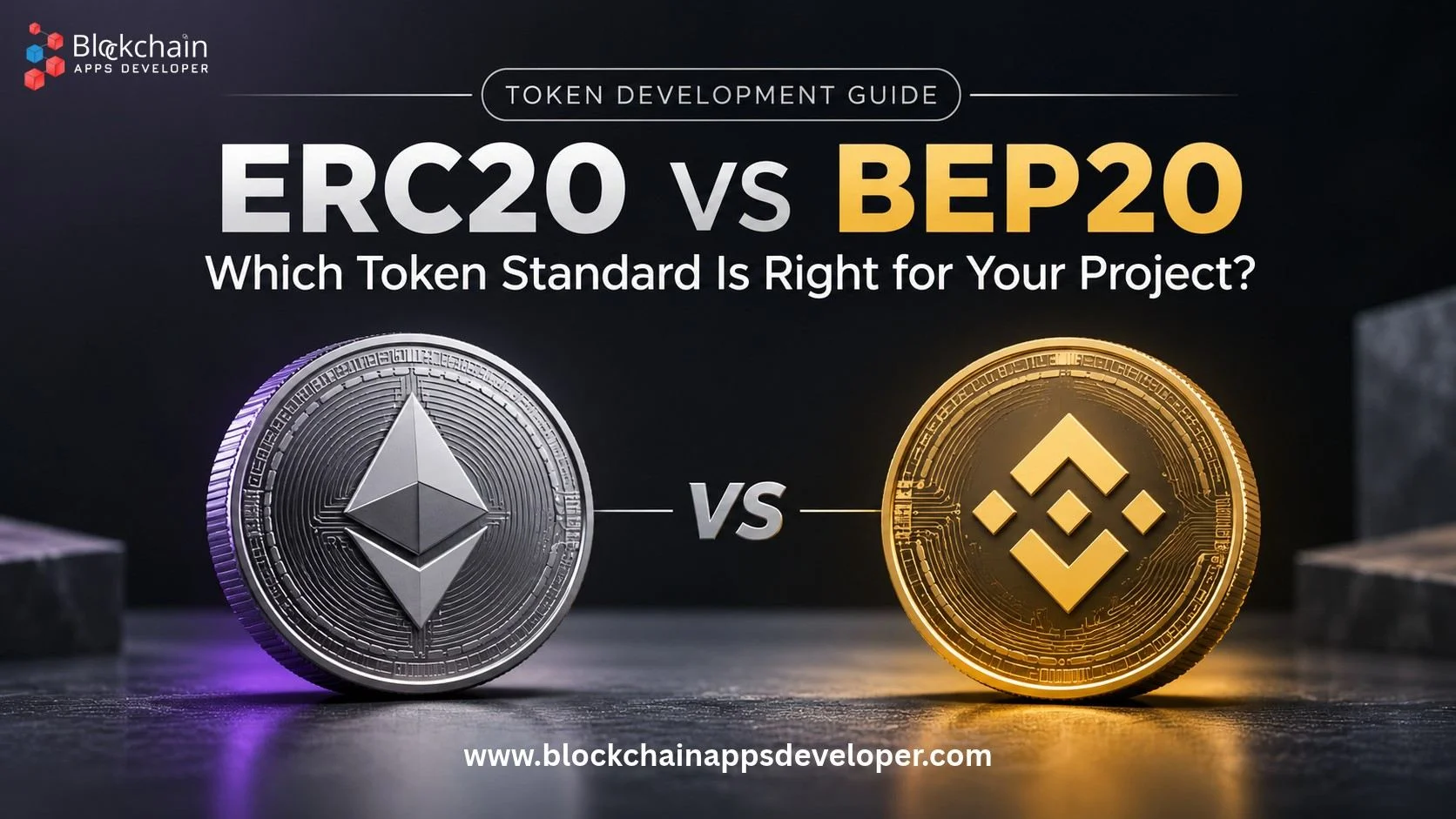
Launching a cryptocurrency token is an important step for any blockchain startup or business entering the Web3 ecosystem. But before starting development, one decision deserves careful consideration: choosing the right token standard.
ERC20 and BEP20 are two widely used token standards in the blockchain industry. Both provide a framework for creating fungible tokens, managing transfers and interacting with decentralized applications. However, they operate within different blockchain ecosystems and offer different advantages in terms of compatibility, transaction costs, infrastructure and ecosystem access.
So, which one should you choose for your project?
Whether you are planning to launch a utility token, governance token, payment token or a custom cryptocurrency, understanding the differences between ERC20 and BEP20 can help you make a more informed development decision.
Let's explore how these standards work, where they differ and which one may be suitable for your business requirements.
What Is ERC20 Token Development?
ERC20 is a technical token standard used on the Ethereum blockchain. It defines a common set of functions and events that fungible tokens should implement to interact consistently with wallets, decentralized applications and other smart contracts.
Introduced through Ethereum Improvement Proposal 20 (EIP-20), this standard makes it possible for developers to create tokens with predictable functionality.
An ERC20 token can be used for several purposes, including:
- Utility tokens for accessing platform services.
- Governance tokens for decentralized communities.
- Payment tokens within blockchain applications.
- Rewards and loyalty tokens.
- Digital assets used in DeFi applications.
For businesses, ERC20 token development provides access to Ethereum's established smart contract infrastructure and extensive ecosystem of wallets, decentralized applications and developer tools.
What Is BEP20 Token Development?
BEP20 is a fungible token standard used on BNB Smart Chain (BSC). It provides a common framework for creating tokens that can interact with compatible wallets, decentralized applications and smart contracts within the BNB Smart Chain ecosystem.
BEP20 follows an interface that is broadly compatible with ERC20, making it easier for developers familiar with Ethereum-based token development to work with both standards.
Businesses can use BEP20 tokens for:
- Utility and governance applications.
- Payments within blockchain ecosystems.
- DeFi platforms and decentralized exchanges.
- Community reward systems.
- Token-based gaming and Web3 applications.
BEP20 token development is often considered by businesses looking for EVM-compatible infrastructure and access to the BNB Smart Chain ecosystem.
ERC20 vs BEP20: Key Differences
Although both standards support fungible tokens, their blockchain environments and ecosystem characteristics are different.
Here is a comparison to help you understand the differences.
The biggest distinction is not simply how the tokens function. It is the blockchain ecosystem in which your token will operate.
1. Blockchain Network and Ecosystem
The first difference is the underlying blockchain network.
ERC20 tokens operate on Ethereum, an established blockchain ecosystem supporting decentralized finance, NFTs, decentralized applications and numerous Web3 services.
BEP20 tokens operate on BNB Smart Chain, which provides EVM-compatible smart contract functionality and an ecosystem of decentralized applications and blockchain services.
Your choice should depend on where your intended users, applications and business integrations are concentrated.
For example, if your project needs to integrate with Ethereum-based DeFi applications, ERC20 may be a suitable option.
If your target ecosystem is primarily built around BNB Smart Chain applications, BEP20 may be more appropriate.
2. Transaction Fees and Network Costs
Transaction fees are another important consideration when choosing a token standard.
On Ethereum, transaction fees are paid in ETH. The actual amount depends on network demand, transaction complexity and prevailing gas prices.
On BNB Smart Chain, transaction fees are paid in BNB. Its fee structure and network conditions differ from Ethereum's.
For projects that expect frequent token transfers or numerous on-chain interactions, transaction costs can influence the overall user experience.
However, fees are not fixed. They change according to network conditions and the complexity of the transaction.
Before choosing a network, evaluate the expected transaction volume, smart contract operations and the cost expectations of your users.
3. Smart Contract Development and Compatibility
Both ERC20 and BEP20 support smart contract-based token creation.
ERC20 follows the Ethereum token interface, while BEP20 offers a similar interface within the BNB Smart Chain ecosystem.
Developers commonly use Solidity to write smart contracts for both networks.
Depending on the project requirements, token functionality may include:
- Token name and symbol.
- Total token supply.
- Token transfers and approvals.
- Minting and burning mechanisms.
- Access control and administrative permissions.
- Vesting and token distribution.
- Additional custom functionality.
Although the standards are similar, deploying a token on one network does not automatically make it available on another. Cross-chain functionality requires additional infrastructure, such as properly designed bridge or interoperability solutions.
4. Wallet and Exchange Compatibility
Wallet compatibility plays an important role in determining how users interact with your token.
ERC20 tokens can be managed through wallets that support Ethereum and the relevant token contract.
BEP20 tokens can be managed through wallets configured for BNB Smart Chain.
Both ecosystems support popular Web3 wallet options, but users must select the correct network when sending or receiving tokens.
Exchange and platform compatibility also depend on the specific token, listing requirements, network support and integration decisions.
If your business plans to distribute tokens or integrate with exchanges, identify the required platforms and confirm their supported networks before development.
5. Security and Smart Contract Auditing
Security should be a priority regardless of whether you choose ERC20 or BEP20.
A token standard provides a framework for functionality, but it does not automatically guarantee that a smart contract is secure.
Poorly implemented permissions, incorrect token logic, access-control vulnerabilities and unsafe custom functions can create risks.
A proper development process should include:
- Smart contract code reviews.
- Functional and edge-case testing.
- Access-control validation.
- Testing of minting and burning permissions.
- Review of token distribution and vesting logic.
- Security assessments and independent audits where appropriate.
Choosing a development team with smart contract security experience can help reduce avoidable technical risks.
ERC20 vs BEP20: Which Is Better for Your Business?
There is no single answer for every token project. The right choice depends on your business model, target audience, technical requirements and long-term ecosystem strategy.
Consider ERC20 if:
- Your project is primarily focused on Ethereum.
- You want to integrate with Ethereum-based DeFi applications.
- Your users already operate within the Ethereum ecosystem.
- Your application requires Ethereum-compatible infrastructure.
Consider BEP20 if:
- Your project targets the BNB Smart Chain ecosystem.
- You want to build around BNB Smart Chain applications.
- Your users and integrations are concentrated within that network.
- You need EVM-compatible smart contract infrastructure.
Before making a decision, evaluate network fees, security requirements, liquidity considerations, wallet support and the integrations your project will need.
Can You Develop Both ERC20 and BEP20 Tokens?
Yes. A project can have token deployments on both Ethereum and BNB Smart Chain.
However, deploying two tokens with the same name or symbol does not automatically make them the same asset.
If you want to support the same economic asset across multiple networks, you need a carefully designed cross-chain architecture.
This may involve:
- Cross-chain bridge infrastructure.
- Token locking and minting mechanisms.
- Supply synchronization.
- Secure message verification.
- Monitoring and risk controls.
Cross-chain solutions introduce additional security and operational considerations. They should be planned as part of the architecture rather than added as an afterthought.
How Much Does ERC20 or BEP20 Token Development Cost?
Token development costs depend on the functionality, complexity and technical requirements of your project.
A basic token contract may require less development effort than a token ecosystem involving custom smart contract functionality, vesting, governance, staking or cross-chain integrations.
The major factors affecting development costs include:
- Token functionality: Standard transfers and approvals versus additional custom features.
- Blockchain network: Network selection and deployment requirements.
- Smart contract complexity: Custom logic, permissions and integrations.
- Security testing: Code reviews, testing and independent auditing.
- Supporting applications: Wallet integration, dashboards and token management tools.
- Post-launch support: Maintenance, monitoring and future enhancements.
Instead of choosing a token standard based only on development cost, consider the total cost of building, deploying and maintaining the complete token ecosystem.
What Should You Prepare Before Starting Token Development?
Before approaching a token development company, prepare a basic project outline.
Consider defining:
- The purpose and use case of your token.
- Your target blockchain network.
- Token supply and distribution requirements.
- Required token functionality.
- Target users and geographical markets.
- Wallet and application integrations.
- Security and compliance requirements.
- Estimated development budget and timeline.
Having these details ready makes it easier for a development team to understand your objectives and recommend an appropriate technical solution.
Why Choose BlockchainAppsDeveloper for Token Development?
Choosing the right development partner is just as important as choosing the right token standard.
At BlockchainAppsDeveloper, we work on custom blockchain and cryptocurrency token development solutions based on individual project requirements.
Our token development capabilities include:
- ERC20 token development.
- BEP20 token development.
- Custom cryptocurrency token development.
- Smart contract development.
- Tokenomics implementation.
- Token deployment and integration.
- Token-related wallet and blockchain solutions.
Whether you are launching a new utility token, developing a governance ecosystem or creating a custom digital asset, our team can help you plan the technical requirements and development approach.
Final Thoughts
ERC20 and BEP20 are both useful token standards, but they serve different blockchain ecosystems.
ERC20 is suitable for projects targeting Ethereum's established infrastructure, while BEP20 is an option for businesses building within the BNB Smart Chain ecosystem.
The best decision depends on your project's purpose, target audience, technical requirements and future expansion plans.
Before starting development, take time to evaluate these factors and select a token architecture that supports your long-term business objectives.