Sign up with Google
 Sign in with Zoho

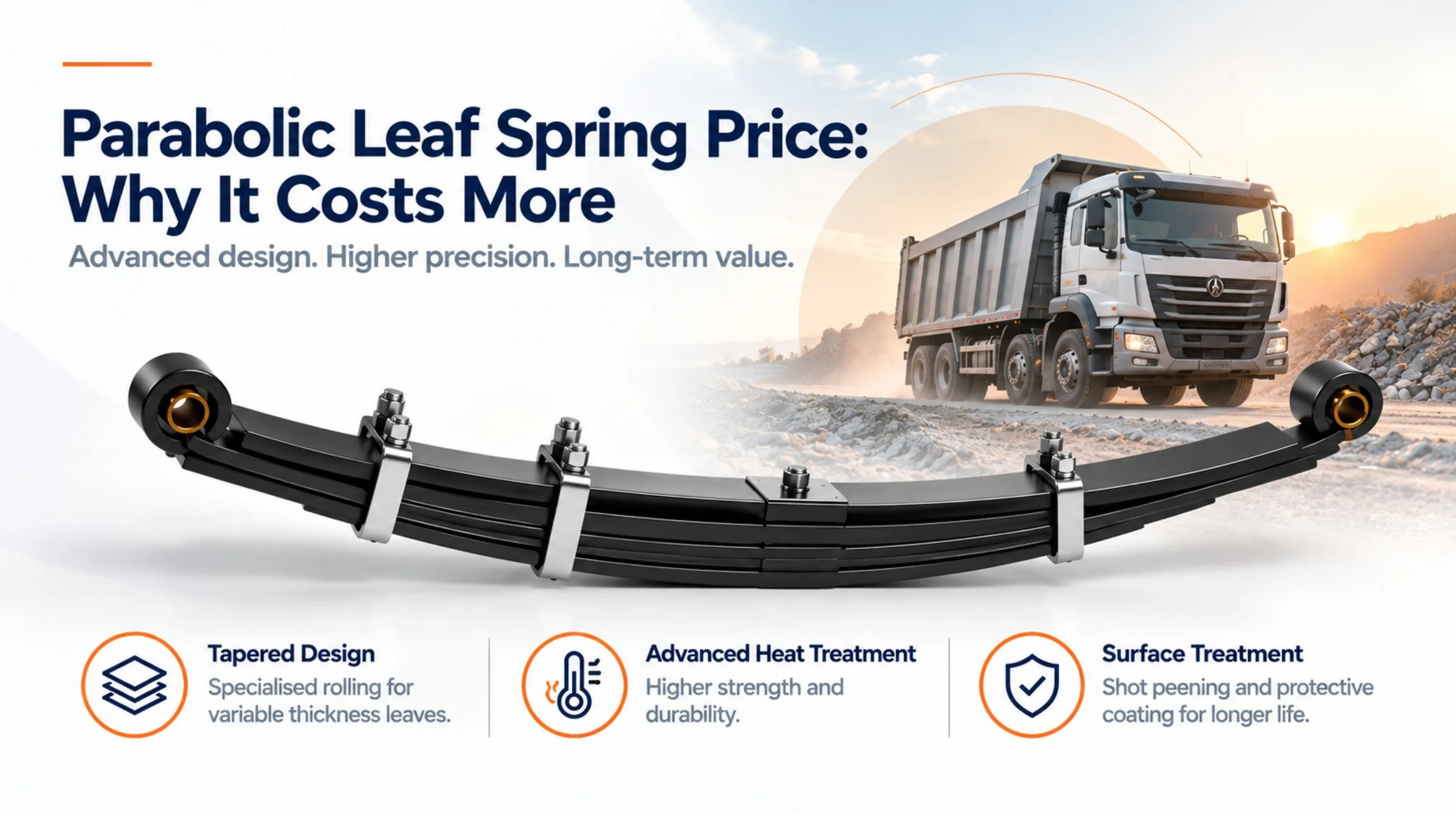
A parabolic leaf spring usually costs more than a conventional multi-leaf spring of similar capacity. Fleet owners and workshop managers fairly ask what the extra money buys and whether it ever comes back. The answer lies partly in how the spring is made and partly in how the vehicle is used. This guide explains what makes a parabolic spring different, why it costs more to manufacture and how a fleet can work out whether the payback suits its routes.
What Makes a Parabolic Leaf Spring Different
A conventional spring stacks many flat leaves of equal thickness and different lengths. A parabolic leaf spring uses fewer leaves, each tapered so it is thick at the centre and thin towards the ends. The taper follows a curve that spreads stress more evenly along the leaf.
The leaves touch mainly at the centre and the ends, with small gaps in between. That reduces rubbing between leaves. Sonico manufactures parabolic leaf springs.
To see where the extra cost comes from, look at how leaf springs are made.
How Are Leaf Springs Made?
Both conventional and parabolic springs follow a similar sequence. Spring steel bars are cut to length. For parabolic leaves, each leaf is then taper rolled. The ends are formed into eyes or other end shapes, and the leaves are heated and bent to the required curve. Quenching and tempering, a controlled cycle of rapid cooling and reheating, gives the steel its strength and springiness. Shot peening follows, then painting or coating, and finally assembly and load testing. Each step affects how long the spring lasts, which is why manufacturing quality matters so much.
Several steps in that process cost more for parabolic leaves.
Why a Parabolic Leaf Spring Costs More to Make
Three parts of the manufacturing process add most of the extra cost.
Taper Rolling
Each leaf is rolled from flat steel to a changing thickness along its length. This needs specialised rolling machines and tight process control, because the taper decides how stress is shared.
Steel Quality and Heat Treatment
With fewer leaves carrying the load, each leaf works harder. Steel quality and heat treatment, the controlled heating and cooling that sets the steel's strength and springiness, matter even more than in a multi-leaf spring.
Surface Treatment
Parabolic leaves are typically shot peened: the surface is blasted with small steel shot, which improves resistance to fatigue cracking. Protective coatings are then applied.
The same steps explain why prices differ between suppliers.
What Drives Parabolic Spring Price Differences Between Suppliers
Parabolic spring price can vary between suppliers for the same size. Differences in steel grade, heat treatment control, shot peening coverage, coating quality and testing all affect cost. A lower price can reflect savings in any of these steps, so compare specifications, not just the number on the quote.
A side-by-side comparison sums up the two spring types.
Taper Leaf Spring vs Multi-Leaf: Quick Comparison
The higher price only makes sense if the spring pays back.
Where Parabolic Leaf Springs Can Pay Back
A lighter spring set can increase legal payload on weight-limited routes, because every kilogram saved on the vehicle can be carried as cargo. The size of the saving depends on the design and the spring it replaces.
Less friction between leaves gives a smoother ride, which reduces shock to the chassis, the cab and the cargo. Fewer leaves also mean fewer parts to inspect.
Multiplying payload gained, trips and value per tonne gives the yearly gain. Compare that with the extra cost to see how many months the spring takes to pay back.
Parabolic springs are not the right answer for every fleet.
When a Conventional Spring Still Makes Sense
Conventional multi-leaf springs remain a sound choice for regular heavy overloading, for rough off-road work where the redundancy of many leaves is valued, and where the upfront budget is tight. Fleets deciding when to switch can compare duty cycles route by route, keeping conventional springs where loads are unpredictable and moving to parabolic springs where weight matters most.
For fleets that do switch, a few questions help choose the right product.
Questions to Ask Before Buying Parabolic Springs
Ask the supplier which steel grade is used and how the leaves are heat treated. Ask whether every leaf is shot peened and how the spring is tested before dispatch. Confirm the rated load and whether the spring suits your axle and mounting points. Ask about warranty terms and how the supplier handles failures. Clear answers to these questions are a good sign of a manufacturer that controls its process.
Once fitted, good habits protect the investment.
Getting the Most from Parabolic Leaf Springs
Load within the rated capacity, keep U-bolts tightened to the specified torque and inspect eyes, bushes and clamps at each service. Because parabolic leaf springs have fewer leaves, a crack in one leaf affects a larger share of the load, so regular inspection matters even more than with multi-leaf springs.
FAQs
Here are answers to common questions about parabolic leaf springs.
1. Why are parabolic springs more expensive?
Because of taper rolling, higher demands on steel and heat treatment, and surface treatments such as shot peening.
2. Are parabolic springs worth it for every truck?
Not for every duty cycle. They suit weight-sensitive, mostly on-road operation best.
3. Can I fit parabolic springs to my existing truck?
Check mounting dimensions, rated capacity and any approvals needed before switching.
4. Do parabolic springs need different maintenance?
There are fewer leaves to inspect, but check eyes, bushes and clamps regularly.
5. How long do parabolic leaf springs last?
Life depends on load, roads, maintenance and manufacturing quality. Keeping within rated load and inspecting regularly gives the best service life.
Conclusion
A parabolic leaf spring costs more because each leaf is shaped, heat treated and finished with more care. The payback comes through payload, ride quality and simpler inspection, and a simple worksheet shows whether it suits your routes, your loads and your budget. Sonico manufactures the parabolic leaf spring; share your axle load and route profile to get the right specification.



.webp)