
 Sign up with Google
 Sign in with Zoho

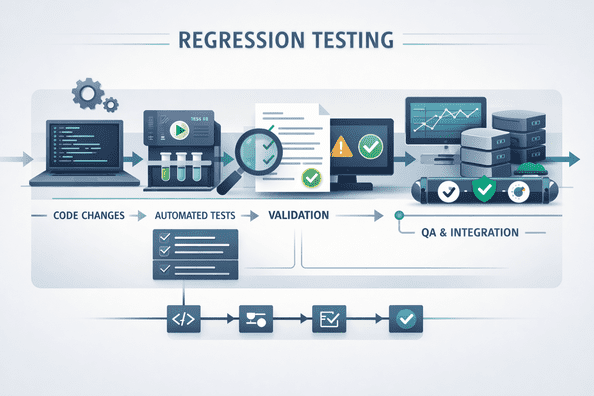
Modern software systems are increasingly built using distributed architectures and microservices. This approach improves scalability and flexibility, but it also introduces new challenges in maintaining system stability. When multiple services interact across networks, even a small change can ripple through the system in unexpected ways.
This is where regression testing becomes critical. The goal is to ensure that existing functionality continues to work as expected after changes are introduced. In distributed systems, this responsibility becomes more complex because failures are often indirect and difficult to trace.
Why Regression Testing Is Harder in Microservices
In monolithic systems, changes are usually contained within a single codebase. In microservices, each service evolves independently. This creates several challenges:
- Services depend on each other through APIs
- Data flows across multiple services before reaching the user
- Different teams deploy changes at different times
- Failures can originate from network latency or external dependencies
Because of this, traditional regression testing approaches that focus on isolated components are not enough.
Key Challenges in Distributed Regression Testing
Before defining strategies, it is important to understand where things typically go wrong.
1. Hidden Service Interactions
A change in one service may affect another service that depends on it, even if there is no direct code connection. These interactions are often missed in basic test setups.
2. Inconsistent Test Environments
It is difficult to replicate production-like environments for multiple services. Missing dependencies or configuration differences can lead to false confidence in test results.
3. Data Dependency Issues
Distributed systems rely heavily on shared or flowing data. Changes in schema or data structure can break downstream services in subtle ways.
4. Delayed Failures
Some issues do not appear immediately. They may surface only after a sequence of interactions, making them harder to detect during testing.
Effective Regression Testing Strategies
To handle these challenges, regression testing in software testing must be adapted to the nature of distributed systems.
1. Focus on Service Contracts
APIs act as contracts between services. Validating these contracts is essential.
Teams should:
- Test request and response formats
- Ensure backward compatibility
- Validate changes against existing consumers
Contract testing helps prevent integration issues before they spread.
2. Prioritize End-to-End Workflows
Testing individual services is not enough. It is important to validate complete workflows that span multiple services.
Examples include:
- User authentication followed by data retrieval
- Order placement and payment processing
- Data updates triggering downstream actions
End-to-end testing ensures that services work together as expected.
3. Use Realistic Test Scenarios
Synthetic test cases often miss real-world complexity.
Instead:
- Use real usage patterns
- Include edge cases based on actual behavior
- Simulate realistic sequences of actions
This improves the chances of catching hidden issues.
4. Automate Selectively
Automation is essential, but running all tests for every change can slow down pipelines.
A better approach is to:
- Run critical regression tests for every change
- Schedule full regression suites periodically
- Trigger specific tests based on impacted services
This keeps testing efficient without compromising coverage.
5. Maintain Service Dependency Awareness
Understanding how services depend on each other is key.
Teams should:
- Map service interactions
- Track which services are affected by changes
- Use this information to select relevant tests
This reduces unnecessary testing and improves accuracy.
6. Handle Data Changes Carefully
Schema changes are a common source of regression issues.
To manage this:
- Validate data compatibility across services
- Test with both old and new data formats
- Ensure backward compatibility wherever possible
This helps prevent data-related failures.
7. Incorporate Real System Interactions
One of the most effective ways to improve regression testing in distributed systems is to use actual system behavior.
Some teams use tools that capture real API interactions and convert them into test cases. Keploy is one such tool that enables this approach. By testing with real traffic patterns, teams can detect issues that are difficult to anticipate manually.
8. Strengthen Observability for Faster Feedback
In distributed systems, testing and monitoring go hand in hand.
Teams should:
- Use logs to trace service interactions
- Monitor metrics to detect anomalies
- Track request flows across services
Better visibility helps identify issues quickly when tests fail.
Common Mistakes to Avoid
Even with the right strategies, teams often face problems due to common mistakes:
- Relying only on unit tests
- Ignoring cross-service interactions
- Running large test suites without prioritization
- Failing to update tests as services evolve
- Treating all services as equally critical
Avoiding these mistakes improves both efficiency and reliability.
Real-World Perspective
In real-world microservices systems, regression issues are rarely straightforward. They often involve multiple services, data inconsistencies, and timing-related problems.
Teams that adopt effective regression testing strategies:
- Detect issues earlier in the pipeline
- Reduce the risk of cascading failures
- Maintain stability across frequent deployments
- Improve confidence in releases
This becomes especially important as systems scale.
Practical Takeaways
To improve regression testing in distributed and microservices systems:
- Validate service contracts consistently
- Focus on end-to-end workflows
- Use realistic test scenarios
- Automate testing strategically
- Maintain awareness of service dependencies
- Handle data changes carefully
These practices help teams manage complexity without slowing down development.
Conclusion
Distributed systems bring flexibility and scalability, but they also introduce new risks. Regression testing must evolve to address these challenges.
By focusing on interactions between services, realistic scenarios, and efficient automation, teams can ensure that their systems remain stable even as they continue to grow and change.












.webp)