Sign up with Google
 Sign in with Zoho

App downloads used to be the number every fitness brand celebrated. In 2026, that number means very little on its own. Fitness App User Engagement — not install count — is what separates apps that grow into long-term products from apps that quietly get deleted after two weeks.
Most users open a new fitness app with real motivation. That motivation fades fast if the app doesn't adapt to them. Without personalization, real-time feedback, and a reason to come back tomorrow, even a well-designed app becomes another abandoned icon on the home screen.
What is the most effective fitness app engagement strategy in 2026? The most effective strategy combines personalized experiences, AI-powered recommendations, wearable integration, gamification, social accountability, frictionless onboarding, meaningful progress tracking, and structured retention loops — not just more features.
Modern fitness apps are shifting from simple workout trackers into personalized digital fitness ecosystems, powered by AI, wearable data, community features, and real-time coaching. Brands that treat engagement as a single strategy, rather than a checklist of add-ons, are the ones seeing the strongest results this year.
Key Takeaways
- Downloads create opportunity, but engagement is what determines whether an app survives past the first month.
- A connected growth loop — acquire, activate, personalize, engage, retain, monetize, re-engage — outperforms isolated feature additions.
- AI-powered personalization and wearable integration are the two biggest engagement drivers for 2026.
- Gamification and community features build habits, but should stay tied to real fitness outcomes to avoid feeling gimmicky.
- Retention should be measured through DAU/MAU ratio, cohort-based Day 1/7/30 retention, and churn rate — not downloads alone.
- Corporate wellness is a fast-growing, UAE-specific opportunity for fitness brands looking to expand beyond direct-to-consumer users.
- The right development partner — with AI, wearable, and scalability expertise — is often the deciding factor between a functional app and a genuinely engaging one.
Why Fitness App User Engagement Matters More Than Downloads
Downloads do not guarantee active users. Acquisition gets someone through the door; activation is what gets them to open the app a second time. A high download count with low activation is a sign of a broken first experience, not a successful launch.
Fitness App Engagement drives retention and lifetime value. Daily and weekly active usage, session frequency, workout completion rates, feature adoption, and subscription conversion all trace back to how engaged a user feels in the first few sessions. An app that earns daily attention earns long-term revenue.
Retention is becoming the real competitive advantage. Fitness businesses are moving away from an acquisition-only mindset and focusing on consistency, accountability, and clear value delivery. Recent industry research points to a more retention-focused fitness app environment across 2026, where user lifetime value matters more than raw sign-up volume.
The 2026 Fitness App Engagement Strategy: From Downloads to Daily Habits
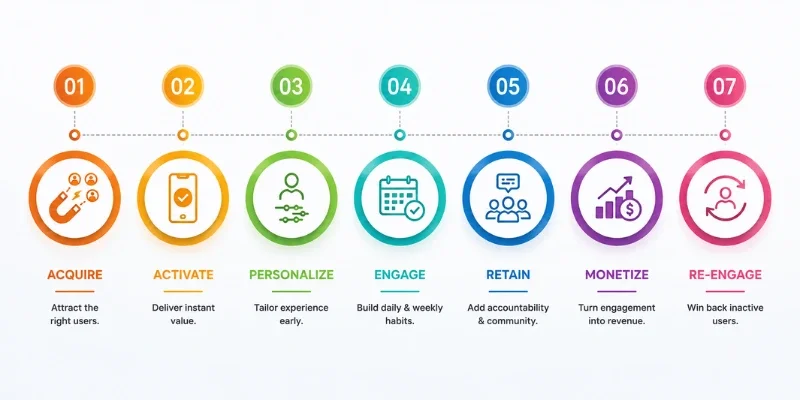
A strong Fitness App Growth Strategy follows a continuous user journey rather than isolated features:
Acquire → Activate → Personalize → Engage → Retain → Monetize → Re-Engage
- Attract the right audience — target users whose goals match what the app actually delivers.
- Create a fast, frictionless first experience — minimal sign-up steps, instant value.
- Deliver immediate personalization — goals, fitness level, and preferences captured early.
- Build daily and weekly engagement loops — habits form through repetition, not one-time features.
- Create accountability and community — shared goals keep users coming back.
- Use data to improve retention — behavioral signals should shape the product continuously.
- Convert engagement into long-term revenue — subscriptions, premium coaching, and partnerships.
Apps that follow this full loop consistently outperform apps that simply bolt on new features without a connected strategy.
10 Fitness App Features for User Engagement That Matter in 2026
A well-built product needs the right Fitness App Features for User Engagement, working together rather than sitting as isolated screens:
- AI-powered personalized workout plans — adaptive routines based on goals, fitness level, and behavior.
- Real-time activity and performance tracking — steps, calories, heart rate, distance, and trends.
- Wearable device integration — smartwatches, trackers, heart-rate monitors, and sleep data feeding continuous insights.
- Gamification and achievement systems — badges, points, streaks, levels, and challenges.
- Social fitness and community features — friend challenges, leaderboards, and group workouts.
- Smart push notifications — contextual, personalized nudges instead of generic reminders.
- Progress tracking and visual analytics — dashboards showing milestones and historical comparisons.
- Nutrition and wellness integration — meals, hydration, sleep, and recovery in one place.
- Live and on-demand fitness content — trainer-led sessions and personalized content recommendations.
- AI fitness coaching and conversational assistance — real-time guidance that feels personal, not automated.
Market research consistently points to AI-powered coaching, predictive analytics, wearable connectivity, social-driven engagement, and real-time feedback as the strongest engagement directions for fitness apps this year.
How AI Personalization Is Changing Fitness App Engagement
How does AI improve fitness app engagement? AI improves engagement by analyzing user behavior to deliver adaptive workout recommendations, predicting when a user is likely to disengage, and personalizing notifications and content in real time. This reduces generic experiences and increases the relevance of every interaction, which keeps users coming back more consistently.
Beyond workout suggestions, AI-based user profiling helps apps understand fitness level, pace, and preferences from day one. Predictive engagement models can flag early churn signals — a missed streak, a drop in session length — before a user fully disengages, allowing the app to intervene with the right nudge at the right time.
How Wearable Integration Creates a More Engaging Fitness Experience
Wearables turn a fitness app from a static tracker into a living feedback loop:
Wearable Data → AI Analysis → Personalized Recommendation → User Action → Progress Feedback
Smartwatch and fitness band integration, continuous heart-rate monitoring, sleep tracking, and real-time workout feedback all reduce manual data entry — one of the biggest friction points in fitness apps. Regional research on the UAE fitness app market specifically identifies activity tracking as a particularly strong growth area, making wearable integration a high-value investment for brands building for this market.
Gamification and Community: Turning Fitness Goals Into Repeatable Habits
Motivation naturally dips after the first few weeks, which is exactly where gamification earns its place. Streaks build consistency by rewarding daily return visits. Challenges encourage active participation, and rewards reinforce the habit loop rather than just performance outcomes. Social competition — leaderboards, friend challenges — adds accountability that a solo tracker can't replicate. The key is balance: over-gamifying can feel gimmicky and cheapen genuine progress, so rewards should always tie back to real fitness outcomes.
Why is community important for fitness app retention? Community creates accountability and a sense of belonging, which makes users significantly more likely to return compared to a purely transactional workout tracker. Friend-to-friend challenges, group goals, and trainer interaction all reinforce this effect.
Fitness App Retention Strategies That Turn First-Time Users Into Long-Term Customers
Strong Fitness App Retention Strategies focus on the full lifecycle, not just onboarding:
Beyond onboarding, brands should identify churn signals early — drops in session frequency, incomplete workouts, ignored notifications — and respond with targeted re-engagement campaigns. Apple's App Store analytics guidance also emphasizes retention as a key indicator of long-term app health, recommending analysis across cohorts and time periods rather than a single snapshot metric.
From Engagement to Revenue: Building a Sustainable Growth Funnel
Engagement only matters commercially if it converts. The funnel typically looks like this:
User Acquisition → Activation → Engagement → Retention → Subscription → Advocacy
Freemium-to-premium upgrades, subscription-based coaching, corporate wellness partnerships, in-app purchases, and B2B gym partnerships are the most common monetization paths. A thoughtful fitness app development roadmap should map these revenue points against the engagement journey from the start, rather than retrofitting monetization after launch.
Why Corporate Wellness Is a Major Growth Opportunity in the UAE
Corporate wellness is quickly becoming one of the strongest growth channels for fitness technology in the region. Employer-sponsored fitness programs, employee wellness dashboards, team leaderboards, HR-facing analytics, and wearable integration all extend a fitness app's reach into the workplace. The UAE corporate wellness market is projected to grow from approximately $266.1M in 2026 to $353.6M by 2033, and the broader UAE wellness apps market is also expanding strongly — making this a genuinely relevant expansion path for fitness brands operating in the region. Businesses exploring employee wellness platforms can also benefit from Corporate Wellness Fitness App Development UAE solutions that combine fitness tracking, engagement challenges, personalized wellness programs, and organizational analytics.
How to Measure Fitness App User Engagement and Retention
Reliable measurement should go well beyond downloads:
- Daily Active Users (DAU) and Monthly Active Users (MAU)
- DAU/MAU ratio (a core stickiness indicator)
- Session frequency and average session duration
- Workout completion rate and feature adoption rate
- Day 1, Day 7, and Day 30 retention
- Churn rate and customer lifetime value
- Subscription conversion rate and re-engagement rate
A simple working formula: Fitness App Engagement Rate = Meaningful User Actions ÷ Active Users × 100. Brands that track this alongside retention cohorts — rather than downloads alone — get a far more honest picture of product health.
What Brands Should Avoid When Trying to Increase Engagement
Common mistakes include adding too many features without user research, sending excessive push notifications, ignoring personalization, building complicated onboarding flows, focusing only on acquisition, neglecting accessibility and UX, failing to protect user data, and not optimizing for wearable ecosystems. More features rarely equal more engagement — the goal is relevance, not volume.
A Practical 90-Day Roadmap for Fitness App Engagement
- Days 1–30: Fix activation — onboarding, goal capture, personalization, first workout, analytics setup.
- Days 31–60: Improve engagement — AI recommendations, gamification, smart notifications, challenges, social features.
- Days 61–90: Improve retention and monetization — churn prediction, retention campaigns, subscription optimization, premium features, A/B testing.
This phased approach keeps teams focused on one measurable outcome at a time instead of shipping features without a clear engagement goal.
Why Choosing the Right Development Partner Matters
Building an engagement-first fitness product requires more than good UI. It needs a partner who understands AI/ML, wearable integration, cloud infrastructure, API integrations, data analytics, scalable architecture, security, and continuous post-launch optimization. Choosing an experienced fitness application development company can help businesses create scalable digital fitness products that combine user-centric UX, personalization, analytics, and engagement-driven features from day one.
Businesses targeting the UAE market specifically benefit from working with a specialized fitness app development company dubai that understands regional user behavior, corporate wellness requirements, and local business priorities — rather than applying a generic global template.
Why SISGAIN Technologies Is Important for Fitness App Development
SISGAIN brings experience across healthcare, fitness, and digital technology — a combination that matters as fitness apps increasingly overlap with wellness, preventive health, remote monitoring, and connected wearable ecosystems.
AI and personalization are used to power adaptive workout recommendations, intelligent coaching, user behavior analysis, and engagement prediction, moving products beyond generic workout libraries.
Scalable architecture — cloud infrastructure, API integrations, and real-time data processing — ensures the product can support growing user bases without performance drops.
Wearable and third-party integration connects smartwatches, fitness trackers, and health platforms so users get a continuous, low-friction data experience.
Engagement-first UX is built around simple onboarding, personalized dashboards, gamification, social features, and clear retention mechanisms rather than feature bloat.
For the UAE and enterprise market, this translates into solutions for gyms, wellness brands, healthcare organizations, and corporate wellness programs, backed by continuous post-launch optimization — analytics, A/B testing, and ongoing feature refinement based on real user behavior.
Looking to build a fitness app that keeps users engaged beyond the first download? Partner with SISGAIN Technologies to create a scalable, personalized, and engagement-focused fitness solution designed around your business goals.
The Future of Fitness App User Engagement in 2026 and Beyond
Expect continued momentum around AI-powered adaptive fitness, predictive engagement and churn prevention, wearable-first fitness ecosystems, integrated fitness and wellness platforms, corporate wellness and employee fitness programs, social and community-driven fitness, real-time health insights, and conversational AI fitness coaches. Current market direction points to hyper-personalization, predictive analytics, and connected health ecosystems as the defining themes for the next several years.

Conclusion
Downloads open the door, but engagement is what keeps users walking through it every day. Retention builds long-term value, personalization keeps the experience relevant, AI makes every interaction smarter, wearables make tracking effortless, and community turns individual effort into shared accountability. Brands that treat these as one connected strategy — backed by continuous data — are the ones building fitness apps that last well beyond the first download.
Frequently Asked Questions ?
How do fitness apps increase user engagement?
By combining personalized workout recommendations, wearable data, gamification, community features, and smart notifications into a connected user journey rather than isolated features.
What are the best fitness app retention strategies in 2026?
Personalized onboarding, habit-based engagement loops, streak-based gamification, social accountability, and early churn detection consistently drive the strongest retention results.
Which fitness app features for user engagement are most important?
AI-powered personalization, wearable integration, gamification, real-time progress tracking, and conversational AI coaching are the highest-impact features in 2026.
How does AI improve fitness app engagement?
AI analyzes user behavior to personalize workouts, predict churn, and deliver timely, relevant notifications — making every interaction feel individually tailored.
How can wearable integration improve fitness app retention?
It reduces manual tracking effort and creates a continuous data-insight-action feedback loop that keeps users engaged with minimal friction.





.webp)