Sign up with Google
 Sign in with Zoho

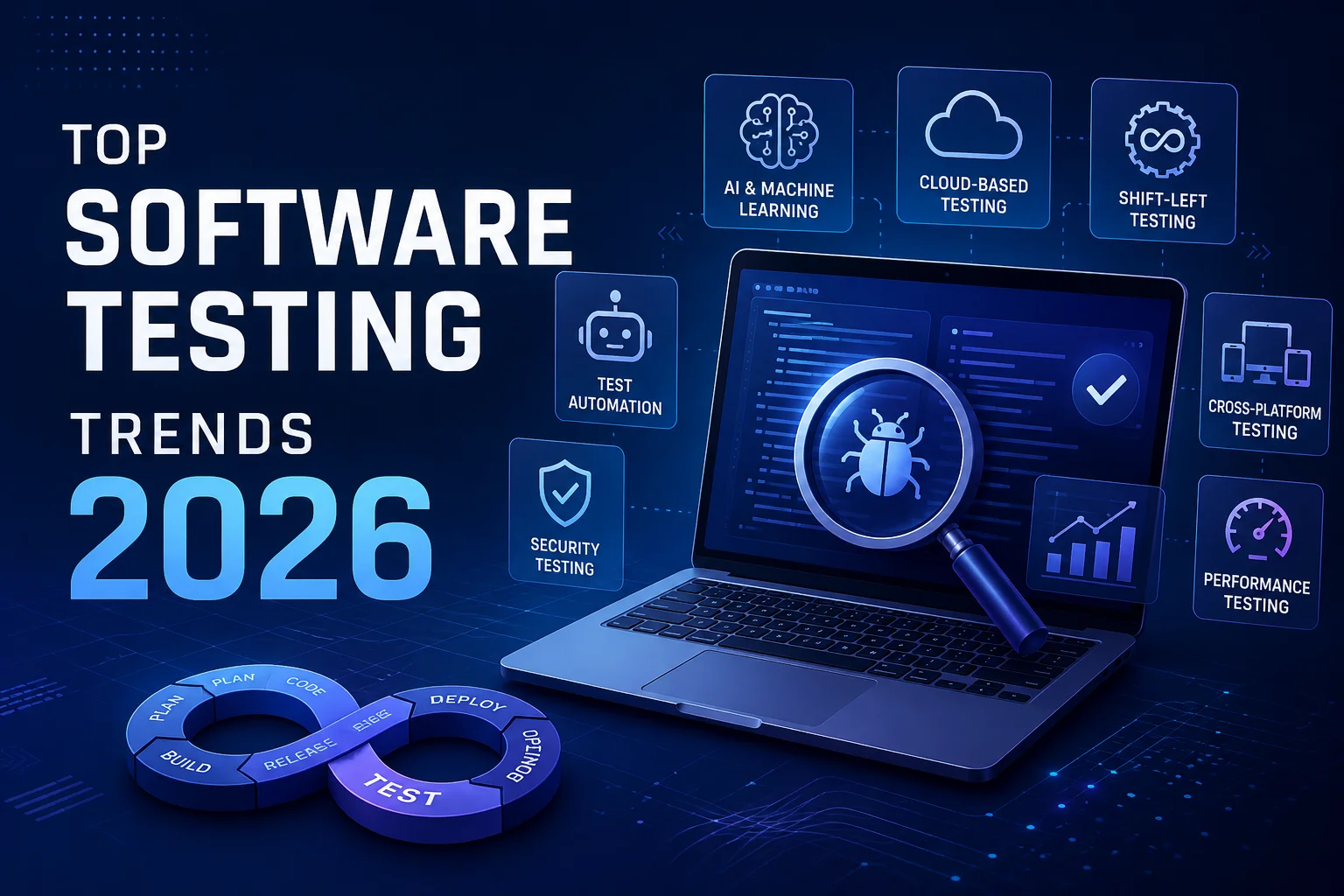
Software development is moving at a pace that conventional testing methods can no longer support. Quicker release cycles, intricate application architectures, and surging user expectations are fundamentally changing how digital quality is managed. As a result, software testing trends in 2026 are tightly centered on smarter automation, continuous validation, and advanced engineering practices designed to help teams deliver highly reliable software without slowing innovation.
Emerging Software Testing Trends for Modern QA Teams
Let’s explore the pivotal shifts in quality assurance that are transforming daily workflows, maximizing deployment confidence, and ensuring software successfully meets demanding compliance and performance requirements.
1. Shift-Left and Shift-Right Testing — Testing Everywhere
The standard software lifecycle historically treated validation as a final gateway before launch. Today, testing is an omnipresent workflow spanning early conceptual designs up through active production environments.
- Shift-Left Practices: Quality validation begins at the requirements phase. Teams build initial API test parameters and design semantic accessibility structures before frontend coding starts, preventing structural bugs when they are cheapest to fix.
- Shift-Right Operations: Testing extends directly into production via canary deployments, synthetic user monitoring, and feature flagging. This balances early simulation with live environmental data.
2. Continuous Testing in CI/CD — Testing Never Stops
Continuous testing has evolved from an aspirational DevOps buzzword into mandatory engineering infrastructure. Instead of isolated verification phases, automated pipelines execute highly parallelized validation hierarchies on every individual code commit.
Parallel test execution delivers feedback loops within minutes rather than hours. This immediate visibility empowers engineering teams to address regression errors before they cascade into complex deployment bottlenecks.
3. Test Automation Expansion — Beyond Web UI Testing
As microservices and headless architectures dominate software designs, automation has expanded far beyond basic browser manipulation. API testing has emerged as a core priority over traditional frontend UI testing.
API automation runs significantly faster, provides isolated business logic verification, and maintains higher stability. It isolates underlying systems from presentation layer adjustments, making it the ideal framework for modern application integration.
4. Security Testing Integration — Security as a Continuous Priority
With escalating regulatory mandates and complex cloud architectures, Enterprise cybersecurity solutions cannot be relegated to pre-release audits. Security is now integrated directly into standard continuous integration pipelines.
- Static & Dynamic Analysis: Teams utilize automated Static Application Security Testing (SAST) during local development, alongside Software Composition Analysis (SCA) to identify open-source dependency vulnerabilities. Dynamic tools (DAST) execute during runtime deployment.
- Automated Compliance: Automated checks regularly validate parameters for HIPAA, GDPR, and SOC 2 requirements, ensuring data encryption, access management, and audit logs are verified on every major build.
5. Cloud-Based Testing Platforms — Scalability and Collaboration
Cloud testing infrastructures provide the elastic compute capacity required for modern cross-platform test suites. Rather than managing physical hardware device labs, distributed teams utilize vast on-demand cloud systems.
Cloud infrastructures provide immediate access to thousands of variations across desktop browsers, mobile operating systems, screen viewports, and emulators. This elastic accessibility optimizes infrastructure budgets via pay-per-use scaling models.
6. Accessibility Testing — Inclusive Design as Standard Practice
Driven by global digital equity laws and inclusive product initiatives, accessibility testing is integrated into the core delivery lifecycle rather than treated as a post-development checklist.
Automated pipeline checks validate contrast ratios, keyboard focus indicators, and screen reader compatibility, ensuring that software remains functionally usable for all demographics prior to production deployment.
7. Performance Testing Evolution — Continuous Performance Validation
Performance testing in 2026 has transitioned into a continuous optimization practice embedded within early development cycles rather than just bulk load testing before major launches.
8. Exploratory Testing — The Human Element Remains Essential
Despite advances in automation, human creativity and intuition remain irreplaceable. Structured exploratory testing sessions use targeted testing charters and time-boxed intervals to discover complex logical flaws and usability edge cases that automated test cases often miss.
Final Thoughts
The software testing trends for 2026 highlight the growing importance of continuous validation, automation, and collaborative quality engineering practices. Adapting to this evolving landscape requires more than adopting new tools—it demands a shift in mindset that treats quality assurance as a shared responsibility throughout the software development lifecycle. Teams that embrace these modern testing approaches will be better positioned to deliver secure, reliable, and high-performing software at the speed today’s markets demand.





.webp)