Sign up with Google
 Sign in with Zoho

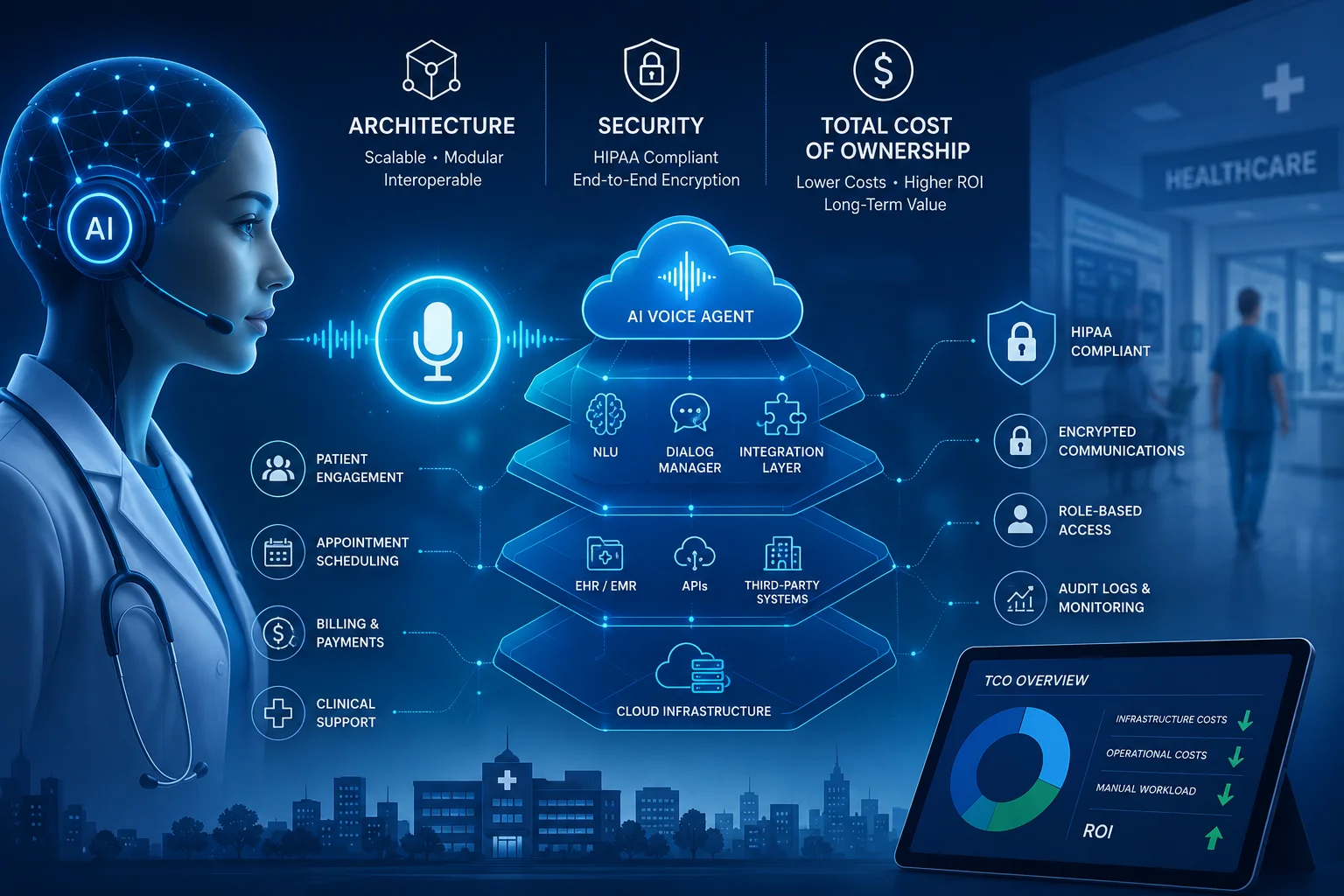
Healthcare organizations are increasingly exploring AI voice agents to improve patient communication, automate routine processes, and reduce administrative workloads. Unlike conventional voice assistants, healthcare AI voice agents must operate within complex clinical environments where privacy, accuracy, reliability, and system integration are critical.
A successful healthcare AI voice agent requires more than a conversational interface. It needs a secure architecture, healthcare-grade integrations, and a clear Total Cost of Ownership (TCO) strategy.
Building the Right Architecture
The foundation of a healthcare AI voice agent is a modular and scalable architecture. A typical system combines speech recognition, natural language understanding, conversational AI, business logic, integrations, and text-to-speech capabilities.
The voice agent first converts a patient's speech into text using a speech recognition engine. Natural Language Understanding (NLU) then identifies the user's intent and extracts relevant information. The dialogue management layer determines the appropriate response or action before the system generates a natural voice response.
Healthcare integrations are equally important. The AI agent may connect with Electronic Health Record (EHR) and Electronic Medical Record (EMR) systems, appointment scheduling platforms, billing systems, CRM platforms, APIs, and patient portals.
A modular architecture allows organizations to add new capabilities without rebuilding the entire platform.
Security Must Be Designed Into the System
Healthcare AI applications handle highly sensitive patient information, making security a fundamental engineering requirement.
AI voice agents should implement strong authentication, role-based access controls, encryption for data in transit and at rest, secure API communication, and comprehensive audit logging. Organizations should also establish clear data-retention policies and ensure that sensitive information is handled according to applicable healthcare privacy requirements.
Another important consideration is access control. A voice agent used for appointment scheduling may require access to different information than an agent supporting clinical workflows. Permissions should therefore be aligned with specific roles and use cases.
Continuous monitoring can further help organizations identify unusual activity, system failures, and potential security risks.
Integrating AI With Existing Healthcare Systems
Integration often determines whether a healthcare AI voice project succeeds in production. A voice agent should not operate as an isolated application.
Through secure APIs and integration layers, the system can retrieve available appointment slots, update patient records, send reminders, verify insurance information, or route complex requests to human staff.
Interoperability also makes it easier to expand the solution across departments and healthcare locations. Instead of creating separate voice systems for every workflow, organizations can establish a reusable AI platform that supports multiple use cases.
Understanding Total Cost of Ownership
The initial development cost is only one part of the investment. Healthcare organizations should evaluate the complete TCO, including cloud infrastructure, speech and AI model usage, API costs, security controls, integration maintenance, monitoring, support, and future upgrades.
A scalable architecture can help control long-term expenses by allocating resources according to demand. Organizations can also optimize costs by selecting appropriate AI models for different tasks rather than using the most expensive model for every interaction.
Automation can generate additional value by reducing repetitive administrative work and allowing employees to focus on higher-value activities.
The Road Ahead for Healthcare Voice AI
Healthcare AI voice agents can become powerful digital assistants when architecture, security, integrations, and cost management are considered together. From appointment scheduling and patient engagement to administrative support, these systems can streamline communication while improving operational efficiency.
The key is to build with scalability, interoperability, security, and measurable ROI from the beginning. A well-engineered healthcare AI voice agent is not simply a chatbot that speaks—it is a secure enterprise system designed to work within the healthcare ecosystem.