Sign up with Google
 Sign in with Zoho

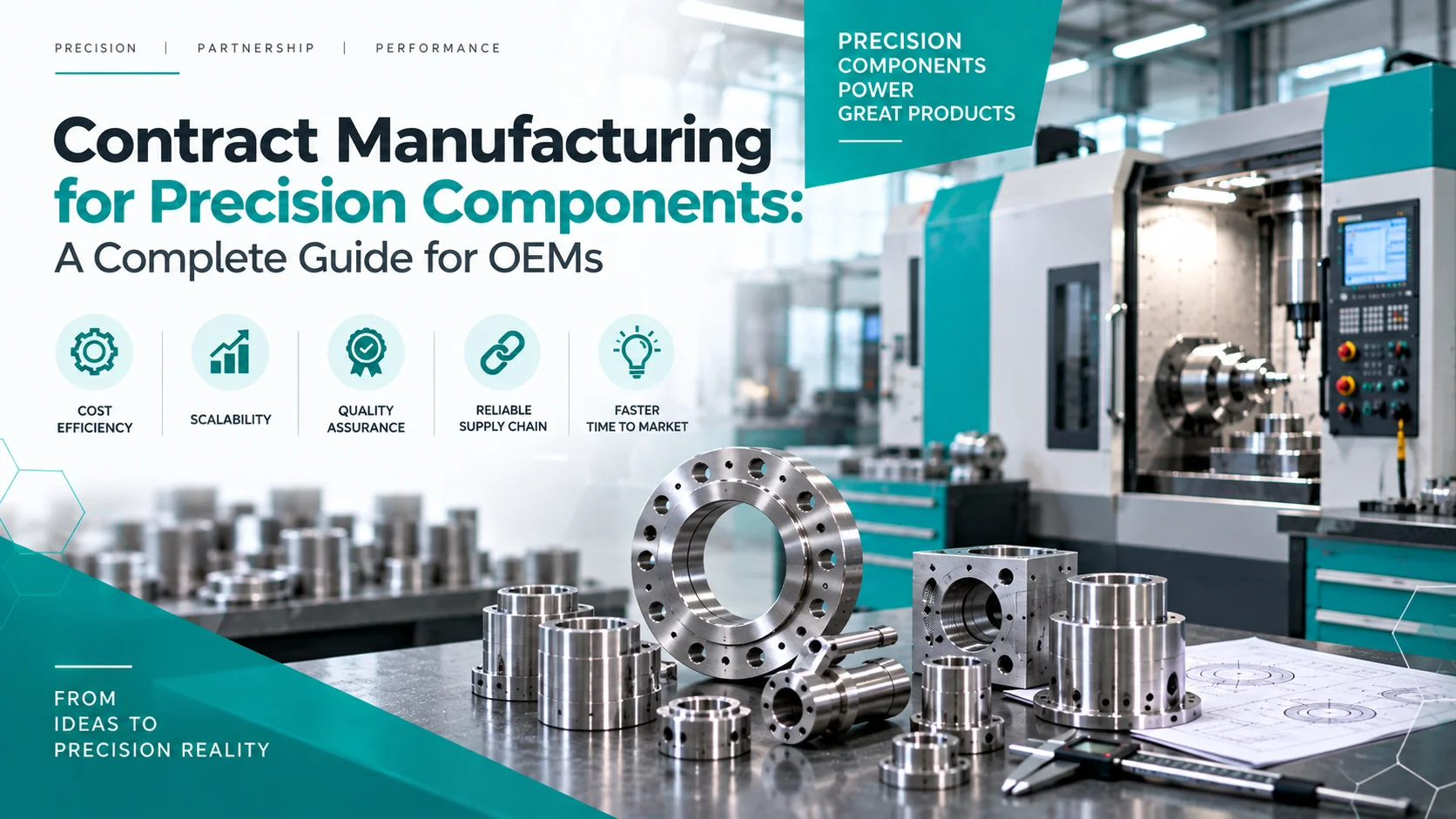
For original equipment manufacturers, the decision to build precision components in-house or hand production off to an outside partner is one of the most consequential calls in a product's lifecycle. Get it right, and you free up capital and engineering focus for what your company does best. Get it wrong, and you're stuck managing quality issues, capacity constraints, or supply chain risk in a process that was never your core competency to begin with.
This guide walks through what contract manufacturing for precision components actually involves, when it makes sense for OEMs, and how to evaluate a potential manufacturing partner.
What Contract Manufacturing for Precision Components Means
Contract manufacturing is an arrangement where an OEM outsources the production of components; often precision-machined parts, castings, or assemblies, to a specialized manufacturer, rather than producing them in-house. The OEM typically provides drawings, specifications, and quality requirements; the contract manufacturer handles sourcing, machining, inspection, and delivery.
This differs from simple job-shop work in scale and relationship depth. Precision component manufacturing for OEMs through a contract arrangement usually involves an ongoing production relationship, not a one-off order, ideally with the manufacturer integrated into the OEM's supply chain planning, quality system, and sometimes even early design input.
Why OEMs Turn to Contract Manufacturing
Capital and Equipment Costs
Precision CNC equipment, CMMs, and the tooling required for tight-tolerance work represent significant capital investment. For OEMs whose core value is in product design and assembly rather than machining, that capital is often better deployed elsewhere.
Access to Specialized Capability
A contract manufacturer that focuses exclusively on precision machining develops process expertise, machine capability, and quality systems that would take years for an OEM to replicate internally for a function that isn't their core business.
Scalability Without Fixed Overhead
Production volume rarely stays flat. Contract manufacturing lets OEMs scale output up or down based on demand without carrying the fixed cost of underutilized equipment and labor during slow periods.
Faster Time to Market
Established contract manufacturers often have existing capacity, tooling, and process knowledge that let a new part move from drawing to production faster than building internal capability from scratch.
Geographic and Cost Advantages
Many OEMs work with contract manufacturers in regions offering strong technical capability at lower production costs, provided quality systems and communication are solid enough to manage the relationship effectively.
What to Look for in a Contract Manufacturing Partner
Quality Certifications Matched to Your Industry
ISO 9001 is a baseline; AS9100 matters for aerospace and defense; ISO 13485 matters for medical devices. Confirm the certification actually matches your application's requirements rather than assuming any certification is sufficient.
Process Capability for Your Specific Parts
Not every precision manufacturer is equally strong across all part types. Ask about their experience with your specific material, geometry complexity, and tolerance requirements, and ask to see examples of comparable work.
Documented Traceability and Inspection
For precision component manufacturing for OEMs, traceability from raw material to finished part matters, especially if your end product carries its own regulatory or warranty obligations. Confirm the manufacturer documents material certs, inspection reports, and first article inspections for new parts.
Capacity and Scalability
Ask directly about current capacity utilization and how they'd handle a volume increase. A manufacturer running near full capacity may struggle to absorb your growth without lead time slippage.
Communication and Engineering Collaboration
The best contract manufacturing relationships involve two-way communication, the manufacturer flagging design-for-manufacturability issues early rather than silently producing exactly what's on the drawing even when it creates unnecessary cost or risk.
Financial Stability and Business Continuity
A contract manufacturing relationship is a long-term dependency. Ask about their business continuity planning, backup equipment or facilities, and how long they've been operating, a supplier's instability becomes your supply chain risk.
Common Contract Manufacturing Models
Full-Service Contract Manufacturing: the manufacturer handles everything from material sourcing to finished, inspected components delivered ready for assembly.
Consigned Material Manufacturing: the OEM supplies raw material, and the manufacturer handles machining and finishing only, useful when the OEM has existing material supply agreements or specific material sourcing requirements.
Build-to-Print vs. Build-to-Spec: build-to-print means the manufacturer produces exactly to the OEM's drawings with no design input; build-to-spec allows the manufacturer more flexibility in how they achieve the required performance specifications, often unlocking cost or manufacturability improvements.
Common Mistakes OEMs Make When Choosing a Contract Manufacturer
- Selecting purely on price without verifying quality systems, leading to higher total cost through rework, delays, or field failures.
- Skipping a pilot run before committing to full production volume, missing the chance to catch process issues early.
- Underestimating communication overhead, especially with international partners across time zones and language differences.
- Not clarifying IP protection and drawing confidentiality upfront, particularly important when sharing proprietary designs.
- Ignoring capacity risk by not asking how a manufacturer would handle a sudden volume increase or a competing customer's larger order taking priority.
Questions to Ask Before Signing a Contract Manufacturing Agreement
- What's your typical lead time for a part like this, from PO to delivery?
- Can you provide references from OEM customers with similar part complexity or volume?
- How do you handle engineering changes mid-production?
- What's your process for a nonconforming part discovered after shipment?
- How do you protect our drawings and intellectual property?
The Bottom Line
Contract manufacturing for precision components can be a genuine competitive advantage for OEMs; freeing up capital, accelerating time to market, and providing access to specialized capability that would be expensive to build internally. The key is treating supplier selection as a strategic decision rather than a transactional one: verify certifications, test capability with a pilot run, and build a relationship that includes real communication, not just purchase orders and shipments.