Sign up with Google
 Sign in with Zoho

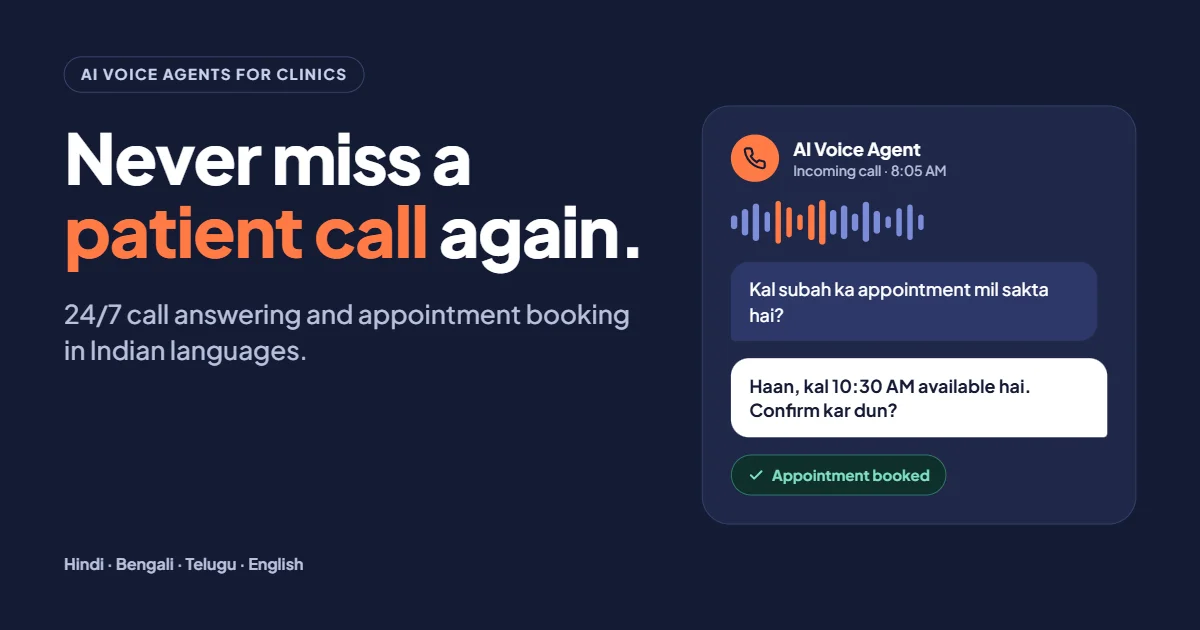
Every clinic owner knows the pattern. Between 8 and 11 a.m. the phone rings constantly, the receptionist is already helping someone at the desk, and calls go unanswered. Each missed call is a patient who may book with another clinic. AI voice agents are now a practical way to fix this, and they are changing how Indian clinics handle patient communication.
This article explains what AI voice agents are, how they work in a clinic, what to look for before adopting one, and where their limits are.
What Are AI Voice Agents?
AI voice agents are software systems that hold natural spoken conversations with callers and complete tasks on their own. Unlike old phone menus that say “press 1 for appointments,” they understand free-form speech, respond in the caller’s language and take action, such as booking a slot or answering a question.
In a healthcare setting, an AI voice agent works as a virtual receptionist that is available around the clock. It does not replace clinical judgement. It handles the repetitive front-desk work that keeps staff from the patients in front of them.
Why Indian Clinics Need Them
Our own estimates suggest clinics can lose 20% to 35% of incoming appointment calls during peak morning hours because the front desk is stretched. The cost is lost appointments, lost revenue and patients who feel ignored. [Replace with a citation to a named study or your own published data before publishing.]
Language makes this harder. A patient in Kolkata may speak Bengali, another may switch between Hindi and English, and a third may call in Telugu. Generic phone automation often fails in this mixed-language reality, which is why AI voice agents built for Indic languages matter more here than in markets with one dominant language.
What an AI Voice Agent Does in a Clinic
A well-designed system typically handles five tasks:
- Answering inquiries. Clinic timings, doctor availability, location and consultation fees.
- Booking and rescheduling appointments. The patient states a preferred time, and the agent confirms it.
- Basic triage. The agent asks routine questions and flags urgent cases for staff attention.
- Follow-ups. It reminds patients about visits and check-ins.
- Multi-channel support. Conversations continue across calls, SMS and WhatsApp.
Because the agent works 24/7, a patient calling at 10 p.m. gets a response instead of a ringing phone.
Our Experience Building for Clinics
At revmaxx, we build AI voice agents and an ambient AI scribe for clinics in India. Our work has shown us that adoption depends less on how advanced the AI is and more on how little it disrupts the clinic’s day. Clinics rarely want to replace their software or retrain staff. That is why our platform works as an overlay on a clinic’s existing browser or EMR rather than a replacement for it.
Five Questions to Ask Before Choosing an AI Voice Agent
1. Does it handle your patients’ languages? Ask for a live demo in the languages and mixed-language speech your patients actually use, not only a scripted one.
2. How does it handle data? Patient conversations are sensitive. Check that the provider follows India’s Digital Personal Data Protection (DPDP) Act 2023 and ask where data is stored and who can access it.
3. Will it work with your existing setup? A system that needs migration or heavy training can cost more than it saves.
4. What happens when the agent is unsure? A good system hands off to a human smoothly rather than guessing.
5. Is pricing predictable? Look for clear per-month or per-minute pricing without hidden charges.
Where AI Voice Agents Fall Short
Honest evaluation matters, so here are the limits:
- They are not a substitute for clinical advice. Triage should support staff, not replace a doctor’s judgement.
- Accuracy varies by language, accent and call quality. Testing with your own patient calls is essential.
- Some patients prefer speaking to a person, so a clear route to a human is important.
- Results depend on setup. The agent needs correct clinic information, schedules and escalation rules.
Clinics that treat the agent as a tool supported by human staff usually get better outcomes than those who expect full automation on day one.
The Wider Picture: Voice AI in Indian Healthcare
India’s push toward digital health records under the Ayushman Bharat Digital Mission is creating demand for structured, standards-based data. Voice technology fits naturally, since much of healthcare already happens through conversation. Alongside front-desk agents, ambient scribes can turn consultations into structured notes so doctors spend less time typing. Together, these tools address the administrative load that keeps clinicians from patients.
How to Get Started
If you run a clinic and want to explore AI voice agents, start small:
- Measure how many calls you miss in a typical week.
- Shortlist two or three providers and test them with real calls in your patients’ languages.
- Run a limited pilot on one number or time window.
- Review call recordings and patient feedback, then expand.
Conclusion
AI voice agents will not fix every problem in a clinic, but they address a clear and costly one: unanswered calls. For clinics that adopt them thoughtfully, with attention to language support, data protection and human backup, they offer a full-time front desk without the cost of staffing one around the clock.