Sign up with Google
 Sign in with Zoho

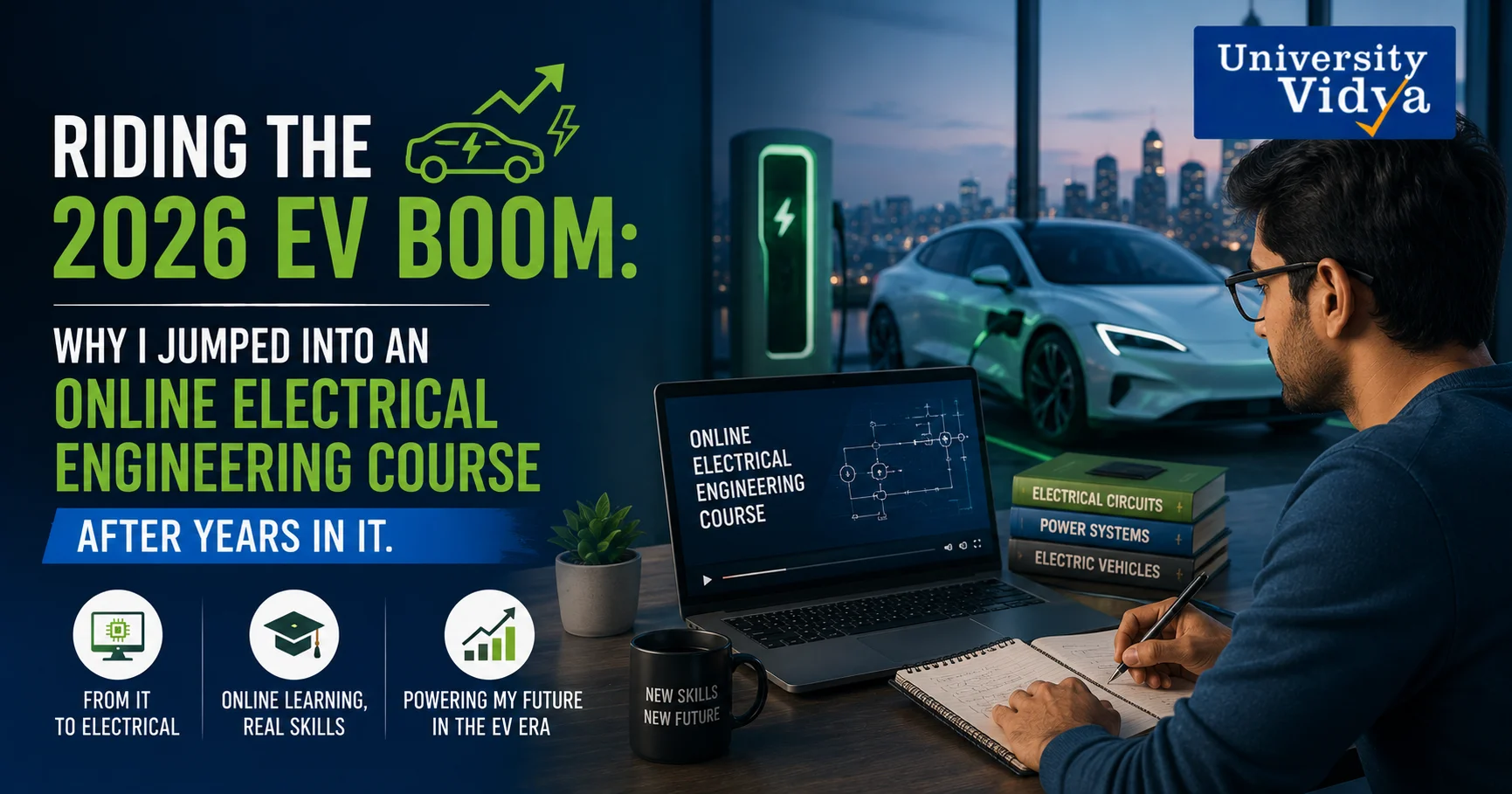
For six years, I was completely comfortable in my mid-level IT role, managing software updates and troubleshooting server crashes. However, as 2026 approached, the entire global market began violently shifting toward sustainable energy and electric vehicles (EVs). I watched massive hardware innovation happening right in front of me, and I realized my purely software-based skill set was rapidly becoming outdated.
I desperately wanted to be part of the physical hardware revolution, not just the software that monitored it. That massive career realization pushed me to completely pivot and enroll in an Online Electrical Engineering degree.
If you are a working professional feeling stagnant in your current industry, or a parent trying to guide your child toward a highly future-proof career, you are in the exact right place. Today, I am sharing my unfiltered journey of shifting from IT to advanced hardware design. I will reveal where my initial study strategies failed, how I rewired my technical brain, and how this digital degree positioned me perfectly for the EV boom.
The Early Fails: Treating Hardware Like Software
When I first started my online classes, my IT ego completely took over. I arrogantly assumed that because I could write complex code, I could easily master physical circuit design. That was my first catastrophic academic failure.
I tried to speed-read through my initial thermodynamics and battery chemistry modules exactly like I used to skim software documentation. Because I ignored the foundational physics, I completely failed my first major practical circuit assignment. I built a physical prototype that immediately short-circuited because I did not understand the actual current load.
That blown fuse was a terrifying, humbling wake-up call. I realized that hardware engineering requires a completely different level of analytical discipline than software coding. You cannot simply hit "undo" when a physical component melts. I had to completely dismantle my old IT habits and rebuild a highly structured, hardware-focused routine.
Rewiring My Brain: Actionable Pointers for the Pivot
To salvage my grades and my career aspirations, I stopped treating my distance education like a casual coding bootcamp. I had to merge my software logic with strict physical safety protocols.
Here are the specific, actionable pointers that drastically improved my digital learning workflow:
- Embrace the Simulators: Before touching physical wires, I forced myself to build every circuit in a virtual CAD simulator. This allowed my "software brain" to safely test the hardware logic first.
- The 5:00 AM Physics Grind: I stopped studying at night when my brain was fried from IT work. Waking up early to tackle heavy mathematical theorems while my mind was fresh changed everything.
- Active Application: Instead of keeping my studies isolated, I started asking my IT firm's hardware vendors highly technical questions about their power supply units during my day job.
Expanding the Grid: Cross-Disciplinary Digital Learning
Once my study routine stabilized, the academic fog finally lifted, and I discovered the hidden power of a digital campus. I initially feared that distance learning meant studying in total isolation. Instead, the virtual ecosystem proved to be incredibly vibrant and heavily populated with ambitious professionals from diverse sectors.
During a virtual seminar on smart-grid infrastructure, I collaborated with a brilliant peer pursuing an Online Electronics and Communication Engineering track. She taught me how to effectively integrate wireless data transmission into my battery management designs, a skill crucial for modern EVs.
The cross-training did not stop there. I learned the immense complexities of industrial power distribution by studying alongside a student taking an Online Electrical And Electronics Engineering Course. Furthermore, I gained incredible practical insights into automated robotic assembly by collaborating with a colleague enrolled in an Online Electronics and Instrumentation Engineering Course.
This exposure to entirely different disciplines made me a highly adaptable, resourceful problem solver perfectly suited for the complex EV industry.
IT vs. Hardware: A Reality Check
To help you visualize this massive career transformation, I often share this comparison matrix. Shifting to the EV sector was not just about learning new formulas; it was about completely rewiring how I viewed technology.
My earlier IT-focused approach often involved fixing software problems with quick code patches, but moving toward a hardware-oriented mindset taught me to address the underlying cause of technical issues. Instead of relying entirely on automated software debugging tools, I began focusing on physical engineering principles, including calculating load tolerances, analysing stress points, and identifying potential overheating risks in circuits. This shift changed how I approached testing and problem-solving, encouraging me to think about long-term reliability rather than temporary fixes. It also reshaped my career direction from maintaining legacy corporate systems to developing the technical knowledge needed to contribute to emerging areas such as sustainable transportation and advanced engineering design.
What I Actually Achieved: Earning the Hardware Role
By my final semester, my intense digital hustle had transformed me into a highly capable hybrid engineer. I understood the software, but I now possessed the deep physical knowledge to design the hardware it ran on.
When a major EV startup in my city opened a position for a Junior Battery Systems Engineer, I applied immediately. During the interview, I confidently bypassed their entry-level questions and presented a complex thermal-management prototype I had designed during my digital coursework. The hiring panel was absolutely blown away by my ability to merge my IT background with advanced electrical theory.
I secured the role, successfully pivoting out of traditional IT and straight into the heart of the 2026 EV boom. Of course, this success relied heavily on finding the right educational partner from day one. I initially struggled to navigate the overwhelming sea of online programs until I used University Vidya. Their expert platform helped me effortlessly filter out rigid institutions and find a highly respected curriculum that adapted to my chaotic schedule.
Powering Up Your Next Career Move
Looking back at my old IT desk, leaving my professional comfort zone was the most intimidating, yet profitable, decision of my entire career. The digital classroom ruthlessly tested my resilience, broke my bad habits, and ultimately built me into an authoritative hardware engineer.
You do not need to pause your career or sacrifice your current salary to future-proof your skill set. The tools and platforms exist to help you pivot into the world's most exciting industries on your own terms.
Take absolute control of your professional trajectory today. Start mapping out your educational goals, embrace the struggle of learning new concepts, and reach out to trusted platforms like University Vidya to discover the perfect academic match. Log in to your virtual portal, grab your breadboard, and start engineering the executive career you truly deserve.