Sign up with Google
 Sign in with Zoho

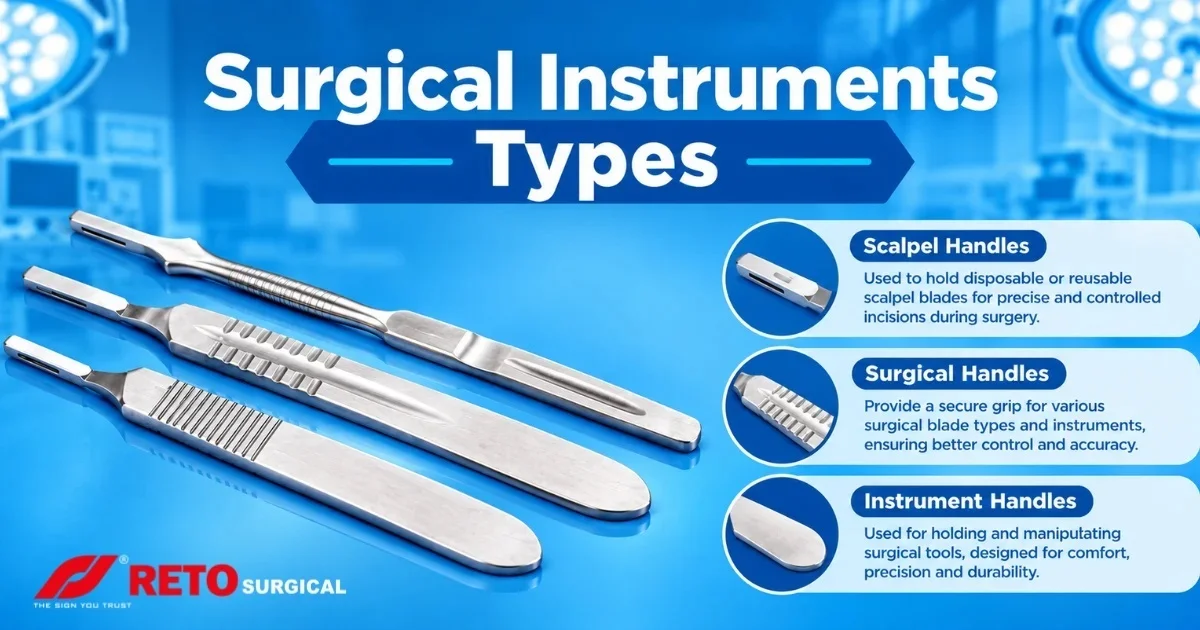
Surgical Instruments Types: A Reto Surgical Overview
Surgical instruments are essential tools used by healthcare professionals to perform procedures with precision, control, and safety. From basic tissue handling and cutting to complex surgical procedures, the right instrument can make a significant difference in clinical performance and efficiency.
With decades of experience in manufacturing and supplying medical and dental instruments, Reto Surgical provides a wide range of precision surgical instruments designed to meet the requirements of healthcare professionals, distributors, importers, and OEM customers worldwide.
In this guide, we explore the major types of surgical instruments, their common applications, important design features, and considerations when selecting quality surgical instruments.
What Are Surgical Instruments?
Surgical instruments are specially designed medical devices used by surgeons, dentists, and other healthcare professionals during surgical or clinical procedures. Depending on their intended function, instruments may be used for cutting, grasping, holding, retracting, dissecting, suturing, or manipulating tissues and other materials.
Surgical instruments are manufactured in different shapes, sizes, configurations, and materials to suit specific procedures. Stainless steel is one of the most commonly used materials because of its strength, corrosion resistance, durability, and suitability for cleaning and sterilization.
The performance of an instrument depends not only on its design but also on material quality, manufacturing precision, finishing, hardness, surface treatment, and quality control.
Major Types of Surgical Instruments
Surgical instruments can be categorized according to their function. Although there are many specialized instruments available, the following categories cover some of the most commonly used surgical instrument types.
- Cutting and Dissecting Instruments
Cutting instruments are designed to cut tissues, sutures, dressings, and other materials during medical procedures.
Common examples include:
- Surgical scissors
- Operating scissors
- Dissection scissors
- Tissue scissors
- Bandage scissors
- Surgical blades and handles
- Bone-cutting instruments
Scissors are available in straight, curved, sharp/sharp, sharp/blunt, and other configurations. The appropriate design depends on the procedure and the material being cut.
Precision is particularly important for cutting instruments because sharp and accurately aligned cutting edges can help provide controlled performance.
- Grasping and Holding Instruments
Grasping instruments are used to securely hold tissues, materials, or surgical components during procedures. Their jaws may be smooth, serrated, toothed, or specially shaped depending on the intended application.
Examples include:
- Tissue forceps
- Dressing forceps
- Dissecting forceps
- Adson forceps
- Allis tissue forceps
- Babcock forceps
- Thumb forceps
Different jaw patterns provide different levels of grip and tissue handling. For delicate tissues, atraumatic designs may be preferred, while toothed configurations can provide a stronger grip when required.