Sign up with Google
 Sign in with Zoho

The Shift From Copilots to Autonomous AI Agents
For the past two years, enterprises have been experimenting with generative AI—mostly as copilots that assist humans with drafting emails, summarizing documents, and writing code. Useful? Absolutely. Transformative? Not quite.
The next evolution is already here, and it's called agentic AI.
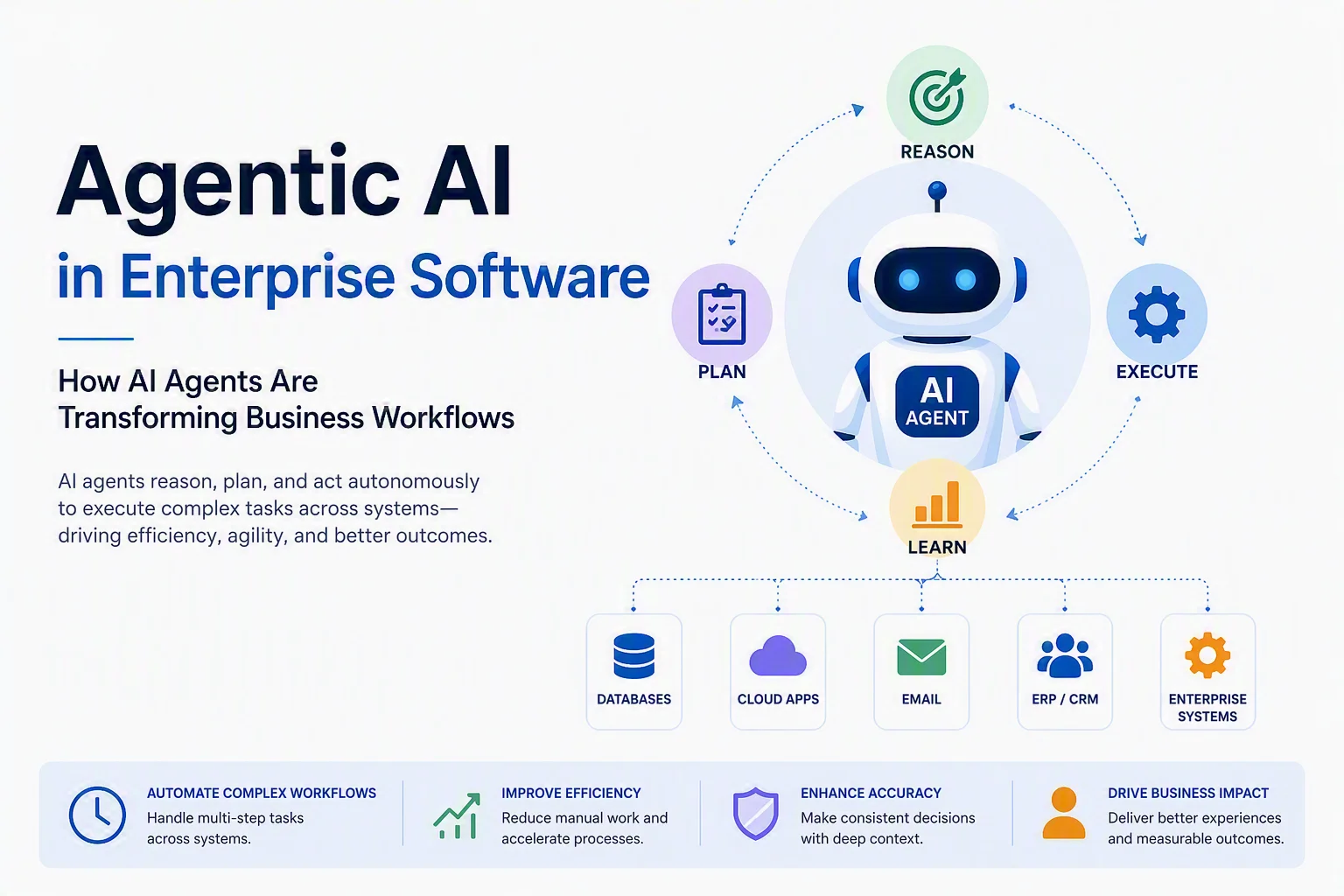
Unlike traditional AI assistants that wait for prompts, agentic AI systems can reason, plan, execute multi-step tasks, and make decisions autonomously. They don't just suggest what to do next. They actually do it.
This shift matters because enterprise workflows are rarely simple. They involve multiple systems, handoffs between teams, conditional logic, and exception handling. That's exactly where AI agents thrive—operating across these complex workflows with minimal human intervention.
So what does this look like in practice? And what should technology leaders actually prepare for?
What Makes Agentic AI Different
Before diving into use cases, it's worth understanding what separates agentic AI from the AI tools most enterprises already use.
Traditional AI vs. Agentic AI
Traditional AI models—including most large language models (LLMs)—are reactive. You give them a prompt, they generate a response. The interaction ends there.
Agentic AI introduces four capabilities that change the equation:
- Goal-oriented reasoning. AI agents can break down a high-level objective into sub-tasks without being told each step.
- Tool use. They can call APIs, query databases, trigger workflows in enterprise systems, and interact with external services.
- Memory and context. They maintain state across interactions, learning from previous steps to inform future decisions.
- Autonomous execution. They can act on decisions within defined guardrails, escalating to humans only when necessary.
Think of it this way: a copilot helps you write a purchase order. An AI agent identifies that inventory is low, evaluates supplier options, drafts the purchase order, routes it for approval, and follows up if there's a delay.
That's the difference between assistance and automation.
Where AI Agents Are Transforming Enterprise Workflows
The real story of agentic AI isn't the technology itself—it's where enterprises are deploying it. Here are the use cases generating the most traction right now.
Customer Service and Support
This is arguably the most mature use case for AI agents. Companies are moving beyond simple chatbots to deploy agents that can resolve complex customer issues end-to-end.
An AI agent in a customer service workflow can authenticate a user, pull up their account history, diagnose the issue, initiate a refund or replacement, update the CRM, and send a confirmation—all without a human touching the ticket.
Salesforce's Agentforce platform, launched in late 2024, is a prominent example. It allows enterprises to build and deploy autonomous AI agents across service, sales, and marketing workflows directly within the Salesforce ecosystem.
IT Operations and Incident Management
IT teams are drowning in alerts. Most enterprises deal with thousands of monitoring events daily, and the majority are noise. AI agents can triage incidents, correlate alerts across systems, run diagnostic scripts, and either resolve issues automatically or assemble the right context for human engineers.
ServiceNow has been investing heavily in this space, embedding agentic AI capabilities into its Now Platform to automate IT service management workflows.
Finance and Procurement
Finance teams spend enormous time on repetitive, rule-heavy processes—invoice matching, expense auditing, vendor onboarding, and compliance checks. These are ideal candidates for AI automation.
AI agents can match invoices to purchase orders, flag discrepancies, route exceptions for review, and even negotiate payment terms with suppliers based on predefined parameters. SAP and Oracle are both integrating agentic capabilities into their ERP platforms to address these workflows.
Software Development
Agentic AI is also reshaping how software gets built. Tools like GitHub Copilot Workspace and Devin (by Cognition) go beyond code completion. They can interpret a feature request, plan the implementation, write the code across multiple files, run tests, and submit a pull request.
This doesn't replace developers. It compresses the cycle time between idea and working code, freeing engineering teams to focus on architecture and problem-solving.
Supply Chain Management
Supply chains involve constant decision-making under uncertainty. AI agents can monitor real-time data from logistics providers, weather systems, and demand forecasts to proactively adjust routes, reorder inventory, or switch suppliers—before a disruption becomes a crisis.
The Enterprise AI Adoption Landscape
Market momentum around agentic AI is accelerating across every major technology platform.
Microsoft has embedded AI agents deeply into its Copilot ecosystem, allowing organizations to build custom agents within Microsoft 365 and Dynamics 365. Google introduced agent-building capabilities through its Vertex AI platform. AWS has expanded Amazon Bedrock to support multi-agent orchestration.
According to a McKinsey Global Survey published in May 2024, 72% of organizations were using AI in at least one business function, up from 55% the prior year. While this figure covers all AI adoption, the report noted that automation of complex workflows—not just content generation—was the fastest-growing area of investment (Source: McKinsey, "The State of AI in Early 2024," May 2024).
The enterprise AI market is moving from experimentation to operationalization. And agentic AI is the mechanism making that transition possible.
Challenges Enterprises Need to Navigate
For all its promise, agentic AI introduces real challenges that technology leaders can't afford to ignore.
Governance and Control
When AI agents act autonomously, the question of accountability becomes critical. Who is responsible when an agent makes a poor decision—one that costs money, violates a regulation, or damages a customer relationship?
Enterprises need robust governance frameworks that define what agents can and cannot do, establish escalation protocols, and maintain audit trails for every action an agent takes.
Data Quality and Integration
AI agents are only as good as the data and systems they can access. Most enterprises still struggle with siloed data, inconsistent schemas, and legacy systems that don't expose modern APIs. Without clean, connected data, agents will make confident but wrong decisions—which is arguably worse than making no decision at all.
Security and Trust
Giving AI agents access to enterprise systems means expanding the attack surface. Enterprises need to treat AI agents like any other identity in their security model—with role-based access controls, least-privilege principles, and continuous monitoring.
There's also the human trust factor. Employees need to understand what agents are doing and why. Transparency isn't just a nice-to-have; it's a prerequisite for adoption.
Orchestration Complexity
Real-world enterprise workflows often require multiple AI agents working together—one handling data retrieval, another managing decision logic, and a third executing actions. Orchestrating these multi-agent systems reliably, at scale, is an engineering challenge that most organizations are still figuring out.
What Technology Leaders Should Do Now
If you're leading digital transformation at an enterprise, here's a practical starting point:
1. Identify high-value, high-volume workflows. Look for processes that are repetitive, rule-heavy, and span multiple systems. These are your best candidates for AI automation.
2. Start with human-in-the-loop designs. Don't go fully autonomous on day one. Let agents handle execution while humans approve critical decisions. Expand autonomy as trust builds.
3. Invest in your data and integration layer. Agentic AI amplifies whatever data foundation you have—good or bad. Prioritize API-first architectures and data quality initiatives.
4. Establish AI governance early. Define policies for agent behavior, decision boundaries, and accountability before you scale. Retrofitting governance is far harder than building it in.
5. Choose partners with enterprise depth. Implementing agentic AI isn't just an AI problem—it's a systems integration, data engineering, and change management challenge. Organizations like Persistent Systems, which combine AI engineering expertise with deep enterprise software knowledge, are helping companies design and operationalize agentic AI workflows across platforms like Salesforce, Microsoft, and AWS. Persistent's approach to AI-led enterprise modernization reflects the kind of end-to-end capability this transition demands.
The Bottom Line
Agentic AI isn't a future concept. It's being embedded into the enterprise software platforms that companies already use, and it's reshaping how work gets done at a fundamental level.
The organizations that move early—with clear governance, strong data foundations, and a focus on practical workflows—will build a significant operational advantage. Those that wait for the technology to "mature" may find themselves playing catch-up against competitors whose AI agents never sleep, never forget, and never stop optimizing.
The age of AI workflows isn't coming. It's here.