Sign up with Google
 Sign in with Zoho
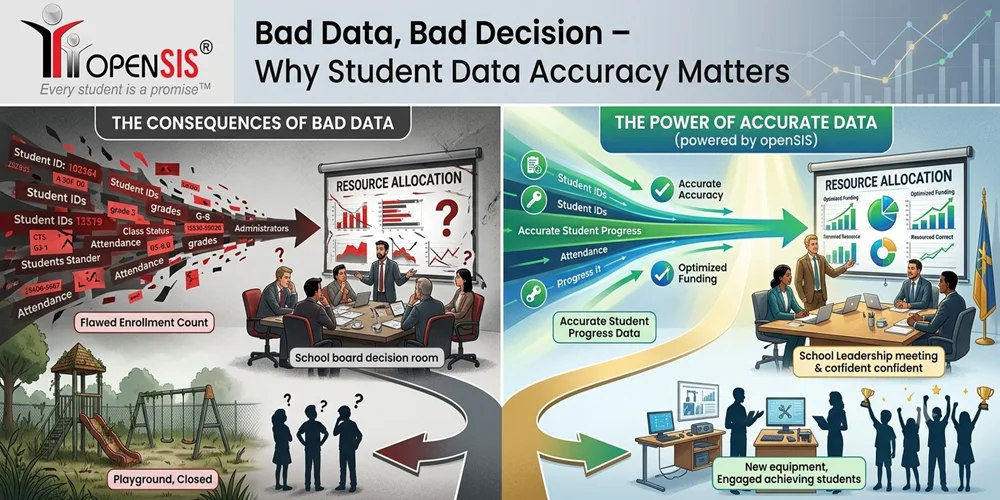
Schools value data for several reasons. First – a data record can influence enrolment. Second – data reports can transform the academic experience. And both of these are essential for any school planning for strategic growth. However, what no one speaks about when discussing school growth is data accuracy. Correct data supports institutional growth and influences strategic decision-making. Yet, when the data is incorrect or misaligned, decisions might affect the next growth move. The Best Student Information System not only collects data, but it also connects school departments to centralize information.
And when an entire school works from the same platform, the chances of data duplication or data errors decrease to a significant level.
The Best School Management Software, like openSIS, creates the structure that you need to build a strong data foundation. It makes data collection, storage, and validation easier.
Student Data Accuracy – A Brief Overview
Data accuracy means maintaining an information system that is correct, updated, and consistent. Relevant information matters when it comes to decision-making. And often, due to the lack of relevancy, data sits dormant inside files. Everything, from a student’s name to their grade, matters in the data ecosystem.
Accuracy also means making data aligned with changing situations. Because a student may drop out any day. A student may change address mid-term. A student may show exceptional skills in some new course. All these need to be documented across the school systems.
To prevent repetitive entries in different files, the Best School Management Software system connects all the departments through one dashboard. Authorized people with access to the dashboard will be able to view required information anytime they want. It swiftly removes two manual operation challenges –
- Data visibility limitation
- Delay in data validation
Once these two are sorted, you can proceed to manage the other essential tasks without hesitation.
Obstacles To Student Data Accuracy
Maintaining student data accuracy sounds simple. However, when thousands of students enroll, the task becomes complex immediately. Then emerges the real challenge – the constant data updating. The larger a school becomes, the more complex this challenge becomes.
The common data accuracy challenges often include –
- Duplicate student details
- Delayed updates
- Manual data entries in multiple places
- Incomplete student profiles
- Data gaps due to missing information
The Best School Management Software system can help you manage some of these frictions with ease. Because SIS centralizes data and connects school departments to one platform, the risk of data duplication or delay in reporting significantly reduces.
What Hinders Data Accuracy
Data accuracy often suffers when schools run on fragmented systems. When a school follows different processes to collect and store data, multiple aspects of administration get affected. A well-implemented SIS can support accurate data management. It reduces –
- Unclear data ownership
- Inconsistent data entries
- Poor data quality
- Delayed validation process
The solution does not lie in implementing hundreds of fancy features. The solution is in creating a system where technology and tradition can co-exist and work together without getting into each other’s ways. Growth creates challenges. What works within a small setting needs expansion under a growing landscape. And this is the reason the expansive academic industry needs digital tools to support administrative work.
Higher student numbers mean more data to manage. If the underlying foundation cannot support the growing volume of data, errors may become a part of the workflow.
Why Data Accuracy Matters
Data accuracy helps schools to evaluate performance, understand patterns, identify student needs, and intervene in time. The Best Student Information System can help schools with –
- Reliable data analysis
- Better resource planning
- Better administrative reporting
- Performance monitoring
Together, these create a coherent operational workflow. And growth becomes easier to manage.
Lastly,
Schools can follow a few practical principles when managing data. Other than implementing the Best Student Information System, they can validate information before making entries, use one data source for all departments, and control data access. These practices can slowly lead to a better data ecosystem in schools.
1. Why is accurate student data important for schools?
Accurate student data supports reliable decisions across academics, administration, reporting, and resource planning.
2. What can cause inaccurate student data?
Manual entry, duplicate records, outdated information, inconsistent processes, and disconnected systems can reduce data accuracy.
3. How does an SIS improve student data accuracy?
An SIS can centralize records, standardize data fields, apply validation rules, and reduce duplicate data entry.
4. How does accurate data support student growth?
It helps educators identify academic and attendance patterns and provide timely, informed support.