Sign up with Google
 Sign in with Zoho

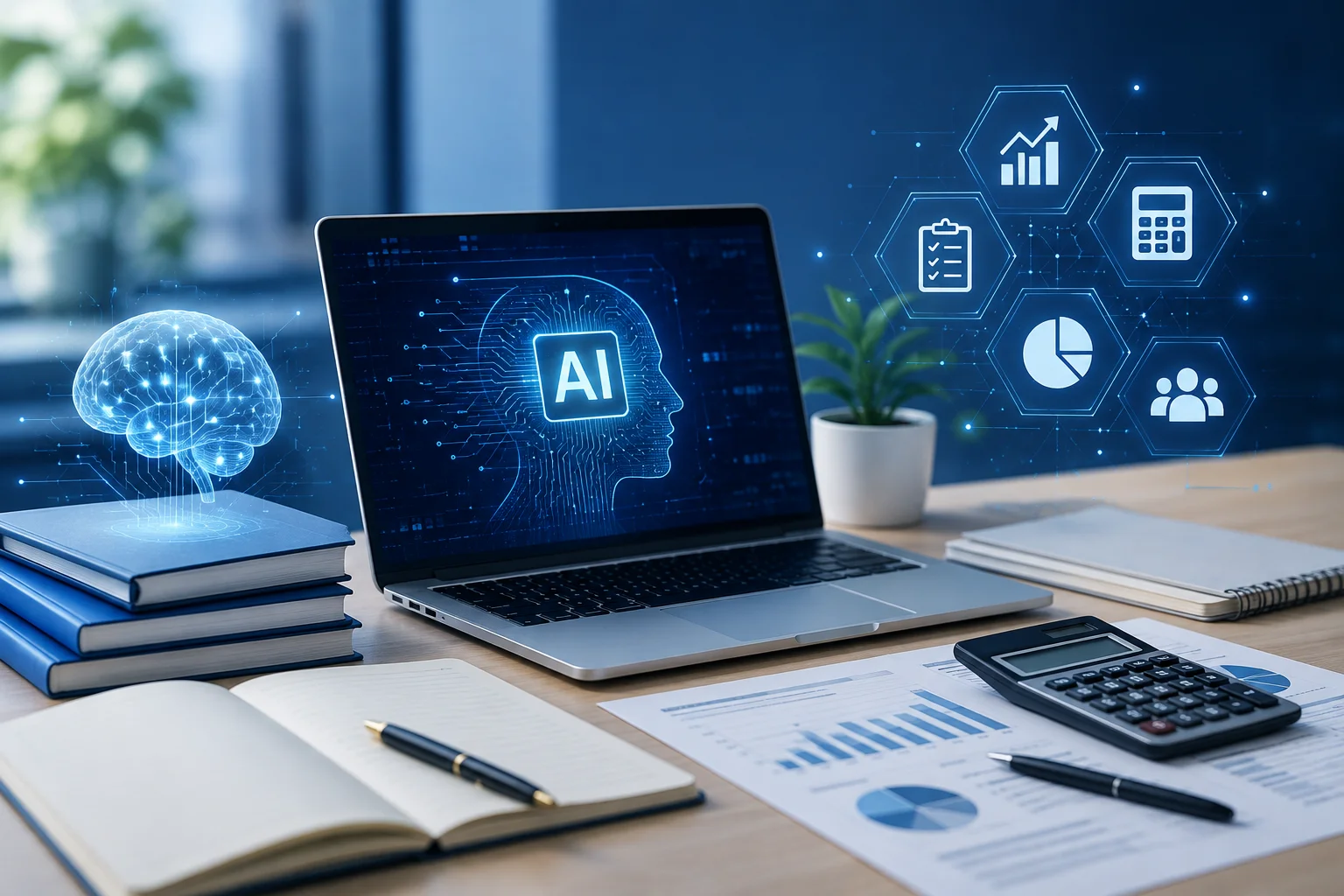
AI literacy has moved from "nice to have" to a core competency for CPAs, EAs, bookkeepers, and finance leaders. The best AI-focused CPE courses combine NASBA-approved credit with hands-on training on the tools firms are already using, including ChatGPT, Claude, Microsoft Copilot, and Power BI, rather than generic, theory-only lectures on "what is artificial intelligence." This guide breaks down what to look for, the leading course formats available this year, and how to build an AI CPE plan that actually changes how your practice works.
Key Takeaways
• AI adoption in accounting has become the norm, not the exception. Most recent industry surveys put daily or weekly AI use among tax and accounting professionals well above 80%.
• CPE for AI generally falls under existing NASBA Fields of Study (typically Information Technology or a firm's chosen technical field), not a separate mandated category, but more state boards and firms are actively encouraging it.
• The strongest AI CPE options fall into two formats: single-topic, self-paced courses on a specific tool, and structured, multi-module Training Programs that end in a certificate.
• Look for courses that are tool-specific (ChatGPT, Claude, Copilot, Power BI) rather than generic "AI overview" content, and that are mapped to your credential (CPA, EA, CMA, CIA, CFE, and similar).
• MYCPE ONE’s AI CPE Courses for CPAs and Accountants now offer 150+ CPE-approved courses across the major AI tools, plus structured programs for accountants, auditors, and HR professionals inside a single subscription.
Why AI CPE Matters More in 2026 Than It Did a Year Ago
The shift isn't theoretical anymore. According to Thomson Reuters' 2025 Future of Professionals Report, CPAs using AI recovered an average of roughly 240 hours of capacity per year, time that firms are increasingly redirecting toward advisory work rather than compliance grinding. Separately, Karbon's 2026 industry research found that nearly all accounting professionals surveyed globally now report using AI in some form, a sharp jump from adoption levels even two years ago.
That speed of adoption creates a real skills gap. Firms are handing staff tools like ChatGPT, Claude, and Copilot faster than they're training them to use those tools safely and effectively. Several 2026 surveys have also flagged a governance problem: a meaningful share of firms report that staff have inadvertently entered confidential client data into public AI tools, a direct result of using AI without structured training on data handling and prompt practices.
This is exactly the gap AI-focused CPE is designed to close. A good course doesn't just explain what large language models are; it teaches a preparer how to draft a client memo with Claude, build a Power BI dashboard from a trial balance, or use Copilot inside Excel without exposing sensitive data.
How to Evaluate an AI CPE Course Before You Enroll
Not all "AI" CPE is created equal. Before committing your CPE hours (and budget), check a course against these criteria:
Is it NASBA-approved and mapped to your credential?
Confirm the provider is listed on the NASBA Registry and that the course specifies which credentials it counts toward: CPA, EA, CMA, CIA, CFE, CFP, AFSP, CRTP, or others. A course that isn't mapped to your license type can cost you the credit hours entirely.
Is it tool-specific or just conceptual?
"Introduction to AI" content has diminishing value in 2026. The most useful courses walk through a named tool, such as ChatGPT, Claude, Copilot, or Power BI, inside a real accounting workflow: tax research, audit sampling, client communication, or financial reporting.
Does it address data security and firm policy?
Look for courses that cover confidential client data handling, firm AI-use policies, and the risk of inputting sensitive information into public AI tools. This is quickly becoming as important as the productivity content itself.
What format fits your schedule?
Self-paced, on-demand courses work well for staff fitting CPE around busy season. Structured, multi-module Training Programs suit professionals who want a credential-style deep dive with a certificate at completion.
Is content updated regularly?
AI tools change monthly. A course recorded in 2023 on an early version of ChatGPT is largely obsolete. Prioritize providers who refresh content on a rolling basis.
Best AI-Focused CPE Course Formats to Know in 2026
Individual, Tool-Specific AI Courses
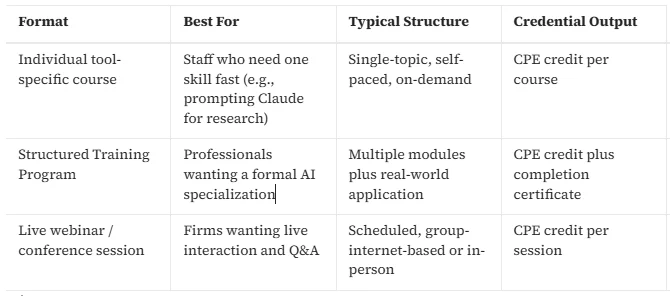
These are single-topic, self-paced courses built around one AI tool, for example, a course on using Claude for technical accounting research, or one on building formulas and dashboards with Copilot in Excel. They're typically shorter, earn CPE credit per course, and are available on demand, making them easy to slot into a busy schedule.
Structured AI Training Programs
Rather than a single course, a Training Program is a multi-module learning journey, often broken into tracks like AI for Accountants, AI for Auditors, or AI for HR Professionals, that combines instruction with real-world application and ends in a certificate. These suit professionals who want to demonstrate a formal AI credential to partners or clients, not just log CPE hours.
Live Webinars and Conference Sessions
Group-internet-based webinars and in-person conference workshops on AI remain useful for firms that want interactive Q&A and peer discussion, though content moves fast enough that on-demand formats are increasingly preferred for staying current.
One platform consolidating both formats is AI CPE Courses for CPAs and Accountants, MYCPE ONE's dedicated AI Academy. It currently offers 150+ CPE-approved courses across ChatGPT, Claude, Copilot, and Power BI, plus structured Training Programs in AI for Accountants, AI for Auditors, and AI for HR Pros, all mapped across 100+ credentials, including CPA, EA, CIA, CFE, AFSP, CRTP, CFP, and CMA. New content is added monthly, which matters given how quickly the underlying tools change.
Comparing AI CPE Course Formats
Best Practices for Building an AI CPE Plan
• Set a firm-wide baseline. Require every staff member to complete at least one tool-specific AI course per year, not just partners or "tech-curious" staff.
• Pair AI courses with a data policy course. Productivity training without a data-handling component is where most firm-level AI risk originates.
• Rotate tools, not just topics. A preparer who only learns ChatGPT will struggle when a client or firm standardizes on Claude or Copilot instead. Cover at least two tools per year.
• Track completions against your state board's Fields of Study. Confirm with your specific board how AI coursework should be classified before relying on it for a technical-hours requirement.
• Reassess annually. Because tools change monthly, a course taken in 2024 shouldn't be assumed current in 2026; budget for refresher courses, not one-and-done training.
Common Mistakes Firms Make with AI CPE
• Treating one AI course as "done." AI CPE isn't a box to check once; tool capabilities shift every few months, and last year's course can teach outdated workflows.
• Choosing generic "AI 101" content over tool-specific training. Conceptual overviews rarely translate into a staff member actually changing how they work.
• Ignoring credential mapping. Enrolling in a course that isn't approved for your specific license type risks a rejected credit hour, especially in an audit.
• Skipping the governance layer. Training staff to use AI faster without training them on what data they can and can't input creates real client-confidentiality exposure.
• Letting only partners take AI CPE. The productivity gains show up fastest when staff doing the day-to-day work, not just leadership, are trained.
Conclusion
AI fluency is quickly becoming as fundamental to accounting practice as tax code knowledge or audit methodology. The firms and professionals pulling ahead in 2026 aren't the ones who took a single "Introduction to AI" webinar; they're the ones treating AI CPE as an ongoing, tool-specific, credentialed learning track. Whether you choose single-topic courses to build skills fast or a structured Training Program to formalize your expertise, prioritize NASBA-approved, regularly updated content mapped to your credential. Platforms like MYCPE ONE's AI CPE Courses for CPAs and Accountants are built specifically to close that gap in one place.
FAQs
What counts as AI CPE for CPAs?
AI CPE generally refers to NASBA-approved courses focused on artificial intelligence tools and applications in accounting, tax, and audit work. It's usually classified under a firm's existing technical Fields of Study, most commonly Information Technology, rather than a separate mandated AI category, so confirm classification with your state board.
Is there a specific number of CPE hours required for AI courses?
No state board currently mandates a separate AI-specific CPE hour requirement as a standalone category. Most CPAs still need to meet the standard 40 hours per year (or 80 hours over a two-year cycle, depending on the state), and AI coursework counts toward the applicable technical or non-technical field, per that state's rules.
Which AI tools should accounting professionals prioritize learning first?
Based on current adoption trends, ChatGPT, Claude, and Microsoft Copilot are the most widely used in accounting and finance workflows, followed by Power BI for reporting and dashboarding. Prioritizing the tool your firm has already standardized on is usually the most efficient starting point.
Are AI CPE courses accepted by all state boards?
CPE credit acceptance depends on the provider being NASBA-registered and the course being properly classified under an approved Field of Study; the content being "about AI" doesn't change that requirement. Always verify with your specific state board.
What's the difference between an individual AI course and a Training Program?
An individual course is a single-topic, self-paced module on one tool or skill. A Training Program is a multi-module curriculum, often built around a role like Accountant, Auditor, or HR professional, that concludes with a certificate, offering a more structured, credential-style outcome.
Can bookkeepers and EAs take the same AI CPE courses as CPAs?
Many AI CPE providers map the same course library across multiple credentials, including CPA, EA, CMA, CIA, and CFE, so bookkeepers and EAs can often take identical or closely related courses, provided the course is approved for their specific credential.