Sign up with Google
 Sign in with Zoho

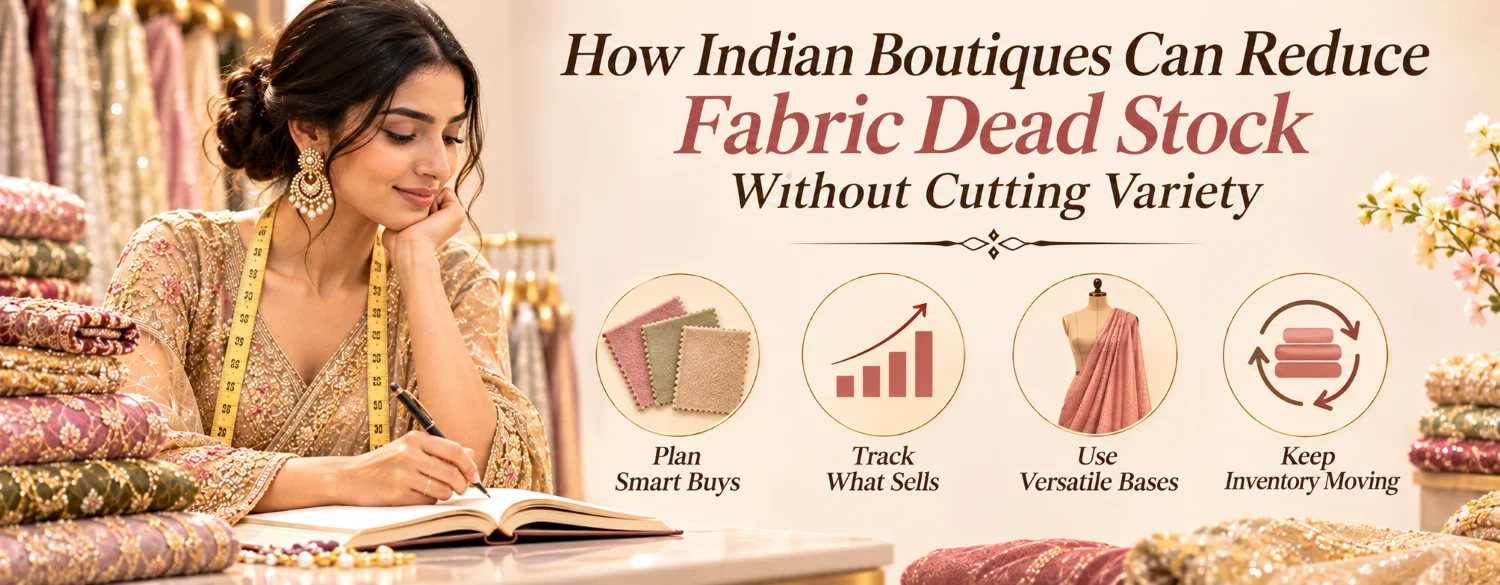
For most Indian boutiques, the biggest loss doesn’t show up as a single bad month. It sits quietly on the shelves: bolts of fabric bought for a season that never quite moved, colours that looked right at the wholesaler but didn’t sell, and leftover metres too short for a full outfit.
Dead stock ties up cash, takes up space and slowly turns into discounts. Yet most boutiques can’t simply buy less, because customers walk in expecting variety. The answer is to buy differently. Here’s how.
1. Split your buying into core and trend
Not all fabric carries the same risk. Divide your purchases into two groups.
Core fabrics: the ones that sell every season, in colours customers always ask for. Solid georgettes, crepes, cottons and basic silks in reliable shades like black, navy, maroon, bottle green, ivory and pastel pink.
Trend fabrics: this season’s colours, prints, textures and novelty finishes.
A practical rule many boutiques follow is to put most of their fabric budget into core and a smaller share into trend. Core fabrics rarely become dead stock because they keep selling. Trend fabrics bring customers in, but you buy them in smaller quantities.
Plain solids like viscose georgette in everyday shades are a good example of core stock. They work for kurtas, sarees, dupattas and linings, so even slow colours eventually find a use.
2. Buy samples before bulk
Before committing to 50 or 100 metres of a new fabric, buy a few metres first. Use it to:
- Stitch one sample garment for display
- Show it to regular customers and gauge reactions
- Test how it washes, presses and wears
If customers ask about it, reorder in bulk. If they walk past it, you’ve lost a few metres instead of a full roll.
3. Track sell-through by fabric and colour
Most boutiques know which outfits sold. Fewer know which fabrics and colours sold. Start a simple record with these columns: fabric, colour, metres bought, metres sold and weeks in stock.
Update it monthly. After one or two seasons, patterns appear. You’ll see which colours sell out quickly, which fabrics sit too long and which suppliers’ stock moves fastest.
This doesn’t need software. A notebook or a basic spreadsheet is enough. What matters is doing it consistently.
4. Plan around the Indian fashion calendar
Demand in Indian fashion follows clear seasons:
- Festive season: Navratri, Durga Puja, Diwali
- Wedding season: roughly late October to February, with regional variations
- Summer: cottons, light georgettes and breathable fabrics
- Smaller peaks: Eid, Karva Chauth, Teej, Onam, Pongal and regional festivals
Buying wedding fabrics after the season peaks is one of the most common causes of dead stock. Plan purchases six to eight weeks before each peak, and taper orders as the season ends.
5. Work with suppliers who offer smaller quantities
Large mills often have high minimum order quantities. For a boutique, that can mean buying 200 metres of a colour you only need 40 metres of.
Look for wholesalers and fabric houses that let you buy smaller lots, mix colours within an order and reorder quickly. Working with fabric suppliers for boutiques and labels that offer flexible quantities means you can buy closer to real demand instead of guessing months ahead.
6. Keep reorders consistent
Dead stock sometimes comes from mismatch, not overbuying. A boutique reorders a popular fabric, but the new lot is a slightly different shade, so the old and new metres can’t be used together.
To avoid this:
- Keep a small swatch from every lot you buy
- Ask suppliers for the lot or batch number
- When reordering, send the swatch and ask for the closest match
7. Give leftovers a second life
Even with good planning, short lengths build up. Instead of discounting them heavily, turn them into products:
- Dupattas and stoles: 2 to 2.5 metre pieces
- Blouses: around 1 metre
- Kids’ wear: small lengths go a long way
- Potli bags, cushion covers and accessories: useful for very short pieces
- Patchwork or panelled designs: combine several leftovers into one statement piece
Rich fabrics like brocade are especially good here. Even a small piece makes a striking blouse, yoke or potli, and customers often pay well for them.
8. Use pre-orders for trend fabrics
For high-risk trend fabrics, consider taking orders before buying in bulk. Display a sample garment, share it on Instagram and WhatsApp, and take advance bookings. Then order fabric based on confirmed demand.
This works especially well for bridal and festive collections, where customers expect a waiting period anyway.
9. Review stock every quarter
Every three months, walk through your stock and divide it into three groups:
- Moving well: keep and reorder
- Slow but usable: move into display, styling or bundled offers
- Unlikely to sell: convert into accessories, offer as remnants or sell to other boutiques or designers who can use it
The earlier you act on slow stock, the more value you recover.
10. Build relationships with regular customers
Your best data source is your customers. Regular buyers will often tell you directly what they want next season. A short conversation at billing, or a quick WhatsApp poll, can save you from a bad bulk purchase.
The real goal: variety without excess
Reducing dead stock doesn’t mean a smaller, duller boutique. It means:
- A strong base of core fabrics that always sell
- A smaller, rotating set of trend fabrics
- Data on what actually moves
- Suppliers who let you buy closer to demand
- A plan for every leftover metre
Boutiques that get this right keep their shelves interesting, their cash flowing and their discounts rare. Over a few seasons, that difference shows up clearly in profits.