Sign up with Google
 Sign in with Zoho

Introduction
Large language models have changed the way businesses and developers approach artificial intelligence. From generating content and writing code to building chatbots and automating business processes, modern AI models can handle a wide range of tasks.
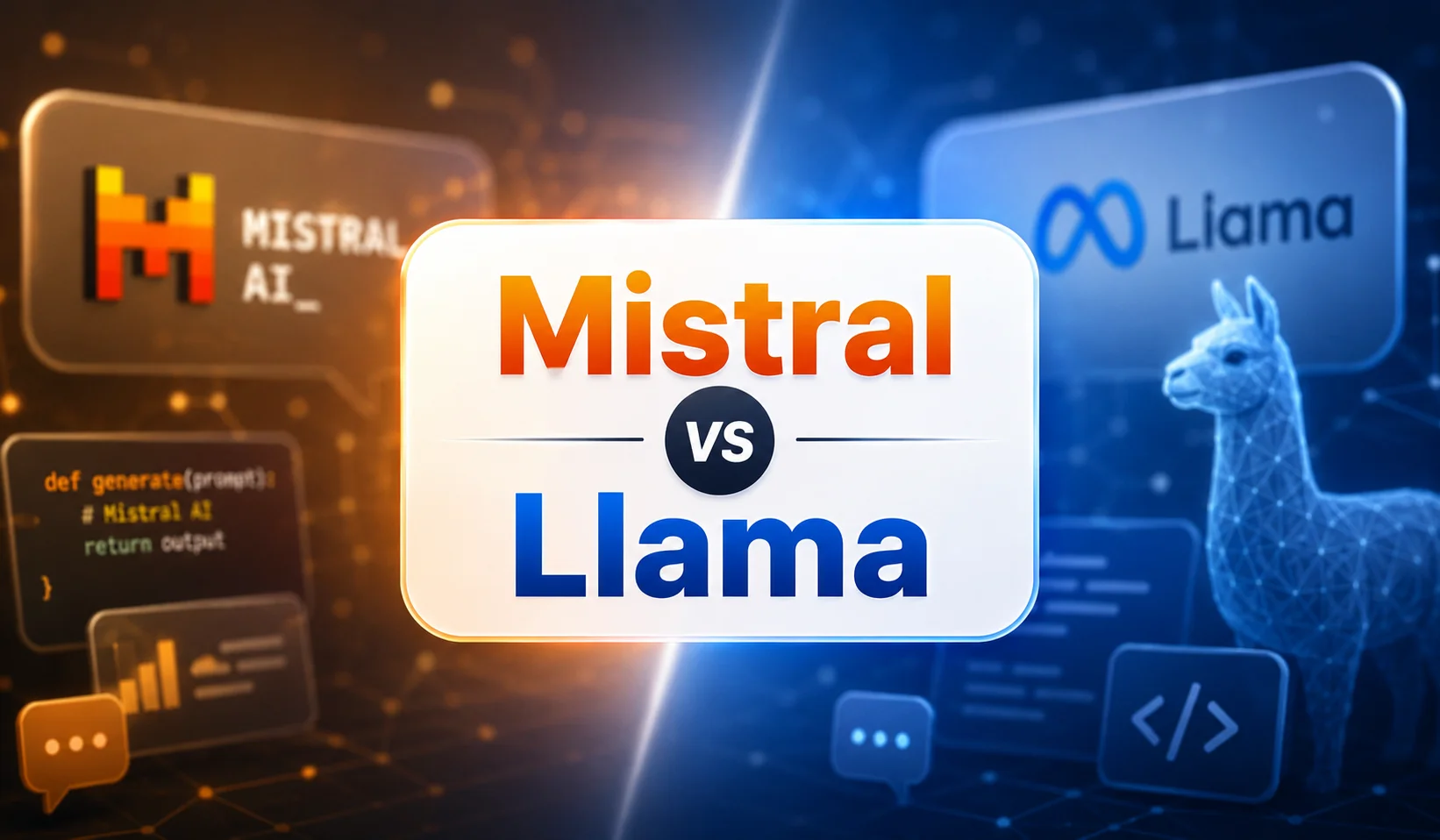
Among the many open and openly available model families, Mistral and Llama have gained significant attention. Both offer powerful language capabilities, but they are designed with different priorities and come in multiple model sizes and variants.
So, when comparing Mistral vs Llama, the better choice depends less on which model is universally “best” and more on what you need to build. Factors such as performance, deployment requirements, context handling, licensing, cost, and customization can all influence the decision.
What Is Mistral?
Mistral refers to a family of AI models developed by Mistral AI. The company has released models ranging from smaller, efficient systems to larger models designed for more demanding workloads.
One of Mistral's major strengths is its focus on efficient AI. Depending on the specific model, developers can use Mistral technology for tasks such as text generation, coding, summarization, question answering, and enterprise AI applications.
Mistral's model portfolio has also expanded beyond traditional text generation, making it suitable for organizations looking for different types of AI capabilities within their technology stack.
What Is Llama?
Llama is a family of large language models developed by Meta. Since its introduction, the Llama ecosystem has become popular among developers, researchers, and businesses looking to experiment with and customize language models.
Llama models are available in different sizes and can be used for applications such as chatbots, content generation, coding assistants, research tools, and enterprise applications.
One of the biggest advantages of the Llama ecosystem is its broad developer community. A large number of tools, frameworks, tutorials, and integrations are available around Llama, making it easier for developers to experiment with the technology.
Mistral vs Llama: Key Differences
Although both model families can support similar applications, there are several areas where they can differ.
Model Architecture
Mistral has used techniques such as Mixture-of-Experts in some of its newer models to improve efficiency and performance. These architectures can activate only a portion of the model for a particular task.
Llama models have evolved across multiple generations and model variants, with Meta focusing on improving reasoning, multilingual capabilities, coding, and general-purpose performance.
Because both companies continue to release new models, architecture should always be evaluated on a model-by-model basis rather than assuming that one family always has an advantage.
Performance
Performance depends heavily on the particular model, benchmark, prompt, and task.
Mistral models can be attractive when developers need strong performance while keeping resource requirements manageable. Llama models, meanwhile, offer strong general-purpose capabilities and have become widely used across different AI applications.
For production projects, businesses should test the exact models they plan to use rather than relying only on benchmark scores.
Customization
Both ecosystems can support customization and integration into application workflows. Developers can adapt models through prompting, retrieval-augmented generation, fine-tuning, and other techniques depending on the model and deployment environment.
The right approach depends on the application's data, accuracy requirements, infrastructure, and budget.
Deployment Flexibility
Deployment is another important consideration. Businesses may want to run models through cloud APIs, managed AI platforms, or their own infrastructure.
Smaller models can be particularly useful when organizations want greater control over infrastructure costs or need AI capabilities closer to their applications.
Mistral vs Llama: Feature Comparison
Use Cases of Mistral and Llama
Both model families can be used across a wide range of applications.
AI Chatbots
Businesses can use language models to build conversational assistants for customer service, internal support, and knowledge management.
Coding Assistants
Developers can integrate AI models into software development workflows to generate code, explain existing code, identify potential issues, and assist with documentation.
Content Generation
AI models can help create drafts, summaries, product descriptions, reports, and other business content.
Enterprise Knowledge Assistants
When combined with retrieval-augmented generation, these models can help employees search and interact with internal documents and business knowledge.
AI Agents
Language models can also serve as the reasoning layer for AI agents that interact with tools, APIs, databases, and business workflows.
Which One Should You Choose?
There is no single winner in the Mistral vs Llama comparison.
Choose Mistral when efficiency, specific model capabilities, deployment flexibility, or particular enterprise requirements make its models a better fit.
Choose Llama when you want access to a broad ecosystem, extensive developer resources, and a flexible model family for general-purpose AI development.
Before making a final decision, consider model performance, licensing terms, infrastructure requirements, latency, context length, security, integration options, and total operating costs.
Why Choose BigDataCentric for AI Development?
Selecting the right AI model is only one part of building a successful AI solution. The way the model is integrated into your application can have an equally significant impact on the final result.
BigDataCentric can help businesses evaluate AI requirements, select suitable models, design AI-powered workflows, and integrate language models into existing applications. Its expertise across AI, data, cloud, and software development can support projects ranging from intelligent chatbots and knowledge assistants to automation and AI-driven enterprise solutions.
The focus should be on choosing technology that solves a real business problem rather than adopting a model simply because it is popular.
Conclusion
The Mistral vs Llama comparison shows that both model families can be valuable for modern AI development. However, the right option depends on the application's specific requirements, including performance, deployment strategy, customization needs, infrastructure, and budget.
Mistral can be a strong choice for organizations prioritizing efficiency and flexible deployment, while Llama offers a broad ecosystem and strong general-purpose capabilities. Since AI models continue to evolve quickly, businesses should evaluate the latest versions and test them against their own workloads before making a production decision.
With a clear AI strategy and the right development approach, either model family can become a powerful foundation for building practical, scalable, and intelligent applications.