Sign up with Google
 Sign in with Zoho

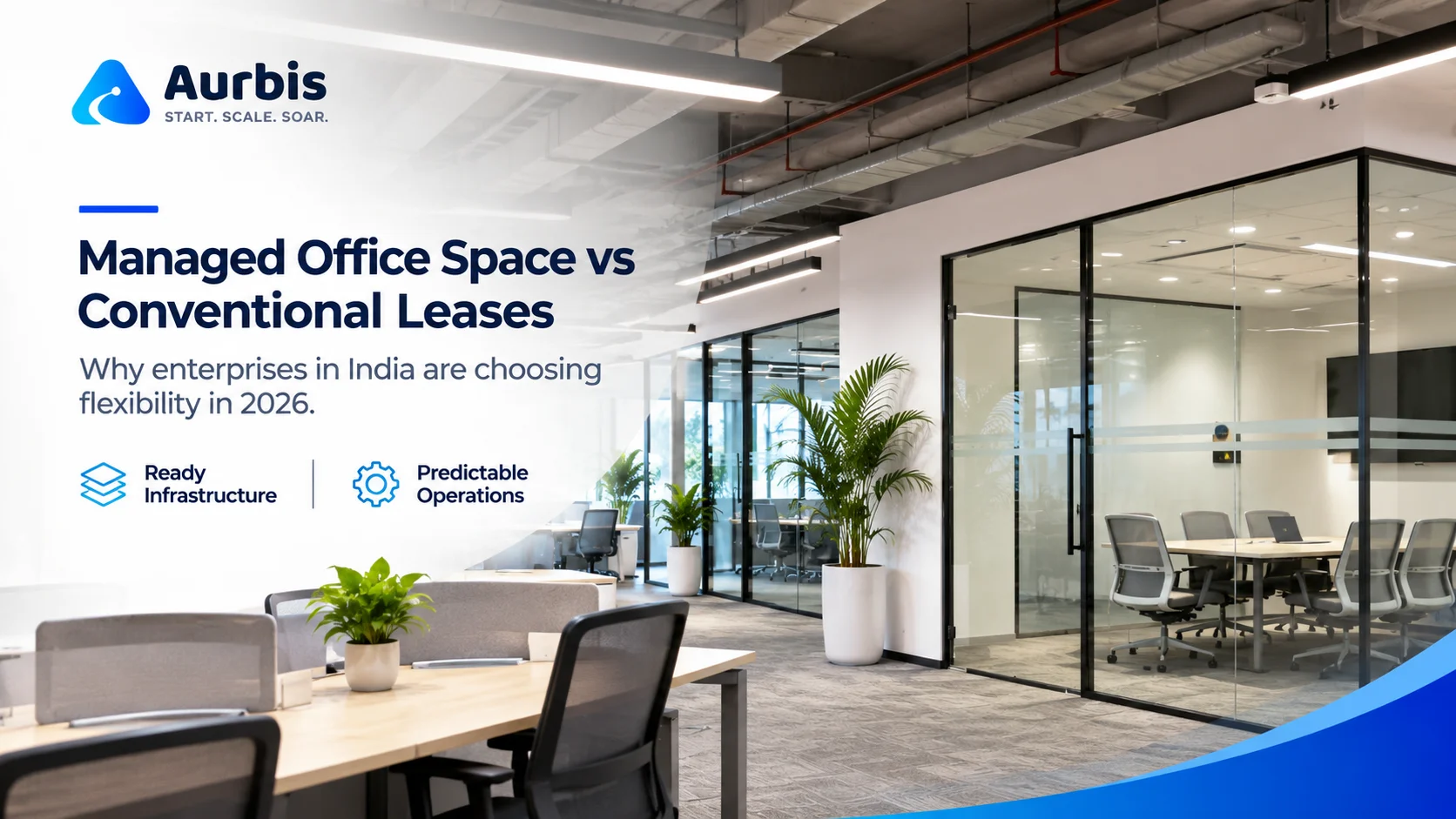
India's corporate office market is undergoing a significant shift in how enterprises approach workspace planning. Traditional commercial leases, once the default choice for established businesses, are increasingly being evaluated alongside fully managed office solutions that offer operational flexibility, faster occupancy, and predictable infrastructure management.
The shift reflects changing enterprise priorities rather than simply a preference for shorter lease commitments. Organisations expanding into new markets, establishing Global Capability Centres (GCCs), or scaling existing operations are looking for workplace solutions that support business continuity without the complexity of managing office infrastructure independently.
According to Knight Frank India's 2026 Flex Space Occupier Intelligence findings, large corporations accounted for 72% of flexible workspace seat absorption across India's eight major cities. This indicates that flexible workspaces are no longer primarily associated with startups and small businesses.
For enterprises evaluating managed office space in India, the decision increasingly centres on financial efficiency, operational control, workforce requirements, and long-term business adaptability.
The Changing Economics of Corporate Office Leasing
A conventional commercial lease typically requires businesses to manage several stages before occupying a workspace. These include property negotiations, workplace design, interior fit-outs, furniture procurement, technology installation, and facility management arrangements.
Each stage introduces financial commitments, administrative responsibilities, and potential delays.
Fully managed office space in India offers an alternative structure in which a workspace provider handles much of the development, infrastructure, and operational management.
Instead of coordinating multiple contractors and service providers, enterprises can operate within a professionally managed facility under a defined commercial agreement.
This arrangement can reduce the operational burden associated with establishing and maintaining a corporate office, although overall cost efficiency depends on occupancy duration, service inclusions, and contractual terms.
Why Enterprises Are Moving Towards Managed Workspaces
1. Faster Office Setup and Business Expansion
Speed of occupancy is a major consideration for enterprises entering new markets or expanding their teams.
A conventional lease may involve significant preparation before employees can begin working. Interior construction, connectivity installation, furniture procurement, and compliance requirements can extend the period between signing an agreement and occupying the premises.
A plug-and-play office in India can reduce this preparation period when essential infrastructure is already available.
For organisations establishing new operational teams, this faster transition can support recruitment schedules, project mobilisation, and business continuity.
However, highly customised workplace requirements may still involve preparation and implementation timelines.
2. Reduced Upfront Capital Requirements
One of the most frequently discussed managed workspace benefits is the potential reduction in initial capital expenditure.
Under a conventional lease, occupiers may need to fund interior construction, furniture, technology infrastructure, and other workplace installations.
Managed office providers can incorporate selected fit-out and infrastructure costs into the commercial arrangement, allowing enterprises to avoid significant direct investments in office development.
This makes a zero fit-out office in India an attractive consideration for organisations seeking to preserve capital for core business activities.
Nevertheless, businesses should assess deposits, setup fees, monthly charges, escalation provisions, and exit conditions before determining whether a managed office is financially advantageous.
3. Simplified Facility and Infrastructure Management
Corporate workplace management involves ongoing responsibilities extending beyond property occupancy.
Maintenance, security, housekeeping, utilities, connectivity coordination, and workplace services require consistent oversight.
A fully managed office transfers many of these responsibilities to the workspace operator, subject to agreed service levels.
This enables internal administration and facilities teams to focus on employee requirements, business operations, and organisational priorities rather than coordinating routine building services.
For geographically distributed enterprises, standardised workplace management can also improve operational consistency across locations.
4. Greater Flexibility for Workforce Expansion
Enterprise headcount requirements can change because of project assignments, business growth, restructuring, or new client contracts.
Conventional leases may restrict an organisation's ability to adjust occupied space without additional negotiations or financial commitments.
Managed workspace arrangements can provide greater flexibility through configurable layouts, negotiated expansion options, and adaptable occupancy structures.
However, actual flexibility depends on available space and the agreement with the provider.
Enterprises should examine lock-in periods, seat expansion provisions, modification costs, and exit clauses before committing to a managed workspace.
Office Lease vs Managed Office: Understanding the Differences
The office lease vs managed office comparison involves more than monthly rental expenditure.
Conventional leases may provide greater long-term control over building specifications, interior design, and workplace management. They can be particularly suitable for organisations with stable occupancy requirements and substantial internal facilities capabilities.
Managed offices, meanwhile, can offer operational convenience, reduced setup complexity, and integrated workplace services.
A serviced office in India may provide similar convenience, although serviced offices frequently focus on standardised, ready-to-use configurations, while enterprise managed offices can accommodate more extensive customisation.
The appropriate solution depends on operational requirements, total occupancy costs, contractual flexibility, and the expected duration of occupation.
Bengaluru's Role in Enterprise Managed Office Demand
Bengaluru remains an important market for technology businesses, multinational corporations, and GCC operations.
Business districts such as Whitefield, Outer Ring Road, and Koramangala attract organisations seeking access to skilled professionals, commercial infrastructure, and established business ecosystems.
Demand for managed office space in Bangalore reflects the importance of location accessibility, workplace quality, and operational readiness.
Enterprises evaluating properties must also consider employee commuting patterns, public transport connectivity, business continuity infrastructure, and future expansion requirements.
A premium office location should support both current operational needs and longer-term workforce planning.
How Aurbis Supports Enterprise Workspace Requirements
Aurbis provides enterprise-focused managed office solutions designed around workspace flexibility, operational efficiency, and modern infrastructure.
Its approach combines professionally managed facilities, technology-enabled workplaces, and workspace configurations suited to established and expanding organisations.
With locations across Bengaluru and Delhi NCR, Aurbis supports businesses seeking managed offices that align with corporate operations, employee experience, and evolving space requirements.
For organisations considering enterprise office space in India, such solutions provide an alternative to independently developing and operating traditional leased premises.
The Future of Enterprise Office Leasing in India
Managed offices are becoming a more established component of corporate real estate strategies in India.
However, conventional leases will continue to remain relevant for organisations requiring extensive control over long-term workplace assets.
In 2026, the central consideration is not whether managed offices can replace traditional leasing entirely, but how different workspace models support enterprise growth, financial planning, and operational efficiency.
For businesses prioritising faster occupancy, reduced infrastructure responsibilities, and adaptable workplace capacity, managed office solutions offer an increasingly practical option.
Aurbis offers premium managed office spaces in Bangalore and Gurgaon, designed to support evolving enterprise requirements. Explore Aurbis managed office solutions to find a workspace that aligns with your business goals and long-term growth plans.