Sign up with Google
 Sign in with Zoho

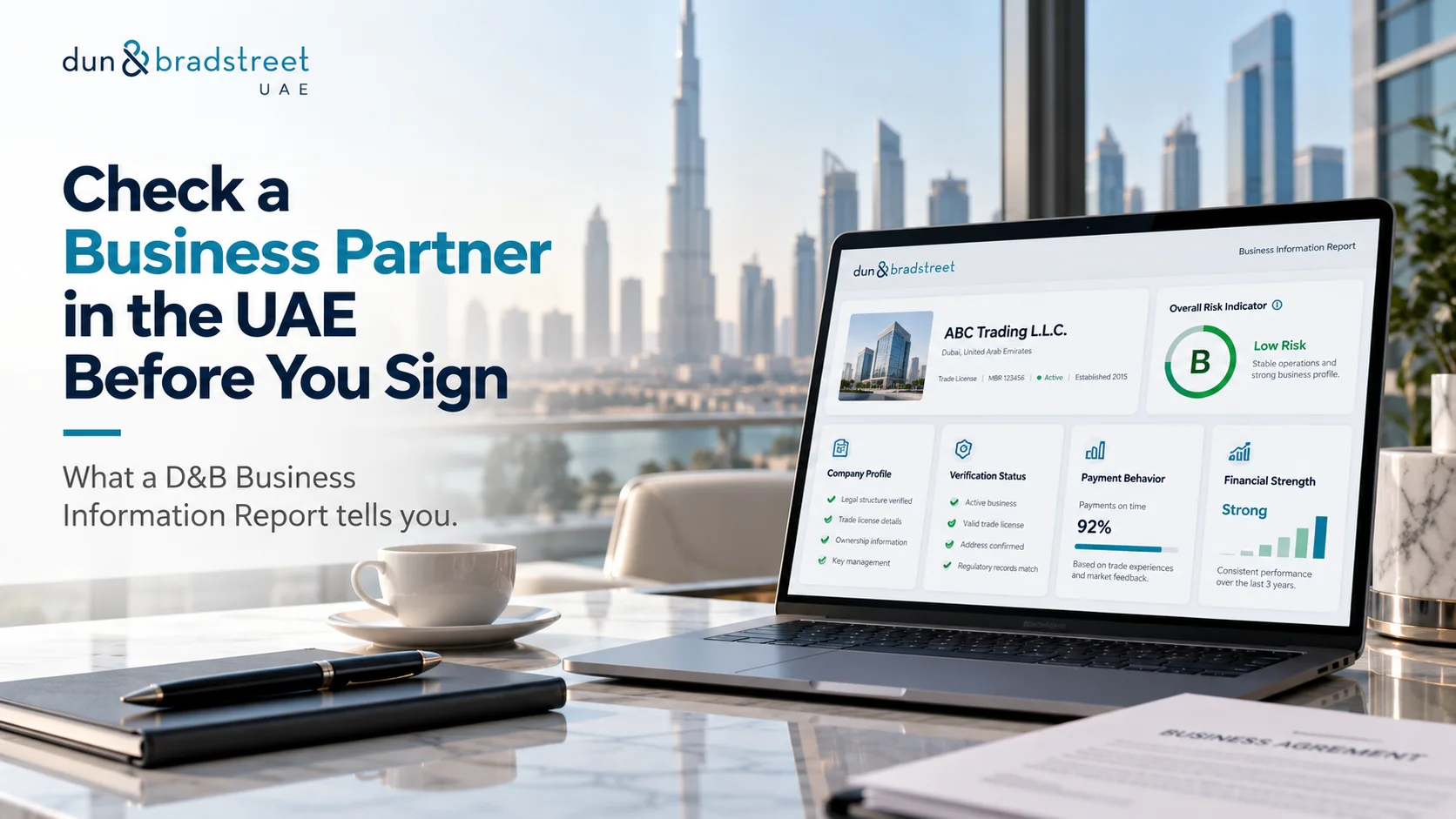
Signing a contract with a new customer, supplier or partner is a decision about trust. Yet in many deals the checks stop at a trade licence and a friendly meeting. A company can look established and still be slow to pay, financially stretched, or tied to ownership and legal issues that only appear later.
A Business Information Report from D&B UAE is designed to close that gap. It brings together a company’s profile, ownership, payment behaviour, financial information and risk indicators in one document, so credit and commercial decisions rest on verified information instead of assumption. This article explains what the report contains, how to read it, and how it fits into a wider due diligence routine for UAE businesses.
Why a Trade Licence Is Not Enough
A trade licence tells you a company is registered to operate. It does not tell you how the company pays its suppliers, whether it is financially stable, who sits behind it, or whether it has faced suits, liens or bankruptcy proceedings. Those are the questions that decide whether you will be paid on time, or whether a supplier will deliver what it promised.
The cost of skipping them is practical rather than theoretical. Late payments strain cash flow. An unreliable supplier disrupts production or projects. A partnership built on incomplete information can end in disputes that take months to resolve. A structured credit report gives decision-makers a consistent, comparable view of every counterparty, which is far easier to defend internally than a judgement made on instinct.
What Is a D&B Business Information Report?
D&B describes the Business Information Report, often shortened to BIR, as a trusted source for assessing a company’s profitability, financial stability and payment performance. It is used to evaluate both new and existing credit relationships, and it is particularly relevant for medium to high risk accounts. Beyond credit teams, procurement and marketing teams can use the same information to understand the companies they buy from and sell to.
The report draws on the D&B global database, which D&B UAE describes as covering more than 500 million organisations worldwide. Information is collected from a range of data sources and translated into a clear risk assessment, so the reader does not have to interpret raw data alone. Because D&B UAE is part of the Dun & Bradstreet Worldwide Network, the same approach can be used for a UAE company or for an overseas counterparty.
What the Report Covers
Each section of the report answers a different question about the company.
Business summary
This section gives factual information on the existence, operations, financial condition, management experience, line of business, facilities and locations of the company. It is the quickest way to confirm that the business exists, understand what it does, and judge whether its size matches what it claims.
Corporate family tree and D-U-N-S Number
The report maps domestic and international relationships, including the parent company, affiliates, subsidiaries and branches, each referenced by name and D-U-N-S Number. The D-U-N-S Number is the D&B identifier for a business, and it helps you recognise the same company across systems and avoid confusing similarly named entities. Seeing the family structure also shows whether you are dealing with an independent company or part of a larger group, which affects who ultimately stands behind an obligation.
D&B Rating
The D&B Rating gives a quick assessment of a company’s size and overall credit appraisal, based on its financial statements and an evaluation of its creditworthiness. It gives credit teams a starting point before they move on to the detail.
History, special events and operations
This section covers incorporation details, share information and ownership, along with special events and any suits, liens, judgments, or previous or pending bankruptcies. It is where legal and reputational warning signs tend to surface. Legal information is included where it is available from sources.
Payment history and payment terms
Here you can see how the company pays its suppliers. D&B works with several collection companies, which gives it a large body of negative payment experiences that help determine the risk of failure. For anyone about to extend credit or agree payment terms, this is often the most useful section of the report.
Data on directors
The report includes information on current and previous management, including the educational and career background of the company’s principals. This lets you review the people behind the business, not only the legal entity.
Recommended credit limit
The D&B Finance Limit Recommendation shows the total value of goods and services that the average creditor should have outstanding at any one time. It gives you a reference point when you set credit limits for customers or agree exposure with partners and vendors.
How to Use the Report at Each Stage
New customers. Before agreeing credit terms, review the payment history, the D&B Rating and the recommended credit limit. Use the business summary to confirm the company is what it says it is. Then set terms that match the risk, instead of applying one standard policy to every account.
Existing accounts. Credit relationships change. A customer that paid on time last year may be paying late today. Reviewing the report on a regular basis helps you spot trends in payment behaviour and financial condition early, so you can adjust limits or terms before exposure grows.
Suppliers and partners. For suppliers, the question is reliability rather than credit. Financial stability, history, ownership and related companies help you judge whether a supplier can deliver, and whether it depends on a group that may be under pressure. For potential partners and acquisition targets, the report is a useful first layer of checking before deeper financial due diligence begins.
When to Go Further
A Business Information Report is a strong first step, but some situations call for more. D&B UAE offers related solutions for these cases. The Business Rating Report helps you assess the health and future viability of a company. The Due Diligence Report supports deeper verification of a counterparty. For compliance work, D&B Direct for Compliance, Beneficial Ownership and Restricted Party Screening address ownership transparency and screening, while D&B Compliance Intelligence and D&B Supplier Intelligence focus on compliance and supplier risk.
Choosing between them depends on the decision in front of you. A routine credit approval may need only the Business Information Report. A large contract, a new overseas supplier or an acquisition usually justifies the additional layers.
A Simple Five-Step Routine for Vetting a Counterparty
- Confirm the business exists and what it does, using the business summary.
- Identify the right legal entity and its group, using the D-U-N-S Number and corporate family tree.
- Review payment history and financial trends before you agree terms.
- Check for suits, liens, judgments and bankruptcies, and look at the directors.
- Set credit limits and payment terms using the D&B Rating and recommended credit limit, and review them regularly.
Following the same routine for every counterparty also makes your decisions consistent. Anyone in the business can see why a limit was set, and why a particular customer was given shorter terms.
Conclusion
Good commercial decisions start with knowing who you are dealing with. A D&B Business Information Report gives UAE businesses a clear, structured view of a company’s profile, ownership, payment behaviour and risk before money or contracts are committed. Used consistently, it supports stronger credit policies, more appropriate payment terms and fewer surprises across the customer and supplier lifecycle.
To request a Business Information Report or discuss your credit and due diligence needs, contact D&B UAE through the Business Information Report enquiry page.
About D&B UAE: CRIF Gulf DWC LLC, a member of the Dun & Bradstreet Worldwide Network, represents Dun & Bradstreet in the UAE.