Sign up with Google
 Sign in with Zoho


Robots are becoming more capable of working in warehouses, factories, healthcare facilities, homes, retail spaces, and other real-world environments. But for robots to understand objects, people, movements, and surroundings, they need more than hardware and algorithms. They also need high-quality training data that represents the situations they are expected to encounter.Robotics data annotation is the process of adding structured labels to images, videos, sensor information, and other robotics data. These labels help AI models understand objects, actions, spatial relationships, human movement, and interactions within physical environments.As robotics moves toward more intelligent and autonomous systems, properly labeled data is becoming an important part of model development. A carefully designed annotation process can help robotics teams create datasets that are more useful, consistent, and suitable for real-world applications.
What Is Robotics Data Annotation?
Robotics data annotation converts raw data collected from physical environments into structured information that machine learning models can understand.A robotic system may collect information through cameras, depth sensors, LiDAR, IMU devices, microphones, and other sensors. Raw data shows what happened, but annotation provides additional context about the objects, actions, and events within that data.Depending on the project, annotations may identify:
- Objects and their locations
- Human actions and movements
- Object interactions
- Human poses and keypoints
- Spatial relationships
- Temporal activities
- Grasping and manipulation events
- Environmental elements
- Sensor-based information
For example, a warehouse robot may need to understand when a worker reaches toward a package, picks it up, moves it, and places it somewhere else. Annotated data can help a model learn these sequences rather than recognize the package itself.
Why Is Robotics Data Annotation Important?
Robots operate in environments that can change constantly. Objects may move, people may interact with machines, lighting can vary, and tasks can happen in different sequences.Traditional image datasets often focus on identifying individual objects. Robotics applications require a deeper understanding of what is happening, where it is happening, and how events change over time.High-quality annotation can help robotics models learn:
- Object recognition and localization
- Human-robot interaction
- Task sequences
- Movement patterns
- Scene understanding
- Navigation
- Object manipulation
- Grasping behavior
- Temporal relationships
The quality of the training data can directly affect how effectively a model learns these relationships. Inconsistent or incomplete labels can make it harder for models to understand complex physical tasks.
Types of Robotics Data That Can Be Annotated
Robotics projects often use multiple forms of data rather than relying on a single source.
1. Image and Video Data
Images and videos provide visual information about objects, people, environments, and activities. Annotation can identify objects, actions, poses, and important events within these visual streams.
2. Sensor Data
Robots can use depth, IMU, LiDAR, force, torque, and tactile sensors to understand their surroundings and physical interactions. Annotating these signals can add valuable context to robotics datasets.
3. Egocentric Data
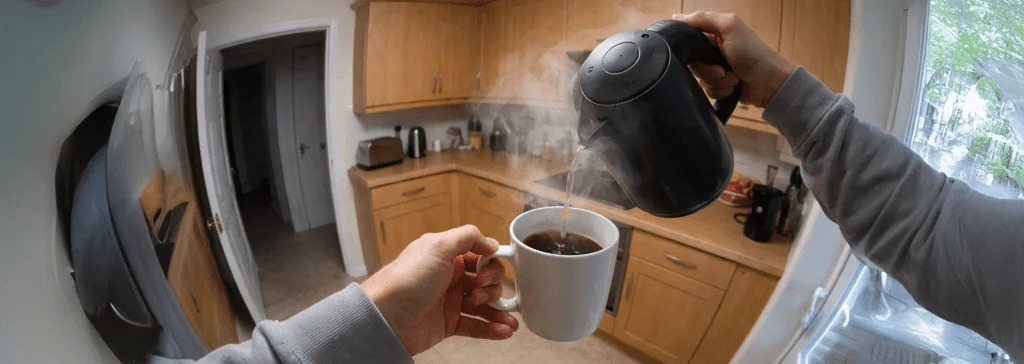
First-person or egocentric recordings can show activities from the perspective of a human operator. This information can help explain hand movements, object interactions, task execution, and human behavior.
4. Teleoperation Data
Human demonstrations captured through teleoperation can provide examples of how a task should be performed. These demonstrations can support imitation learning and other robotics training approaches.
Common Annotation Techniques
Different robotics applications require different labeling methods. The appropriate technique depends on the model, data type, and intended task.
1. Bounding Box Annotation
Bounding boxes identify objects within images or video frames. They can be used to locate packages, tools, vehicles, people, or other objects.
2. Segmentation
Segmentation provides more detailed information about object boundaries. It can be useful when robots need to distinguish precise shapes or understand different areas of a scene.
3. Pose and Keypoint Annotation
Pose annotation identifies body joints or important points on a person or object. It can help models understand movement, posture, and human-robot interactions.
4. Action Annotation
Action labels describe what is happening over time. Examples may include picking, placing, opening, closing, pushing, pulling, or assembling.
5. 3D Annotation
Three-dimensional labels can provide information about an object's position, dimensions, orientation, and spatial relationship with other objects. This can be particularly useful for navigation and manipulation tasks.
Robotics Data Annotation for Real-World Applications
Robotics is being developed for a wide range of environments, and each application creates different data requirements.
1. Warehouse Robotics
Warehouse robots may need to identify packages, shelves, workers, carts, and other objects. Training data can represent picking, packing, sorting, and navigation tasks.
2. Manufacturing
Industrial robots can perform assembly, inspection, material handling, and quality-control tasks. Data can help models recognize components and understand different stages of a workflow.
3. Healthcare Robotics
Robots designed to support healthcare environments may need to understand human movement, objects, rooms, and interactions. Specialized data can help models learn the relevant tasks and environments.
4. Home Robotics
Domestic robots operate in complex and unpredictable environments. They may need to identify furniture, kitchen items, tools, people, and everyday objects while understanding how those objects are used.
5. Autonomous Systems
Autonomous machines need to perceive their surroundings and respond to changing conditions. Diverse visual and sensor data can help train models for navigation, object detection, and decision-making.
How to Build High-Quality Robotics Training Data?
Creating useful robotics datasets requires careful planning. Businesses should first identify what the model needs to learn and what conditions it will encounter after deployment.Important considerations include:Define annotation guidelines: Clear instructions help annotators apply labels consistently.Capture diverse scenarios: Data should represent different environments, objects, people, lighting conditions, and task variations where relevant.Maintain consistency: Labels should follow standardized definitions throughout the dataset.Include quality checks: Reviewing annotations can help identify missing, incorrect, or inconsistent labels.Plan for scalability: Data requirements may increase as robotics models develop, so annotation workflows should be able to handle larger volumes.Macgence provides customized data solutions for robotics and AI applications, helping businesses develop datasets around their specific project requirements. Its approach can support different data types and annotation needs depending on the intended robotics application.
Challenges in Robotics Data Annotation
Robotics annotation can be more complex than conventional image labeling because the data often contains multiple synchronized modalities and time-based activities.Some common challenges include:
- Understanding complex human actions
- Maintaining temporal consistency
- Handling multiple sensors
- Labeling occluded objects
- Managing large video datasets
- Defining detailed annotation guidelines
- Maintaining accuracy at scale
For example, when a person's hand is temporarily hidden behind an object, annotators may need to understand the surrounding sequence before assigning the appropriate label. Similarly, synchronized camera and sensor data must remain aligned to preserve the correct timing of events.This makes quality control and experienced annotation teams especially important for advanced robotics projects.
Why Choose Macgence?
Macgence supports organizations developing AI and robotics systems with customized data solutions. The company can help businesses collect and prepare different types of training data according to their specific application requirements.Its solutions can support visual data, sensor information, human demonstrations, and other datasets used for robotics model development. A customized workflow can help businesses focus on the data their models actually need instead of relying only on generic datasets.Macgence also provides scalable solutions, which can be useful when robotics projects move from early testing to larger production requirements.
Frequently Asked Questions
1. What is robotics data annotation?
It is the process of labeling robotics-related images, videos, sensor data, and other information so AI models can learn objects, actions, movements, and physical interactions.
2. What types of data are used for robotics training?
Robotics training can involve images, videos, sensor data, LiDAR, depth information, IMU data, audio, teleoperation recordings, and human demonstrations.
3. Why is accurate annotation important for robots?
Accurate labels provide models with clearer information about objects, actions, environments, and interactions, helping them learn more effectively.
4. Can robotics data annotation be customized?
Yes. Annotation guidelines, object categories, action labels, data formats, and quality requirements can be designed around the specific robotics application.
5. What does Macgence offer for robotics projects?
Macgence provides customized data solutions that can support robotics and AI projects requiring visual, sensor, demonstration, and other forms of training data.
Conclusion
Robots need to understand the physical world before they can operate effectively within it. High-quality training data provides the foundation for that understanding. Robotics data annotation turns raw observations into structured information that AI models can use to learn objects, actions, movements, and interactions.As robotics becomes more advanced, businesses will increasingly need datasets that go beyond simple object labels. Data that captures temporal behavior, spatial relationships, human demonstrations, and sensor information can help support the development of more capable robotic systems.